
“Nevertheless, the consuming hunger of the uncritical mind for what it imagines to be certainty or finality impels it to feast upon shadows in the prevailing famine of substance,” writer Eric Temple Bell once observed.
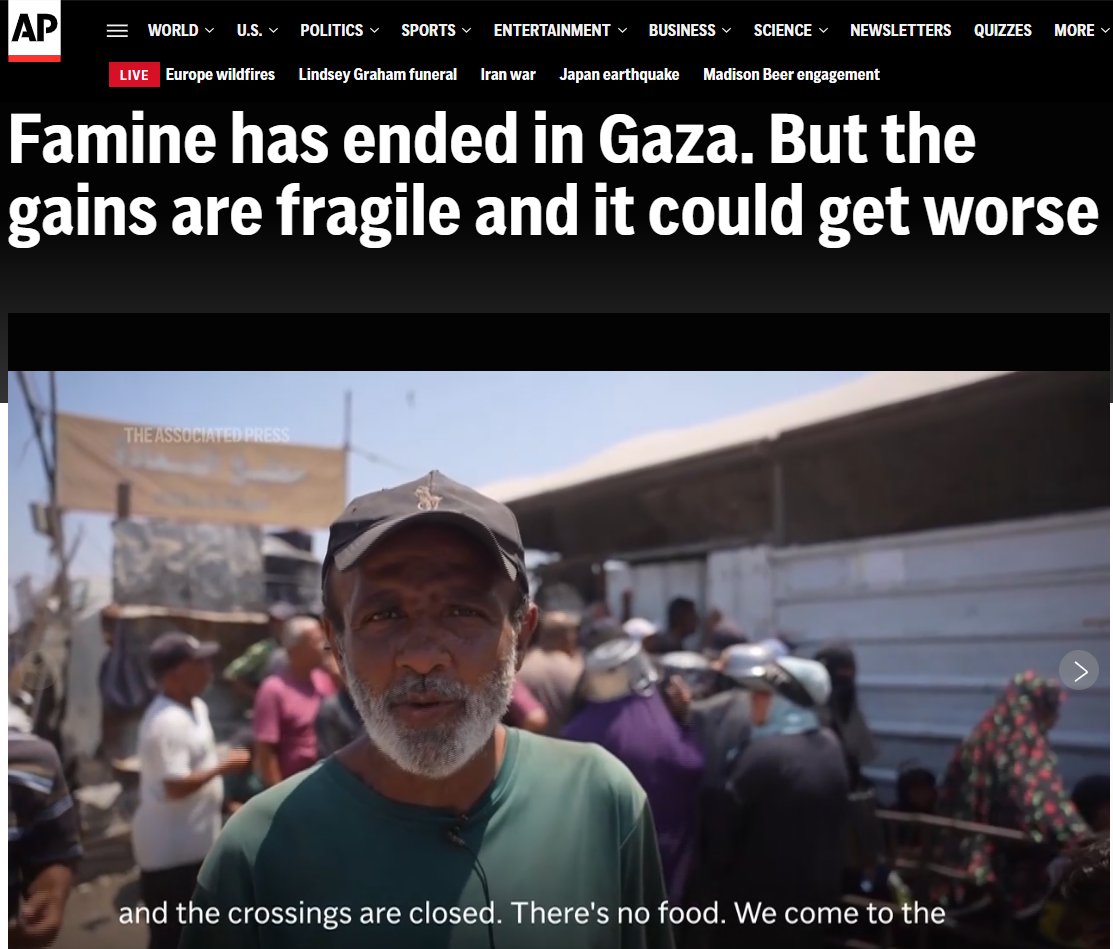 The Associated Press’ July 24 headline and article which state as fact that there was a famine in the Gaza Strip last year stunningly illustrates the mathematician’s insightful point (“Famine has ended in Gaza. But the gains are fragile and it could get worse“).
Rigidly tied to a predetermined narrative while completely disregarding the overwhelming evidence to the contrary, AP’s insistence on a Gaza “famine” is a veritable feast upon shadows in the prevailing famine of substance, as Temple Bell so eloquently put it.
The headline and article accept as fact the heavily disputed and baseless “famine” claim by the Integrated Food Security Phase Classification (IPC) last year, despite the abundant substantive data contradicting the falsehood. The article’s first sentence echoes the headline: “The world’s leading authority on food insecurity said Thursday that the situation in Gaza has improved since famine was declared in parts of the Palestinian territory last year. . . “
The article by AP’s Sam Metz and Wafaa Shurafa ignores critical raw data — including figures from the Global Nutrition Cluster’s State of Palestine report from October 2025 and Hamas’ own mortality figures. It conceals the highly compelling non-Israeli raw evidence behind Israeli denials, stating: “Israel strenuously denied allegations of widespread hunger and manmade famine in Gaza, calling them lies.”
At no point does the article examine the aforementioned relevant raw data from the global tracking body and from Hamas which completely undercuts IPC’s “famine” claim, while it adopts the baseless claim as fact with the “Famine has ended” headline.
As Times of Israel reported in November 2025:
Data released by an authoritative global malnutrition tracking organization has demonstrated that a crucial hunger threshold was never breached in Gaza during a period in which a famine declaration in the territory fueled intense criticism of Israel and played a key role in the country’s isolation on the world stage.
The figures released last month by the Global Nutrition Cluster’s State of Palestine department, along with mortality statistics from the Hamas-run Gaza Ministry of Health, raise serious doubts about the findings of the Integrated Food Security Phase Classification system (IPC) famine monitoring organization over the summer, though experts say devastating malnutrition was still rampant in the Strip, even if not at levels previously claimed.
The October data from the nutrition cluster shows that malnutrition levels in Gaza in July and August were some 23 percent lower than figures used by the IPC to underpin a declaration of famine. At the same time, while figures on “malnutrition-related deaths” spiked in that period, the level of excess mortality appears to have been greatly below what would be expected during a famine.
AP consistently expresses its faith in the reliability of Hamas’ Ministry of Health-issued fatality figures. The news agency reported on June 18, for instance, that Hamas’ MoH “is staffed by medical professionals and maintains detailed records viewed as generally reliable by the international community.” And yet Hamas’ own Ministry of Health published starvation-related mortality figures that were not even close to the required threshold to determine famine. If AP endorses Hamas’ figures for starvation fatalities, then how can it also justify publishing IPC’s famine claim as fact? They can’t both be reliable.
Finally, the article casts the very real issue of food distribution as an Israeli claim (and therefore by default suspect), while ignoring the United Nations’ July 12 statement about “not isolated” cases of Hamas’ interference with the aid distribution. Earlier this month CAMERA turned to the AP about its apparent failure to cover the alarming statement by Dr. Ramiz Alakbarov, United Nations Deputy Special Coordinator for the Middle East Peace Process, and Resident and Humanitarian Coordinator for the Occupied Palestinian Territory, who slammed Hamas’ assault of two World Food Programme bus drivers at a distribution warehouse. The news agency neglected to cover the issue at the time.
AP’s lengthy July 24 article about the “fragile” food security gains quotes WFP official Ross Smith pleading: “we need to have continued access and continued feeding.” But the very same article — in feeding on shadows instead of substance — says not one word about the terror group’s sabotage of efforts to ensure continued food distribution, including at WFP facilities.
Forsaking its sustaining mission of “advancing the power of facts,” AP’ scavenges for shadows, not substance, condemning its journalistic welfare to wither away.
For the Hebrew version of this post, please see CAMERA Hebrew.