
Feb.15 UPDATE:
Reuters Corrects After Underreporting Number Murdered in Hamas Suicide Bombings
Following communication from CAMERA and publication of this post, on Feb. 12 Reuters corrected, in both English and Arabic, its underreporting of victims murdered in Hamas suicide bombings. The report originally cited "scores." Editors revised the language to refer to "more than 330 Israelis in suicide attacks from 1994 to 2005, according to Israel's government." Contrary to Reuters' standard practice, the correction was not noted at the top of the article.
When Houthis fired hundreds of ballistic missile attacks at Israel, the news agency cited "dozens." When hundreds of Hamas rockets sent more than one million Israelis running for shelters, Reuters underreported "thousands" sought shelter. And in September 2024, when at least 38 Israelis had been killed in terror attacks in the West Bank and Jerusalem since Oct. 8, 2023, Reuters lowballed 22.
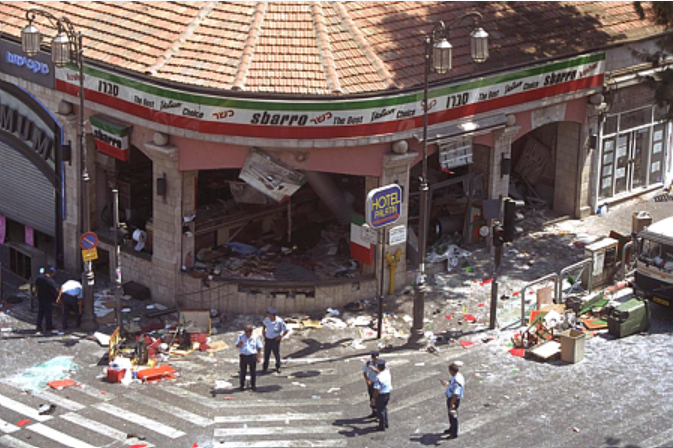
Outside the Sbarro pizzeria in Jerusalem, Aug. 9, 2001, following a Hamas suicide bombing attack in which 16 were murdered, including 7 children (Photo by Avi Ohayon/GPO)
The latest instance of anti-Israel terror subjected to Reuters' minimizing treatment appears in a July 30, 2025 article updated Feb. 9, ("What is the two-state solution to the Israel-Palestinian conflict"). The background article grossly understates the number of Israelis killed in Hamas suicide attacks, erring: "Hamas, an Islamist movement, killed scores of Israelis in suicide attacks." In fact, as earlier Reuters reporting has indicated, Hamas has killed hundreds — not scores — of Israelis.
As rightly reported in Reuters' Feb. 5, 2010 article, "Hamas 'regrets' civilian deaths, Israel unmoved," "Hamas suicide bombers have killed hundreds of civilians over two decades."
That wasn't the only instance of faulty reporting in July's explainer article, updated this week to include the Israeli government's new decisions on West Bank land. In a serious omission, under the subheading "What are Israel's New Decisions," the article egregiously skips over what exactly the repealed Jordanian law entailed. Thus, the article elliptically reports that the Israeli decision would "also repeal a Jordanian law governing land purchases in the West Bank."
Any foreign person who previously held Jordanian or Palestinian nationality and is of Arab origin may own immovable property outside municipal boundaries, zoning areas, or town basins to the extent necessary for their construction or agricultural activities. Likewise, any non-Jordanian Arab may own immovable property outside the aforementioned areas to the extent sufficient for their residence and business management only. In both instances, this shall be effected upon the recommendation of the Minister of Finance and the approval of the Council of Ministers. [Article 4, Section 2; Translation by CAMERA Arabic]
By concealing that the Israeli government repealed a discriminatory law, banning non-Arabs from buying land, the article's opening framed the decision as part of "the latest blow to the idea of establishing a Palestinian state co-existing peacefully alongside Israel in territory Israel captured in the 1967 Middle East war."
The Reuters piece then goes on to list what the news agency considers the obstacles to peace, with one particularly glaring omission — Palestinian terror attacks. About the growing obstacles, the selective account reads: "They include accelerating Jewish settlement on occupied land and uncompromising positions on core issues including borders, the fate of Palestinian refugees and the status of Jerusalem."
The closing section of the article, entitled "How Big Are the Obstacles Today," expands on the skewed tally of obstacles, providing greater detail on the extensive barriers attributed to Israel. The section includes two passing references to Palestinian terrorism. In the first, it plays a bit role as the pretext for a purported Israeli obstacle — land theft.
Thus, according to Reuters: "During the Second Intifada two decades ago, Israel also constructed a barrier in the West Bank that it said was intended to stop Palestinian suicide bombers from entering its cities. Palestinians call the move a land grab."
In the second diminished appearance, Reuters closes the article with a "both sides" moral equivalency reducing the deadliest slaughter of Jews since the Holocaust — mass terror including all manner of war crimes such as the murder of families in their homes and civilians dancing at a music festival, rape, kidnapping, mutilations — to merely the latest installment of tit-for-tat war: "Hamas and Israel have fought repeated wars over the past two decades, culminating in the attacks on communities in southern Israel on October 7, 2023, that ignited the Gaza war."
"In its scope, depravity, and national reach, the Hamas assault was a much greater shock to Israelis," then 9/11 was for Americans, Robert Satloff wrote for The Washington Institute. In American population terms, the more than 1200 victims in Israel "would be equivalent to killing nearly 40,000—13 times more than the number of Al Qaeda victims on 9/11," he said.
With a record of repeatedly underreporting terror attacks targeting Israelis including missile attacks and suicide bombings, is it any surprise that Reuters fails to accurately convey the magnitude and cataclysmic impact of Oct. 7, the most devastating mega terror attack in recent memory?