
“Neither [journalist] Jesús [Sérvulo González] nor El País are antisemitic, it was a mistake that we corrected when we saw it,” El País foreign desk chief Guillermo Altares insisted earlier this month.
His protestations were an effort to quell a wave of outrage over the newspaper’s publication of an article claiming that U.S. federal judge Alvin Hellerstein, who is presiding over the trial of Nicolás Maduro in New York, “has made an effort to maintain an impartial stance despite being a well-known member of the Jewish community.”
Yet, years-long systematic analysis of El País’ Israel coverage indicates that the unfortunate episode was hardly a one-off error on the part of a publication highly sensitive to antisemitism. To the contrary, it was a revealing slip which exposed a deeply ingrained framework in which Israel and Jewish identity are regularly portrayed as suspicious, problematic, or incompatible with values such as impartiality or political legitimacy.
For decades, El País has maintained a structurally anti-Israel bias that at times borders on antisemitism and that, since Oct. 7, 2023, has devolved into openly militant informational activism. This shift has been characterized by the uncritical adoption of Hamas’ narrative, systematic distortion of facts, and the promotion of the “genocide” framework as its primary interpretive lens.
Why El País Matters
El País is not a marginal outlet. As the flagship newspaper of Spain’s democratic transition in the 1970s, it became the most influential daily in the Spanish-speaking world, with editions in Spain and Latin America, as well as English-language versions. It defines itself as “the global newspaper.” Given that Spanish is the world’s second most spoken language, the way it frames international conflicts has a direct impact on millions of readers.
For this reason, its coverage of Israel is not merely a marginal local editorial matter—it is an issue of global journalistic concern. And while its ideological bias has long been problematic, clear radicalization post-Oct. 7 has greatly escalated the problems.
A Longstanding Bias
In 2009, 14 U.S. congressmen sent a letter to the Spanish prime minister decrying El País’ systematic publication of cartoons and articles containing “crude antisemitic stereotypes.” That same year, Haaretz published an article entitled “Bias in Black and White” denouncing the “unique combination of negligence and undisguised hostility toward Israel” present in the Spanish daily.
When new leadership took the helm in 2014, El País seemed for a time to partially correct its course, prioritizing journalistic considerations over ideological ones. Nevertheless, the Pavlovian bias of much of the editorial staff never completely disappeared. It is also true that a couple of correspondents approached their work from a more professional perspective, attempting to provide a better understanding of Israeli society in all its complexity, but they were soon replaced by journalists more interested in expressing their prejudices than in reporting the news.
This cadre of new writers, which was responsible for serious journalistic failures, apparently never faced any consequences. In one case, a correspondent took an interviewee’s words out of context, portraying him as justifying the BDS movement—something he never did. The interviewee contacted the journalist twice requesting that his statements be properly contextualized. The correspondent refused and knowingly repeated the distortion in two subsequent articles.
The newspaper also reported, on the night of May 13–14, 2021, that Israel was invading Gaza, when a single reliable source would have sufficed to confirm that this was not the case. El País later changed the headline, but without any written acknowledgment or correction notice.
In 2017, CAMERA Español documented how El País had abandoned numerous journalistic standards and applied a clear double standard. The paper described then-Hamas leader Ismail Haniyeh as “moderate” and “pragmatic,” while labeling the Israeli government “radical” and “extremist.” It also humanized terrorists such as Leila Khaled—a member of the designated terror organization Popular Front for the Liberation of Palestine responsible for airplane hijackings—portraying her as the product of a “traumatic life experience,” reducing the conflict to a simplistic framework in which Israel appeared as the sole cause of all violence.
In hindsight, that period now appears as the least biased phase of the newspaper. Another change in management in 2018 ultimately submerged the media outlet’s credibility in a sea of ideology—not only in international affairs.
Oct. 7: From Partiality to Activism
Hamas’ Oct. 7 attack marked a turning point. Rather than clearly presenting Israel as the victim of a savage assault, El País chose from the outset to dilute responsibility and avoided framing Israel as the victim of a massacre.
Thus, on Oct. 7 itself, when information was still emerging, El País ran the headline: “Hamas launches a surprise and unprecedented attack against Israel from Gaza.”
The subheadline incorporated Hamas’ justification and sought to equate victims, stating:
Palestinian militias kill at least 250 people by infiltrating dozens of fighters, kidnapping civilians and soldiers, and firing thousands of rockets, in the largest attack on Israeli territory in decades. Hamas justifies the carefully planned surprise operation by citing “the crimes of the occupation.” “We are at war,” Netanyahu declares before the army killed 232 Palestinians in bombings.
El País was also unable—or unwilling—to convey the extreme cruelty and sadism of the attack, softening it with terms such as “message” or “challenge,” simplifying events to a mere “escalation of violence” and imposing moral equivalency with respect to Israeli victims butchered in the massacre and Palestinians, including combatants, killed in Israel’s military response. In the same vein, the headline for the Oct. 7 editorial was “Hamas Challenges Israel” and the piece urged stopping a “bloodbath” that could spread.
Over the following five months, CAMERA Español analyzed every El País headline across all of its sections. Headlines function as a kind of user’s manual for framing the information that follows. They summarize for readers what they are about to encounter and, crucially, what they are expected to think. This framing is especially significant given that most readers consume little more than these headline “sound bites” as their sole source of information — a trend that has only intensified with the rise of social media as a news platform.
The study revealed a structural bias that consistently downplayed Hamas’ responsibility while assigning Israel the central role of blame and violence. This bias, rooted in source selection, language choices, and systematic omissions, prevented readers from understanding both the Oct. 7 massacre and its profound impact on Israeli and Jewish society. For example, during that period the newspaper published more than 30 editorials. Not a single one clearly condemned Hamas for the massacre or identified it as responsible for the escalation of the war.
Hamas as a Privileged Source
One of the most troubling aspects of El País’ coverage has been the credibility systematically granted to Hamas.
The Al-Ahli hospital case is paradigmatic. On Oct. 17, the newspaper accepted as fact Hamas’ claim that Israel had bombed the hospital, killing 500 people. The source was presented as the “Gaza Health Ministry,” without clarifying that this body is controlled by Hamas.
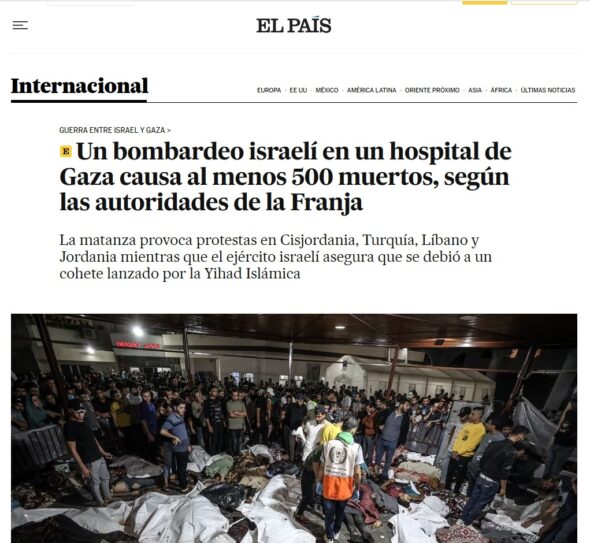 The original headline was “Israeli bombing of a Gaza hospital causes hundreds of deaths.” (See screenshot at left.)
When investigations later showed that the explosion was caused by a failed Islamic Jihad rocket and that the casualty figures had been inflated, El País amended the headline without issuing a clear correction.
The revised headline, “Bombing of a Gaza hospital causes hundreds of deaths,” failed to identify Islamic Jihad as responsible nor did it acknowledge the error. The episode was reduced to a vague incident with no clear perpetrator, in which “the parties accuse each other.” Several subsequent articles likewise failed to clarify the facts.
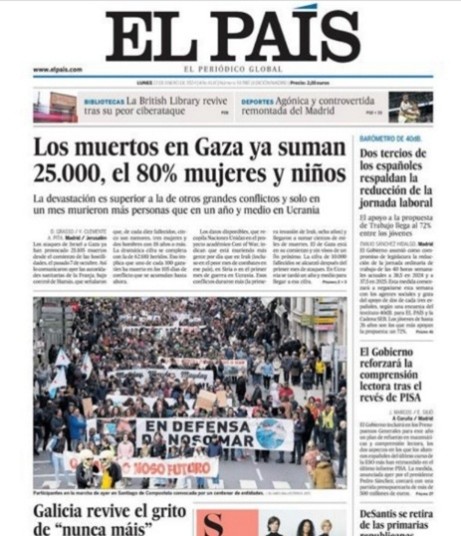 The pattern of uncritical acceptance of unverified data repeated with casualty figures, alleged attacks on hospitals, ambulances, and humanitarian convoys—always to Israel’s detriment. The paper effectively handed over its front page to Hamas on multiple occasions, allowing the group to foreground its figures and narrative without any context.
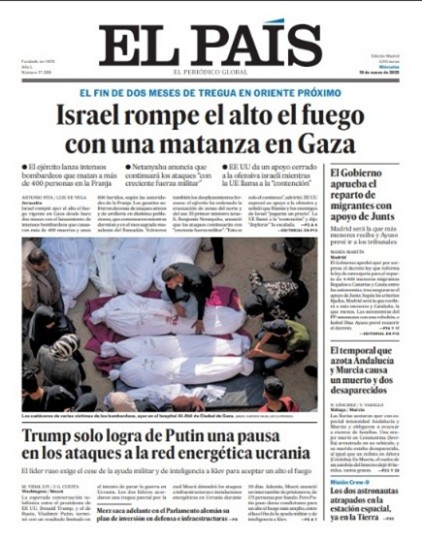 El País silences the terrorist group’s stated objectives—destroying the Jewish state and repeating Oct. 7 “again and again”— while its opinion columns, front pages, and headlines amplify Hamas’ accusations against Israel. In contrast, the media outlet buries Israeli positions to deep within lengthy articles.
The chosen language further reveals a strong ideological bias. It is not uncommon to find articles describing the Israeli military or the Israeli army as an “occupation army,” without quotation marks and as if it were a factual description. In other cases, the term “murdered” is used to describe collateral casualties, implying criminal intent.
For example, a Sept. 7, 2024 article carried the headline: “The family and NGO of the Turkish-American activist murdered in the West Bank reject the Israeli version.”
The subheadline added: “The International Solidarity Movement accuses the military of killing Aysenur Ezgi ‘in cold blood,’ who, according to the occupation army, was throwing stones.”
In this case, editors later stealthily removed the term “murdered” without any acknowledgment of the change. The phrase “occupation army,” which appears in various El País items, remained untouched.
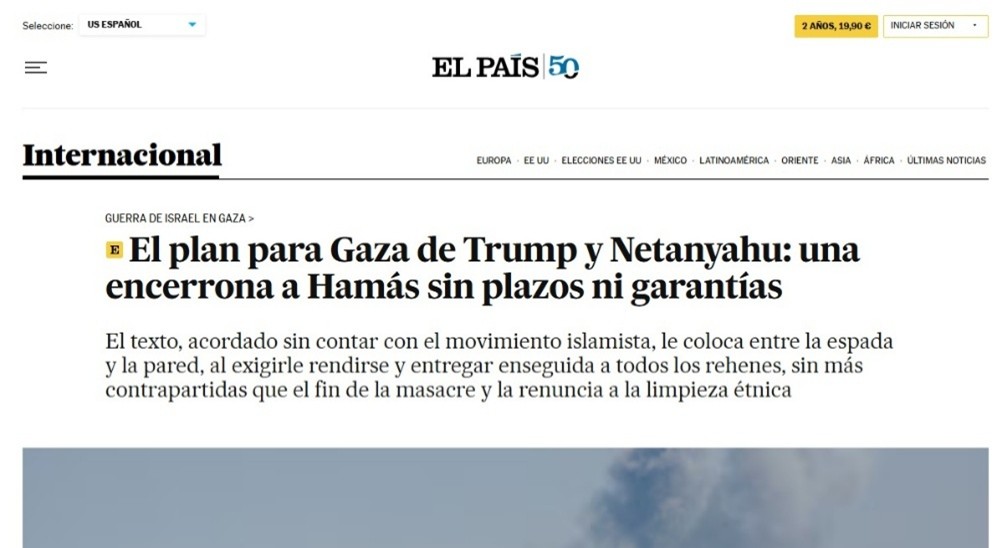 El País alignment with Hamas’ discourse is illustrated by the following headline (screenshot at left) and first paragraph, which appear to lament that a peace plan does not benefit the terrorist group:
Trump and Netanyahu’s plan for Gaza: a trap for Hamas with no deadlines or guarantees
The text, agreed upon without including the Islamist movement, leaves it between a rock and a hard place by demanding that it surrender and immediately hand over all hostages, with no compensation beyond the end of the massacre and the renunciation of ethnic cleansing.
Pushing the ‘Genocide’ Framework
Another central element of El País’ activism has been its insistence on introducing the term “genocide” into the news agenda, even when international bodies have not made such a determination. As noted, it appears frequently in opinion pieces—as if genocide were a matter of opinion—but is also assumed as fact in news reporting, without quotation marks.
One revealing example was an article about the targeting of Jewish businesses and schools in Barcelona, initially published under the label “Genocide,” thereby shifting the focus and responsibility away from antisemitism and instead blaming the victims themselves.
Coverage of the International Court of Justice decision was similarly illustrative. Although the court did not rule that Israel was committing genocide, El País nonetheless ran the false headline: “The reasons why the UN court considers it plausible that Israel is committing genocide in Gaza.”
Editorials and Diluted Antisemitism
El País once displayed a certain “European” sensitivity when addressing antisemitism and the Holocaust. Even during periods of harsh coverage of Israel, it maintained some openness toward Spain’s Jewish communities. After the last two changes in management, that door closed. Statements and perspectives from the Jewish community stopped finding space in the paper, which even rejected an Op-Ed by a regular contributor presenting the mainstream Israeli position—without providing any justification.
Occasionally, the paper publishes an Israeli critical of his own government or articles addressing distant historical episodes. In short, the paper finds room for pieces that function as symbolic indulgences and allow El País to avoid confronting contemporary antisemitism manifested today primarily through hatred and demonization of Israel.
In addition, there is ample space for texts that trivialize the Holocaust, compare it to Gaza, or rely on the marginal “good Jew“ who accuses the rest of the community of complicity in “genocide.”
Opinion pieces hostile to Israel are overwhelmingly dominant while articles presenting the Israeli perspective are scarce. Among the foreign voices published, interviewed, or promoted are figures such as Peter Beinart with his charges of Jewish “supremacy” and advice on how “how to be Jewish after the destruction of Gaza,“ Naomi Klein who amplifies the Gaza “genocide” libel, and United Nations extremist Francesca Albanese, treated with uncritical praise. Domestic contributors include the president of UNRWA Spain, whose affiliation with the organization is systematically concealed by the newspaper despite his clear conflict of interest—turning those pieces into undisclosed advocacy.
An Oct. 30, 2023, headline perfectly encapsulated El País’ stance: “It’s Netanyahu, not Hamas.”
According to the newspaper, Hamas is an irrelevant actor despite having initiated the war with an unprecedented massacre. All responsibility falls on Israel—even for Oct. 7 itself.
Not Errors, but a Pattern
From the impartial American judge “despite being Jewish” to the systematic adoption of Hamas’ language and figures, and from the omission of relevant information to the promotion of the genocide framework, what emerges is not a series of technical mistakes, but a coherent and persistent editorial pattern.
This pattern portrays Israel as always guilty, Hamas as irrelevant or merely reactive, and Jews—both in Israel and in the diaspora—as suspects whose legitimacy, suffering, or right to self-defense must constantly be questioned.
The problem with El País is not only what it corrects under pressure, but everything it continues to publish without correction at all.
For the Spanish version of this article, see CAMERA Español.