
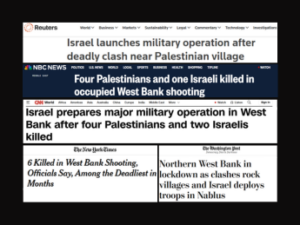
Illustration of Reuters, NBC, CNN, New York Times, Washington Post headlines on the story (screenshot/edited via Canva)
On Friday, July 24, 2026, four Palestinians and two Israelis were killed in clashes in Area B of the West Bank, near the Palestinian town of Tell and the Israeli settlement of Havat Gilad (in Area C), with circumstances that remained unclear even a week later.
The 1993 and 1995 Oslo Accords divided the West Bank into three administrative zones – Area A (full Palestinian control), B (Palestinian civil control and joint Israeli security control), and C (full Israeli control). For Area B, Israeli law requires advance military authorization for entry to prevent friction and security incidents.
These restrictions exist due to decades of state-sanctioned antisemitic incitement that have made any identifiable Jewish presence in these areas a target for deadly violence.
In this case, the IDF said that Palestinians attacked Israeli hikers and one killed an Israeli reservist after taking his gun. The Israeli government classified the event as a Palestinian terrorist attack.
Some outlets begged to differ.
Same day reporting by CNN, Reuters, The Washington Post, and The New York Times framed the story as a case of settler violence, while omitting key details.
NBC, which used the Reuters story, entirely failed to update its headline to state that two Israelis were killed in the altercation, rather than just one.
CNN and Reuters did not even include the names of those killed in the confrontation, even though their names were publicly available. The Post solely mentioned the name of one slain Israeli.
The Times named all the individuals killed, but it largely relied on he-said-she-said accounts from officials and failed to investigate and disclose who the group of hikers and Palestinians were, like the other outlets mentioned above.
In terms of the he-said-she-said accounts, the Times and Reuters quoted Tell representatives in Fatah who accused Israeli settlers of attacking the town itself, saying that the Palestinians involved were acting in defense. There was no evidence to corroborate this narrative of events.
To explain the incident, the Times, the Post, and CNN all relied on raw footage from social media that they said they confirmed as authentic. Such clips often create illusions, not clarity because they record moments of escalation, not origin. Psychological researchers on media bias consistently demonstrate that an out of context video allows viewers with opposing political positions to watch the exact same clip and draw opposite conclusions. Journalistic investigation and explaining the context is therefore a journalist’s vital task, which all these outlets failed to accomplish.
Because these mainstream media failed to do their jobs, it befell to CAMERA to investigate who the individuals involved in the incident were.
Who were the Palestinians involved in the incident?
The four Palestinians killed were Farouk Ramadan, Ibrahim Ramadan, Jawad Ramadan, and Imran Ramadan, all family members. IDF said Farouk Ramadan was the person responsible for killing the Israeli reservist.
Cross-referencing their names and photos in Arabic news revealed three of their social media profiles, excluding Farouk Ramadan.
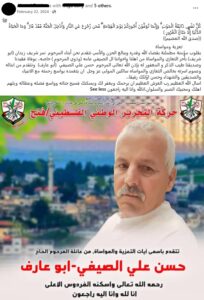
An example of a Facebook post with the Fatah emblem, illustrating how the faction has claimed an Al-Saifi family member. (screenshot of Facebook)
Their profiles revealed that they belong to the Al-Saifi family, a prominent local clan with strong ties to Fatah. Fatah has publicly claimed several of their family members as part of its ranks, and the town representative Reuters quoted shares their family name. The victims had re-shared Fatah posts on their profiles, but there was no clear evidence indicating they were members of the faction themselves.
Fatah bears the blame indirectly for institutionalizing violence. Its regional infrastructure continues to glorify armed resistance and views any unannounced Israeli presence in Area B as an aggressive provocation, contrary to its post-Oslo commitments to prevent incitement and terror threats. Understanding this context and the deep-seated hostility governing Area B is essential to understanding how a hike quickly devolved into a fatal clash. Yet, mainstream outlets completely omit these local political dynamics so as not to discredit it since it is the only organized alternative to Hamas.
Who were the Israelis involved in the incident?
The Israelis at the scene were part of a hiking group, created by the organization Tiuli David V’Ahikam. Its founders named it after David Rubin and Ahikam Amihai, two off-duty Israeli soldiers who were hiking near in the Judean Hills near Hebron on Dec. 28, 2007, when Palestinian terrorists murdered them in a shooting attack.
The military prosecution by the Israeli Defense Forces (IDF) finally filed an indictment in February 2025 against the main perpetrator, Fatah member Ali Dandis, who planned the attack with two other Palestinian terrorists, Basel Natsheh (killed at the scene) and Amar Taha, who was also in Fatah and a member of the Palestinian Security Forces.
Through a shared-interest Facebook group, CAMERA found the Tiuli David V’Ahikam WhatsApp chat, which contained the planned itinerary for that day. The route included Cliff Mountain, Sheikh Abu Jud, and the pool in Jit, locations situated inside Area B.
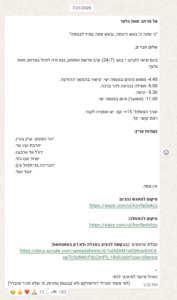
Screenshot of the hiking itinerary from the Tiuli David V’Ahikam WhatsApp chat for July 24, 2026.
The hiking group had planned its route in advance, but it did not request permission from the IDF. This is standard for the group, which organizes weekly hikes explicitly designed to reject the Oslo framework and normalize Jewish sovereignty across the West Bank. Shared material in their WhatsApp chat reveals they operate on the principle that “wherever the Jewish hiker walks, there the border passes.” To demonstrate their belief that no such boundaries exist, the group actively chooses routes that traverse Areas A, B, and C.
The social media videos of the altercation show young boys alongside the men in the hiking group, and unconfirmed reports from a tour guide familiar with the group suggest a few women were present as well.
Bringing young families into volatile territory presents severe risks. Pro-Israel advocacy spaces frequently condemn Palestinian terrorist groups for placing children in harm’s way, whether through child soldiers, early-age indoctrination, or military paraphernalia.
Yet in this case, an Israeli group similarly compromised their children’s safety (albeit this situation is not the same as Palestinian terrorist organizations using children in suicide bombings during the second intifada, for instance).
Still, fully aware of the potential consequences, they deliberately brought their families into a high-risk environment characterized by antisemitic hostility, a decision that ultimately forced the IDF to risk soldiers’ lives in a high-stakes rescue operations when violence expectedly broke out.
Consequently, Major (res.) Benayahu Mellet and Major Yuval Ezra fell in the line of duty.
Through the Magnifying-Glass
What sets coverage of the West Bank apart is the unique magnifying glass the press holds to it. When CNN, Reuters, NBC, and The Times omitted the basic facts of the story, they left readers with an incomplete picture.
Trespassing is wrong, but it does not result in several deaths in most of the civilized world. That it did in this episode is a symptom of what ills peace between Israelis and Palestinians. Mainstream media claim to be biased towards peace, but the fact that they never provide the obstacles to peace on the Palestinian side belies that claim and prolong the conflict further.