
SEPTEMBER 9, 2026 UPDATE:
Boston Globe Corrects
After CAMERA informed editors of Omer Bartov’s inaccurate translation of Yoav Gallant’s remarks, the Boston Globe has updated the transcript to include the correct language.
See below for a detailed update.
When rigorous standards go missing in both the academic and journalistic fields, the result looks like the Aug. 26, 2026 episode of the Boston Globe’s “Say More” podcast. Entitled “A genocide scholar asks ‘what went wrong’ in Israel,” the episode features Brown University academic Omer Bartov who weaves an unchallenged narrative of a genocidal Israeli society committing the crime of crimes against Palestinians in Gaza.
Demonstrating a marked absence of journalistic zeal, host and editor of The Globe’s editorial page, James Dao, utterly failed to challenge Bartov as he fabricated quotes, uttered falsities, and relied on conjecture bordering on the absurd.
Bartov’s Narrative
Bartov’s central thesis is that Israel committed “genocide” in Gaza. To identify genocide, Bartov explains, “you need to show intent…. Genocide is actions carried out with the intent to destroy a particular group in whole or in part.” This is nearly true; the “particular group” must be a “national, ethnical, racial or religious group,” and the intent must be to destroy them “as such.”
Evidence of genocidal intent must meet an extremely high bar. Bartov relies on four pieces of evidence to demonstrate this supposed intent on the part of Israel. Two pieces are statements by Israeli leaders. The third piece is an alleged “pattern of operation” of “telling people to leave their homes…and then destroying their homes.” The fourth piece of evidence is Bartov’s own assessment of the Israeli mentality.
One would think, given the gravity of the allegation, that Dao would fulfill his journalistic responsibility, testing the veracity and strength of Bartov’s evidence. To this extent, Dao utterly failed. The Globe’s listeners were left unaware that: Bartov’s first piece of evidence was a fabricated quote; the second piece is a deeply cynical decontextualization and reinterpretation of a quote; the third piece contradicts the existence of genocidal intent, and; the fourth piece isn’t evidence at all.
Consider each in turn.
Bartov’s Falsified Quote
Just two days after the October 7, 2023 massacre carried out by Hamas against communities in southern Israel, Bartov claims, Israeli defense minister Yoav Gallant said: “They will have no water, they will have no food, they will have no energy. They are human animals and they should be treated as such.”
That is not what Gallant said. Bartov deceitfully changed several critical, but inconvenient, words to uphold his narrative. What Gallant actually said, as Israeli forces were still battling invading Hamas terrorists who had gleefully recorded themselves butchering, kidnapping, raping and torturing their way through southern Israel communities was, “אנחנו נלחמים בחיות אדם ואנחנו נוהגים בהתאם,” which means, “We are fighting human animals and we are acting accordingly.”
Bartov’s rewording works to deceive listeners into believe Gallant is referring to Gazans as a whole (“they are”) as “human animals,” the kind of dehumanizing rhetoric one would expect in a genocide. Gallant’s actual words show he is referring specifically to the combatants/terrorists (“we are fighting”) who had just committed inhuman atrocities.
CAMERA alerted both Dao and the Boston Globe’s managing editor for operations and standards to this deceptive mistranslation. Their inaction indicates they stand by Bartov’s egregious falsehood. This contrasts with, for example, the New York Times, which acted to correct yet another false claim made in an op-ed by the error-prone Omer Bartov.
Bartov’s Cynical Reinterpretation
Bartov’s next piece of evidence is a quote by Israeli Prime Minister Netanyahu, “Remember what Amalek did unto you.” According to Bartov, Netanyahu “mean[s] what you should do to Amalek is destroy their cattle, their sheep, their men, their women, their children, their babies. That’s what the Bible says.”
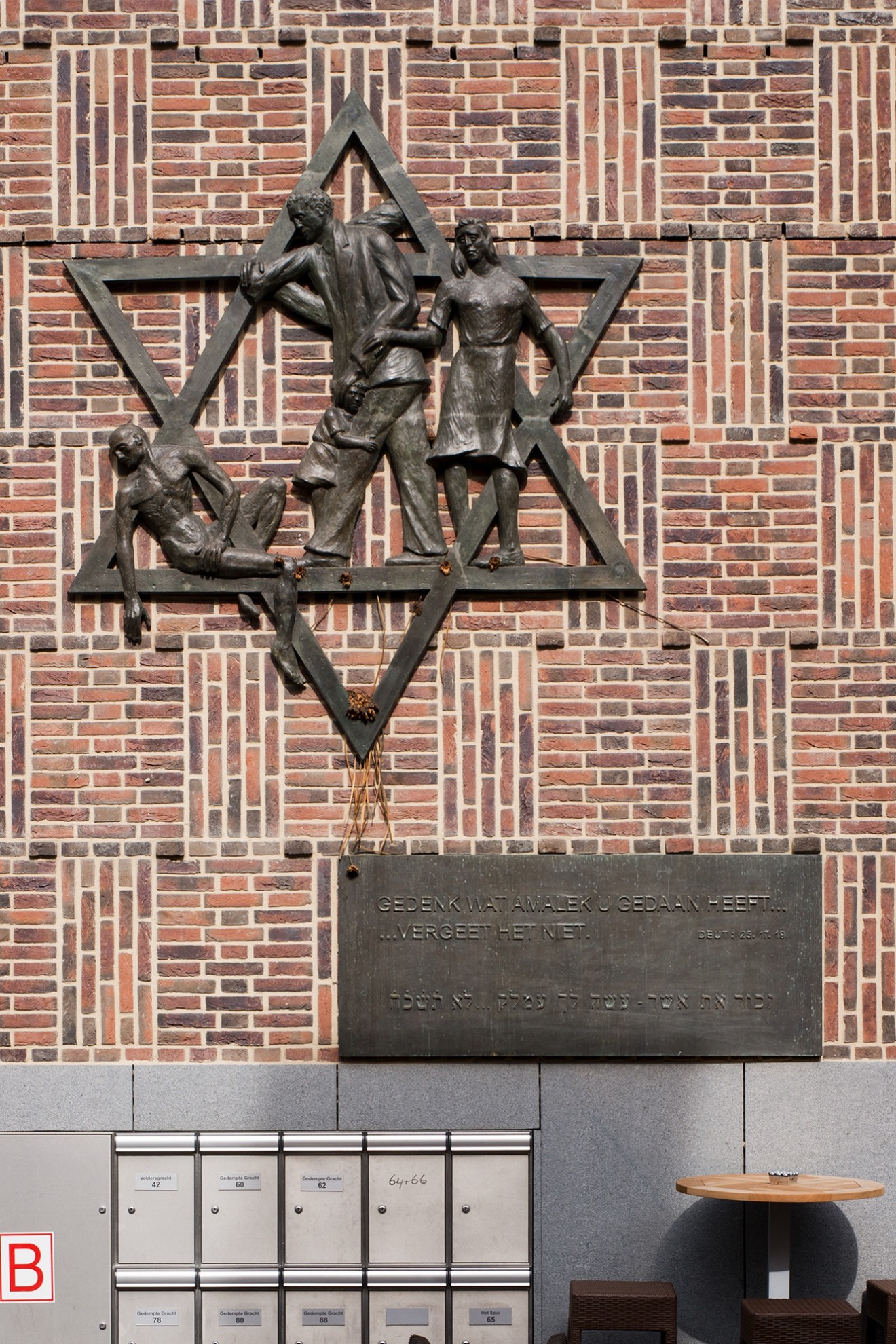
A Holocaust memorial in The Hague, featuring the same quote about Amalek as uttered by Israeli Prime Minister Benjamin Netanyahu.
But, as CAMERA’s Gilead Ini noted, Netanyahu is quoting a specific part of the Bible: Deuteronomy 25:17, which simply commands Jews to remember the evil inflicted upon them by the people of Amalek, who have become a stand-in for evil in Jewish tradition. The phrase is featured in Holocaust memorials, from Yad Vashem in Israel to a memorial in The Hague, where the International Criminal Court and International Court of Justice sit.
In Bartov’s conspiratorial imagination, Netanyahu’s use of the phrase serves as a coded call for Israelis to commit genocide. Though academic and journalistic rigor demand contending with plausible alternative explanations, neither Bartov nor Dao so much as acknowledge the more plausible interpretation that Netanyahu was simply comparing the evil inflicted by Hamas on Jews in southern Israel to that inflicted by Amalek and the Nazis. Indeed, Netanyahu’s use of the phrase was in the context of describing Hamas as “the same enemy” as that faced by the Jews held in the Warsaw Ghetto during the Holocaust.
Bartov’s Self-Defeating “Pattern of Operation”
Bartov next points to “another indication of intent…the pattern of operations by the IDF” in “telling people to leave their homes because those areas will become areas of operation and then destroying their homes.”
Bartov is suggesting the IDF has the same level of strategic thinking as the comically inept cartoon villain, Wile E. Coyote. At risk of asking the obvious, if the IDF intended to destroy Palestinians in Gaza as such, why didn’t it just bomb the homes while the members of that group were still in them?
This is where Dao’s journalistic failure is most egregious. Noticing the obvious gaps in Bartov’s logic here requires only basic critical thinking.
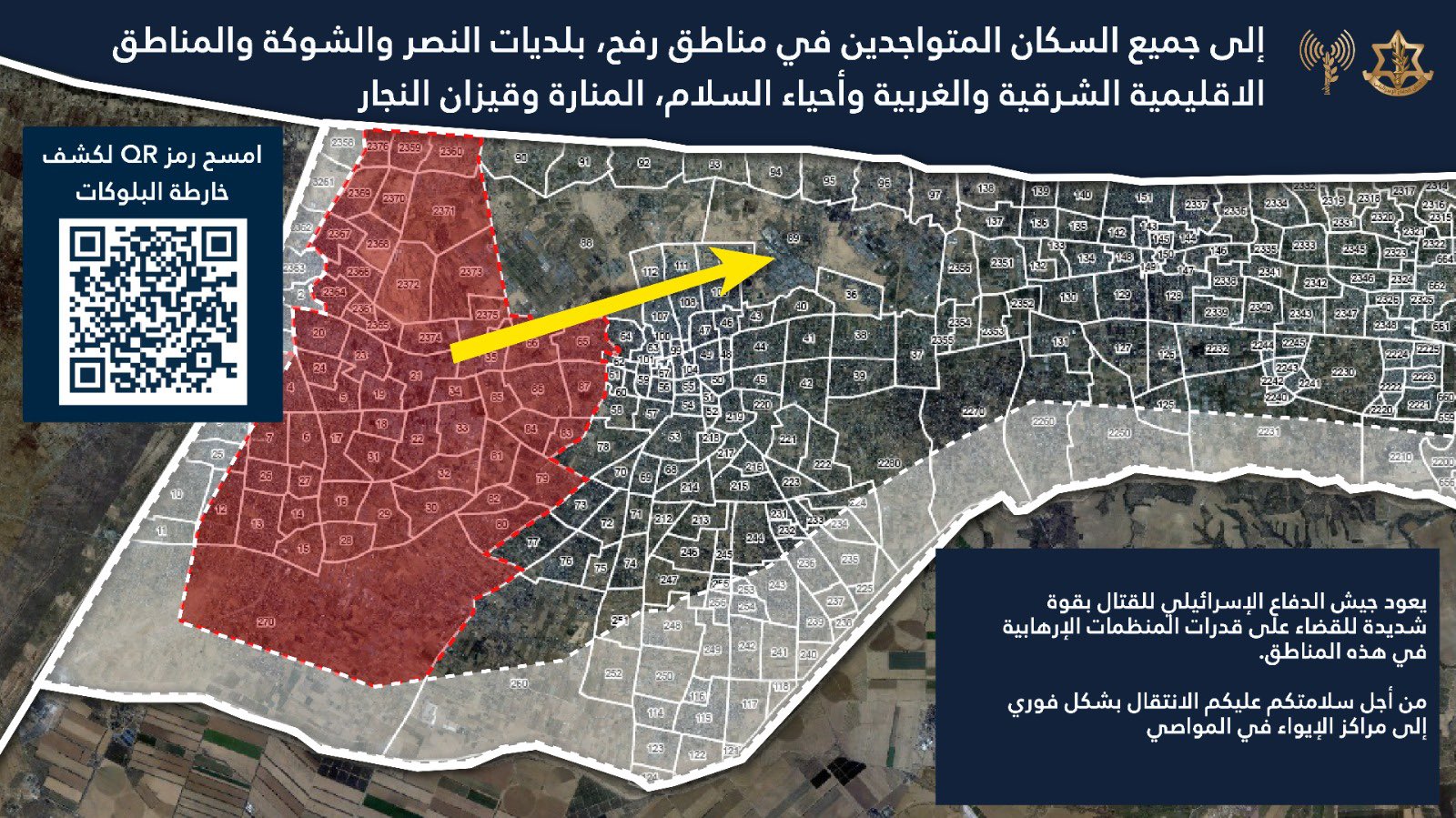
An IDF evacuation notice given to Palestinians in Gaza in March 2025.
Dao never asked, that if the IDF was committing genocide, then why did it regularly issue evacuation notices and warn Gazans of impending military operations? Why did it facilitate humanitarian pauses and corridors? Why did it facilitate the entry of millions of tons of humanitarian aid? Why were over a dozen field hospitals opened in Gaza? Why did Israel repair water pipelines bringing scarce freshwater from Israel into Gaza? Why did Israel facilitate a polio vaccination campaign for over 600,000 Gazan children? Why did the bombing campaign feature a historically low number of deaths per ton of explosives? Why do military age males make up such a disproportionately high number of the dead and wounded? Does this not all suggest the campaign was to destroy Hamas, a lawful objective, instead of Palestinians as a whole?
Bartov simply ignores these facts, and Dao lets him. The conclusion is treated as credible simply because Bartov said so, as if his academic position allows him to dispense with the need to engage with the facts.
Bartov’s Mean Girl Scholarship
Beyond the fabricated, decontextualized quotes and the self-defeating “pattern of operation” assertion lies only Bartov’s assessment of Israeli mentality. This is a common feature of Bartov’s “scholarship” on Israel – playing the role of token Israeli and declaring the existence of evil thoughts among his fellow countrymen.
Like a radical American professor declaring all Americans to be irredeemably racist, Bartov declares all Israelis to be fundamentally genocidal and savage. Last year, for example, CAMERA recorded Bartov telling an audience at Brown University that “a poison has been distilled into the veins of the country [of Israel], and slowly but surely it proceeds toward savagery.”
Bartov doesn’t provide evidence, he just “thinks” it’s true. He tells Dao, “The mentality in Israel after October 7th, I would say across the board, was filled with this kind of sense of vengeance. ‘Let’s wipe them all out.’” Dao accepts this without question.
Later, Bartov again plays the role of token Israeli, telling Dao, “I think today about Israeli society, there is widespread denial of what happened in Gaza, and a reluctance, a refusal to look at the facts.”
The irony of this remark is severalfold.
Bartov follows that remark up with the claim that medical, legal, and academic associations in Israel have said “nothing” about “what happened in Gaza.”
But that’s demonstrably and obviously false. Those associations have said plenty about the war, just not what Bartov wants them to say.
Therein lies the rub. Bartov’s problem isn’t that Israelis aren’t talking about Gaza, it’s that they don’t agree with his assessment. His ideas have been rejected by Israeli society. Rather than accept that, he’s gone abroad to rally external actors to try and force Israelis to bend to his way of thinking. He tells Dao that the “reckoning…will not come without massive external pressure.”
Dao and the Boston Globe oblige Bartov by handing him a platform free of journalistic rigor.
The Boston Globe’s Lack of Journalistic Rigor
The Boston Globe may not be a court of law, but even the field of journalism has ethical rules of fairness, rigor, and honesty. The more serious the topic (e.g., accusing an entire nation of genocide), the stricter the adherence should be to those rules.
Instead of living up to those standards, The Globe allowed Bartov to omit inconvenient facts and paper over gaping holes in his narrative.
The dishonesty extended far beyond just his “evidence” for “genocidal intent.” Consider other statements left unchallenged by the Boston Globe.
Victim-Blaming: Referring to his service in the IDF in the Northern Sinai in October 1973, when Egypt and Syria launched a surprise attack on Israel, Bartov recalls “not quite understanding why we were there, and knowing that our very presence was a trigger for animosity, hostility, and potential violence.” The implication is that Israel invited Arab hostility and violence with its presence in the Sinai.
But the IDF was there because Egypt had twice already used the Sinai, in 1948 and 1967, as a launching pad to wage existential wars against Israel. In neither case did Israel have a presence in the Sinai, or in any Egyptian land. Dao never asked Bartov to explain what “invited” the Arab hostility and violence during those earlier wars.
Exaggerated Costs: Elsewhere, Bartov claimed that Israel’s security fence next to Gaza was a “multi-billion dollar fence.” It cost slightly over one billion. Why exaggerate?
Historical Revisionism: At one point, Bartov tries to contrast Israel with the allies after World War II, asking “what did they do once they won the war?” He points to the Marshall Plan, whereby the U.S. helped rebuild Germany, and then says: “[T]hat’s not Israel’s policy. Israel’s policy is to either boss it over the Palestinians or, as it has become after October 7th, just get rid of them.”
But the allies did not simply pour a bunch of reconstruction money into Germany and Japan and hope for the best. The allies heavily bossed it over the Germans and Japanese. General MacArthur governed Japan until 1951 and West Germany didn’t regain most of its sovereignty until 1955 (some rights were reserved by the allies even until 1991). These periods were marked with leadership purges coupled with societal deradicalization programs.
Israel’s policy in Gaza is reflected in the 20-Point Plan, which it agreed to in 2025. Much like in postwar Germany and Japan, it calls for Gaza to be “deradicalized” and for Hamas to be “disarmed.” A temporary governing institution for the territory, the National Committee for the Administration of Gaza, overseen by the U.S.-led Board of Peace, is in the works. The plan includes the reconstruction and redevelopment of Gaza. A surge of humanitarian aid has long been underway with the close cooperation of Israel.
Instead of aiming to “just get rid of them,” as Bartov claims, the plan states: “No one will be forced to leave Gaza, and those who wish to leave will be free to do so and free to return.”
Boston Globe’s Audience Deserves Better
News consumers deserve to know the quality of the journalism they are paying for. The Globe’s failure here isn’t just failing to rigorously report; they are knowingly lying to their audience.
The paper’s subscribers should ask: “Why am I paying to be lied to?”
Update: Boston Globe Corrects
Following communications from CAMERA and members of the public, the Boston Globe updated the transcript on September 4 to include the correct language used by Yoav Gallant.
At the top of the transcript, a note has been added stating:
Since publication, it has been amended to include a verbatim quote from Yoav Gallant.
Further down, after the false translation given by Bartov, another note has been added, reading:
Gallant’s exact quote from Oct. 9, 2023, as translated by The Times of Israel, was: “I have ordered a complete siege on the Gaza Strip. There will be no electricity, no food, no fuel, everything is closed. We are fighting human animals and we are acting accordingly.”
Finally, on September 8, the Boston Globe published a response to the criticism, including language from members of the public and linking to CAMERA’s critique of the podcast episode.
We commend the Boston Globe for the correction.