
NPR deserves a medal in the category of gaslighting its audience, which it managed to do not once, twice, but three times in the same piece. In a recent report, “Three years on, Israel still bars foreign journalists from entering Gaza,” NPR continued with the charade that its Gazan journalist, Anas Baba, is not subject to Hamas control – despite the recent revelation by Motaz Azaiza that all “journalists” in Gaza are – and because NPR refused to acknowledge this, the outlet perpetuated the charade of “not understanding” why Israel still bars foreign journalists from entering Gaza. Finally, NPR hid from its audience how many “journalists” in Gaza were later outed as terrorists.
The broadcast began with Kat Lonsdorf sharing how she was sitting in Jaffa, Israel, looking at a beautiful sunset while receiving a text message from her colleague Anas Baba in Gaza, with a picture of the same sky. Lonsdorf lamented that despite only being about 40 miles from Baba, she has never met him because “Israel bars most Palestinians from leaving Gaza, and Israel has not allowed foreign journalists to enter Gaza independently since the war started.” (As a sidenote, Lonsdorf does not explain why she and Baba do not attempt to meet up in Egypt, as Egypt also shares a border with both Gaza and Israel.)
Baba’s sole contribution to the broadcast was to say that if foreign journalists could work alongside him again in Gaza, “[i]t would mean [Palestinian journalists] are no longer carrying this burden alone.”
Missing from NPR’s reporting both in the broadcast or anywhere on the outlet’s website, is the well-known fact, acknowledged by foreign and local Gazan journalists, that all journalists in Gaza risk being “disappeared” if they publish anything other than what Hamas wants. One such local journalist, Motaz Azaiza, recently revealed that every journalist in Gaza is on a Hamas WhatsApp group chat – which, by definition, includes NPR’s Baba.
NPR’s refusal to acknowledge this made the soundbite from Clayton Weimers, of Reporters San Frontières (RSF), also known as Reporters Without Borders, nothing less than deceptive. Weimers said, “You have to ask yourself, if the policy is don’t let international journalists observe what’s going on, what exactly are they trying to hide?”
A better question is what is RSF trying to hide?
RSF bills itself as a nonprofit organization whose mission and values are to “[a]ct for the freedom, pluralism and independence of journalism” – yet it refuses to acknowledge that Hamas does not allow press freedom in Gaza. If the organization does not realize or recognize this, it is not a serious organization. If it is fighting to allow entry to journalists who need to censor themselves due to Hamas threats and intimidation (or risk being “disappeared”), then it is not actually expecting journalists to report freely and independently from Gaza.
It might sound far-fetched to the average American for a non-profit organization to cooperate with a terrorist organization, but it isn’t an alien concept. Among other things, RSF co-led a campaign, launched Sept. 1, 2025, to promote the narrative that Israel deliberately targeted journalists in Gaza. As reported more comprehensively in the Jewish Journal, 150 allied media outlets, including, unsurprisingly, Al Jazeera, were given “prepackaged content, uniform graphics, time-zone-based publishing instructions, and synchronized hashtags.”
In addition to the soundbite by Weimers, NPR also included commentary from Jodie Ginsberg, of the Committee to Protect Journalists (CPJ), which NPR host Kat Lonsdorf described as “an organization that promotes press freedom worldwide and has been pressing Israel on the issue.” Ginsberg alleges that Israel has “repeatedly attacked [Palestinian journalists’] credibility.” Ginsberg then offers similarly disingenuous comments as Weimers, saying that “having international journalists in[to Gaza] who are able to corroborate what is being documented by their colleagues is also really important.”
Here, the gaslight meter goes up another notch. CPJ participated vociferously in propagating the lie that Israel targets journalists, yet Lonsdorf does not mention, or elicit from Ginsburg, the admission that just a few weeks ago, CPJ removed 22 “journalists” from its rolls because they were outed as terrorists – by the terrorist organizations themselves. This was after CPJ had already quietly taken at least eight off its list following Hamas and Palestinian Islamic Jihad’s publication of their obituaries. Moreover, as reported by The Washington Free Beacon, more than half of the names on CPJ’s list of journalists killed in Gaza are still linked to terrorist groups.

These facts made Lonsdorf’s bold statement that the Israel Defense Forces (IDF) “has . . . killed many of the Palestinian journalists in Gaza . . . saying, often without providing evidence, that they are members of Hamas” even more stunning – because it is just not true. The IDF has provided copious evidence about the terror affiliations of “journalists” in Gaza, including military number, ID number, position held in the organization and death notice published by the terror group.
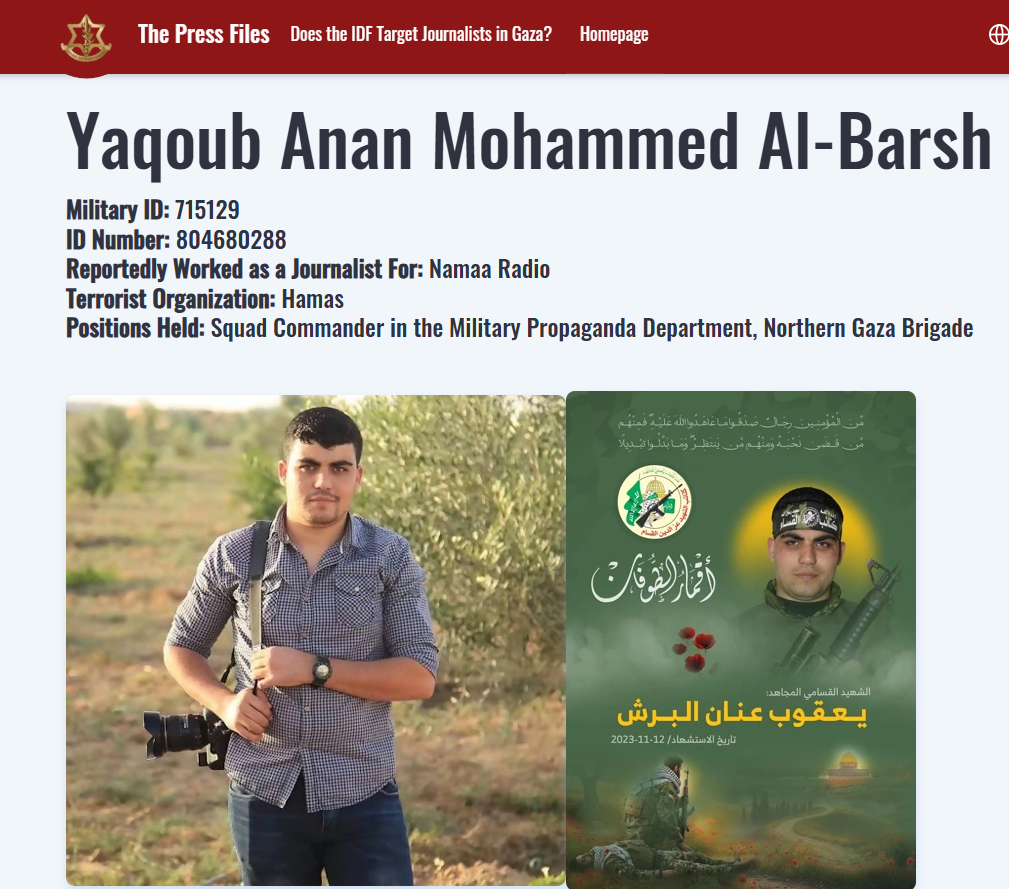
If Lonsdorf’s complaint is that such evidence is not given contemporaneously, or she believes what has been provided is insufficient, she should specify such claims. Otherwise, it appears she is simply ignoring the fact that the IDF has made this information available.
Journalistic integrity requires telling the full story, not providing soundbites in service of a convenient narrative. NPR’s distortions and omissions actively mislead its audience, leading to one question: why doesn’t NPR value the truth?