
Writing for Foreign Policy on Oct. 8, 2026, in a piece entitled “The Next Iran War Is This Iran War,” Ali Hashem, a Lebanese journalist at Al Jazeera and formerly with the Hezbollah-aligned Al Mayadeen, providing a single, out-of-context piece of evidence, asserted that the Iranian people are rallying behind the Islamic Republic less than a year after the massacre of tens of thousands of protesters.
The article begins oddly:
To understand how the current war in Iran will develop, one must first understand that it did not begin seven months ago. It didn’t even begin months earlier, when Israel targeted Iranian commanders and nuclear scientists in June 2025. These are all milestones that mark the renewal of a war that has continued for decades, ever since Washington and Tehran parted ways and Iran became an Islamic republic.
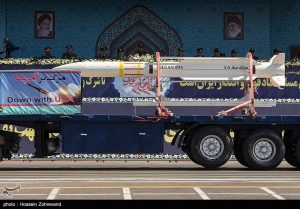
Tasnim News Agency, CC BY 4.0 <https://creativecommons.org/licenses/by/4.0>, via Wikimedia Commons
Hashem cleverly ascribes equal blame to the two sides for their enmity. It is worth remembering how this enmity emerged.
The Islamic Revolution triumphed on Feb. 11, 1979. One of the revolution’s slogans was “Death to America.” Nonetheless, the Carter administration recognized the government of the religious-nationalist Mehdi Bazargan and maintained diplomatic relations with Iran, despite an initial attack on the U.S. embassy in Tehran.
Marxist revolutionaries attacked the U.S. embassy on Feb. 14. The guerrilla fighters shot and injured Kenneth Kraus, a U.S. Marine tasked with embassy security. The Bazargan government ended the siege. But at the time, two parallel governments ran Iran: Bazargan’s and a revolutionary government which religious fanatic Ruhollah Khomeini had appointed. The latter transferred Kraus to a revolutionary prison, where interrogators tortured him, and a kangaroo court sentenced him to death. The U.S. government eventually secured his release, but the Carter administration reduced U.S. diplomatic and intelligence presence in Iran.
The Carter administration tried to improve relations over the next seveal months. Over the summer and fall of 1979, the United States briefed Iran on intelligence regarding Saddam Hussein’s Iraq and discussed the delivery of military spare parts to Iran.
But when the Carter administration admitted the Shah into the United States for cancer treatment, Iran demanded extradition. The United States refused out of justifiable concerns that the new regime would summarily execute him, as it was doing many others. On Nov. 4, Islamist students attacked the U.S. embassy, took those inside hostage, and triggered the hostage crisis. Relations collapsed entirely.
Hashem is right that hostilities did not start this year, but only to that extent. Washington and Tehran did not “part ways” when “Iran became an Islamic republic.” Those who made Iran an Islamic Republic chose confrontation with the United States, which was offering them olive branches.
The rest of Hashem’s article is similarly filled with unsubstantiated claims. One paragraph stands out:
Yet the war has, over the past few months, also produced an opposite effect, where domestic support for the state has significantly increased. The war may even have resulted in the regime enjoying its highest level of public support in years. This is mainly due to the rhetoric adopted by Trump and Israeli Prime Minister Benjamin Netanyahu, which many Iranians perceive as directed against Iran’s national identity. Added to this was the assassination of the country’s highest religious authority, the supreme leader, which made Shiism itself appear under threat.
Hashem supports the proposition that the regime has become more popular with circumstantial evidence: “The so-called Janfada-e Iran (or the “ones who sacrifice their lives for Iran”) rally on Sept. 18, for example, drew hundreds of thousands of people to Tehran, the largest gathering since the war began” But this isn’t new; the regime has always managed to rally crowds that look large on television for propaganda.
Meanwhile, survey data contradict Hashem’s claim. A June 2026 poll by diaspora pollster GAMAAN showed the regime’s popularity at 13.4 percent, down from 20 percent in 2024. The poll also demonstrated that Iranians were split in half over the war, with roughly equal numbers supporting and opposing foreign intervention to bring down the regime.
Most interestingly, 44 percent hold a positive view of President Donald Trump, but 51 percent hold a positive view of Prime Minister Benjamin Netanyahu, who has used even harsher rhetoric against the regime. So much for Hashem’s argument that Netanyahu’s harsh rhetoric has discouraged Iranians. The Israeli prime minister has consistently praised instead of attacking Iranian national identity, publishing videos directly talking to the Iranian people as a friend. Hashem seemingly cannot distinguish between Netanyahu and Trump, whose threats “to obliterate Iran’s civilization” he cites as evidence, but many Iranians can.
Hashem further exposes his ignorance of Iran by citing Khamenei’s standing as a religious leader. But in 2020, only 32 percent of Iranians identified as Shi’ites. Since then, the figure has likely declined further with growing secularization in Iranian society. Among the Shi’ite faithful in Iran, Ayatollah Ali Sistani has maintained a larger following than Khamenei, who forged his clerical credentials in 1989 to become the supreme leader and remained suspect within the seminary.
More to the point, it is implausible that the millions of people who chanted “Death to Khamenei” for over a decade suddenly rally behind the regime because someone granted them that wish.
Hashem’s article is poorly researched, sourced, and argued, yet it survived Foreign Policy’s editorial standards. This raises a concern: Is the core standard an honest commitment to fact-based analysis or preaching to the choir?