
On the third anniversary of the largest massacre of Jews since the Holocaust, a caption on “La Hora de La 1,” a program on Spain’s public broadcaster RTVE, summed up the occasion as follows: “Three years of genocide in Gaza.”
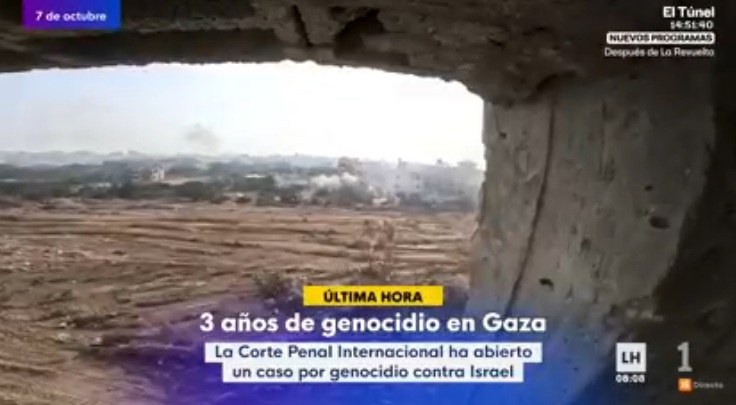
A screen capture of RTVE’s Oct. 7, 2026 report citing “Three years of genocide in Gaza.”
Below it, another caption spread misinformation: “The International Criminal Court has opened a genocide case against Israel.”
It would be difficult to better summarize Spanish public television’s grossly skewed coverage of the third anniversary of Oct. 7—and, by extension, of the entire war: ideological reframing and factual errors.
This formulation was not merely an unfortunate choice of words, but a political framework through which RTVE rearranged events to turn the victim of aggression into the aggressor.
On the anniversary of a massacre, Spain’s public broadcaster chose to highlight not the massacre itself but an accusation of “genocide” against the people who had been attacked. To reinforce that narrative, the network added a statement that was objectively false.
To be clear, the International Criminal Court (ICC) has not opened a genocide case against Israel. The proceedings initiated by South Africa under the Genocide Convention are before the International Court of Justice (ICJ), an entirely different institution. Nor has the ICJ determined that Israel committed genocide: the case remains pending.
RTVE devoted several programs to commemorating Oct. 7, including reports and interviews dividing attention between Israeli and Gazan suffering—a duality which, given the occasion, already suggested a clear intention to relativize the horror Israelis experienced.
The segments devoted to Palestinian suffering were filled with images of anguish, personal stories identifying individuals by name, voice-over narratives, testimonies from Gazans on the ground, details of deaths and a continuous display of empathy.
Consider this passage from the 3 p.m. newscast on “Canal 24 Horas”:
[Israel] also controls 60 percent of the Strip. In that territory, Palestinians cannot even recover their dead, as the team working with RTVE from Gaza has confirmed. These are the markings of the yellow line drawn by Israel in Gaza. They define a perimeter that Israeli troops frequently change and determine where Palestinians can neither live nor recover their dead.
Amal Hundiyla lost 28 members of her family—children, her husband, nephews and nieces—the day Israel attacked her home, which had suddenly found itself in a prohibited area. She now recalls telling RTVE’s collaborator in Gaza that her brother-in-law was trapped under the rubble, calling for help on his phone, but they were not allowed to approach. He died there, and his body remains there.
Palestinian Civil Defense does enter the prohibited territory, but always under international supervision. They estimate that 3,000 bodies are buried beyond the line. Mahmud Basal believes that even with resources it would take one or two years to retrieve them. Identifying them is another challenge. The dead can only be recognized by their clothes or belongings because Israel has destroyed all the DNA laboratories in Gaza.
Uncertainty is the daily pain of Suja Abu Sajhlul. She does not know what happened to her husband, perhaps buried on the other side of the line. She is raising her seven children alone. “The war,” she says, “has taken away my life and my future.” Like Amal, whose name means “hope” in Arabic, but who now feels she no longer has a place in this world.
RTVE does not identify the “team working with RTVE from Gaza,” omitting the fact that operating in the Strip requires Hamas’ approval, and that the organization controls the discourse and images emerging from the territory. Similarly, RTVE fails to explain that Palestinian Civil Defense is part of Hamas’ internal security apparatus. Even broadcasters such as the BBC have openly referred to it as “Hamas-run Civil Defence.”
Yet Spain’s public broadcaster adopts propaganda serving the perpetrators of the Oct. 7 massacres, conveniently sanitizing its sources as independent and impartial entities.
Israeli Suffering
By contrast, RTVE’s segments on Israeli suffering were more clinical and invariably juxtaposed with Palestinian victims in Gaza. The day commemorating the massacre became just another date on a kind of calendar of horrors. The massacre’s victims were reduced to numbers, without any mention of the sadism that they suffered.
This is how “Canal 24 Horas” presented the anniversary in its 2:30 p.m. newscast, opening with footage of the attack filmed by Hamas itself:
It has been three years since Oct. 7, when thousands of Hamas militants stormed into Israel, spreading terror. They killed 1,200 people and kidnapped 250. The Israeli government’s response to the worst attack in the country’s history was the deadliest and most destructive offensive against Gaza. Today Israelis are holding dozens of commemorations, Marc Campdelacreu, which also coincide with the election campaign.
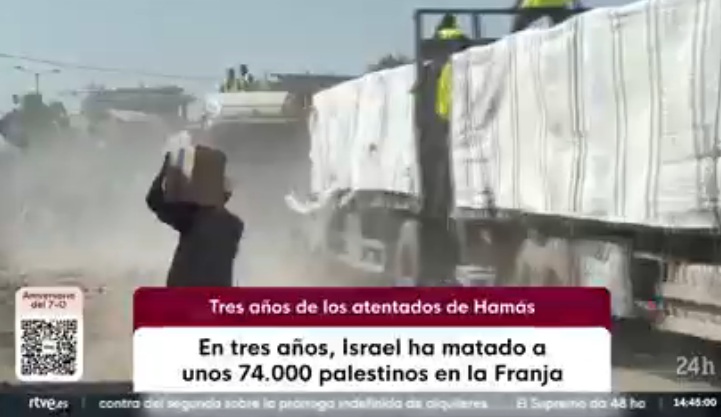
RTVE reported: “In three years, Israel has killed approximately 74,000 Palestinians in the Gaza Strip.”
The anchor then turned to RTVE’s correspondent at the Nova festival memorial site:
Yes, today marks three years since the attacks carried out on Israeli soil by Gaza-based militias led by Hamas. They murdered 1,200 people and took 251 hostages. Following those attacks, Israel launched an offensive that has devastated the Palestinian enclave and left at least 74,000 dead.
That was it. The report immediately moved on to Israel’s debate over the security failures of Oct. 7, placing Netanyahu at the center of attention:
Beyond that, three years later, the families still have many questions. They wonder, for example, how it was possible that their intelligence services failed to anticipate an attack of such magnitude, or whether Netanyahu—who, as you know, is now fighting for reelection—had been warned about a similar attack.
This was the predominant framework throughout RTVE’s analyses and reports that day: a focus on Palestinian suffering from a human perspective, alongside a constant effort to turn Israeli suffering into a matter of Israel’s own culpability.
The Voices RTVE Chose
In addition, RTVE suppressed the voices of Israeli victims. On the Israeli side, victims were given strikingly little time to describe their suffering, and not a single Israeli journalist, academic or sociologist was invited to explain the prevailing feelings within Israeli society.
For example, “Canal 24 Horas” devoted one minute and thirty seconds of its 3 p.m. newscast to an Israeli peace activist who lost his parents in the Oct. 7 attack. He denounced the current government and opposes the war. During his segment, viewers saw children greeting him in Nazareth and heard how many Palestinians had come to offer their condolences: “In Nazareth I learned something: the lower the walls, the greater our security.”
In another program (2:30 p.m.), RTVE interviewed two Israelis who had survived Hamas captivity. They were given barely 40 seconds between them. The voice-over translated their statements:
This couple survived captivity in Gaza. “Something was lost forever,” Aviva laments. Her husband Keith endured 484 days as a hostage. “Thinking about the Holocaust,” he says, “gave him strength and resilience.”
That was all.
Immediately afterward, RTVE brought in Haizam Amirah-Fernández of the Center for Contemporary Arab Studies to discuss whether Netanyahu had known about the attack in advance and failed to prevent it. For context, as early as Oct. 9, 2023, Amirah Fernández was already justifying Hamas’ attack by describing it as “resistance,” while introducing the word “genocide” into the debate. Barely 48 hours after the Hamas attack, he was already framing his explanation around “occupation,” “resistance” and “genocide.”
As though RTVE’s interpretation of Oct. 7 were not yet clear enough, the voice-over once again directed attention to Netanyahu:
1,095 days later, the Israeli government has not launched an independent investigation into what happened and what was or was not known beforehand. Resignations followed among the military and intelligence leadership, but Netanyahu has paid no price for Oct. 7—neither for his possible responsibility nor for the destruction and war crimes committed in Gaza under the pretext of self-defense.
RTVE also gave airtime to Raquel Martí, executive director of UNRWA Spain. But the public broadcaster failed to explain that UNRWA is not merely an outside observer of the conflict. Its ties to Hamas go back years. The U.N. itself acknowledged the possible involvement of nine employees in the Oct. 7 massacre, while a 2026 US government investigation identified more than 100current or former staff members with alleged links to Hamas or the attacks. These verified Hamas affiliations among UNRWA people come on top of years of allegations concerning Hamas infiltration of its unions and schools. Presenting its representative as a neutral voice gives viewers a profoundly incomplete picture of reality.
Panel discussion
There was also a panel discussion featuring, among others, two journalists, which focused largely on Netanyahu’s alleged war crimes and his electoral use of the conflict.
One participant was Natalia Sancha, a nonresident senior researcher on the Middle East and North Africa at the Elcano Royal Institute. Sancha makes no secret of her ideological position. On her X account, one can readily find accusations of “genocide,“ reposts of calls to protest “genocide,” and her assertion that Netanyahu’s “greatest crime” is “reactivating the shared trauma of the Holocaust to drag an entire society into complicity in genocide, all in order to remain in power.”
Despite such an explicit position, RTVE presents her as just another expert, granting her the credibility of an impartial observer.
Among her statements, we hear:
There is an enormous amount of disinformation. The Israeli press is quite persecuted, cornered in a way. Very few independent journalists remain. So there is also a very aggressive battle over the narrative in the Israeli media.
Referring to Netanyahu, she claimed:
He has marketed himself as the defender of security, and what he wants is to conceal the fact that he may go down in history as responsible for that tremendous security failure on Oct. 7—by opening the war he has opened with Iran, the war he has opened with Hezbollah in Lebanon, and now by taking advantage of that latest attempted attack involving the Flydubai flight.
But Netanyahu did not open any of those fronts. On Oct. 8, 2023, the day after the Hamas massacre, Hezbollah opened a second front against Israel, firing rockets and artillery shells at Israeli positions. Months later, in addition to the possible links between the Iranian regime and the Oct. 7 attack itself, on the night of April 13–14, 2024, the Islamic Republic of Iran launched its first direct attack on Israeli territory, firing more than 300 drones and missiles.
As for the press, Israel has a pluralistic, independent media capable of harshly criticizing the government and its own institutions. As Freedom House noted in its 2025 report, “Israel’s media sector is vibrant and free to criticize government policy.” In fact, the report gives Israel a score of 3 out of 4 for media freedom—curiously, the same score as Spain.
Another RTVE expert, journalist Gonzalo Caretti, who does not have an activist profile, offered a surprising explanation of Hamas’ objectives. To begin with, he sought to provide a justificatory framework for the Oct. 7 attack, claiming: “In recent months and years, Israel had greatly tightened the blockade on Gaza, and this was causing a major economic and social crisis.”
The problem is that this, too, is false.
Before Oct. 7, Israel had been easing restrictions on Gaza, expanding work permits and facilitating the entry of goods. According to the U.N.’s own figures, in July 2023 departures through the Israeli crossing reached their highest level since records began in 2004, and a month later the volume of goods entering Gaza even exceeded pre-2007 blockade levels. Granted, the population had more than doubled, but the conditions of the blockade had by no means been tightened.
More surprising still was his account of what happened. According to Caretti, Hamas wanted to upend the status quo. And it did so through an attack:
According to many documents seized by Israel during its occupation of Gaza, supposedly belonging to the Gaza command, the objective was clear: to kidnap as many Israelis as possible, civilians or soldiers. Why? To use them as bargaining chips in negotiations with Israel and thereby obtain concessions they could not have secured in any other way.
Now, in that plan, Hamas did indeed make a series of miscalculations, as you say. First, it misjudged the political nature of the Israeli government. The Israeli government, remember, is the most far-right government, full of supremacists, and Benjamin Netanyahu himself is on the ropes. It misjudged what the response would be. I do not think Hamas ever expected a full-scale invasion of the Strip. It was not prepared, nor could it have been prepared, for a confrontation of that magnitude. It also misjudged how the offensive itself would unfold, because when the barriers were breached, not only Hamas militants entered, but also militants from other groups and individuals with their own interests, who no longer followed the strategic objective—not to mention Hamas’ own militants. It became a free-for-all.
Note the double standard in vocabulary: Caretti described a democratic government as “far-right” and “full of supremacists,” while laundering a savage terrorist attack with euphemisms, arguing that Hamas merely sought to “obtain concessions” and “misjudged the response.” According to the journalist, Hamas only wanted to take hostages to “obtain concessions they could not have secured in any other way,” but once the barrier was breached, other actors joined the “free-for-all.”
Surprisingly, Spain’s public broadcaster barely mentioned the two Spanish citizens murdered by Hamas. Only once did a presenter refer to them, without naming them: Maya Villalobo and Iván Illarramendi.
So many segments were devoted to turning Oct. 7 coverage into a condemnation of Israel that listing them one by one would be repetitive. As we have seen, the framework consisted of pushing Israeli suffering and the scale of the massacre into the background while focusing on Palestinian suffering through unverified clichés and a persistent insistence on the term “genocide.”
When discussing Israel, RTVE preferred to concentrate on the political debate surrounding Netanyahu. That debate certainly exists, but it cannot become the centerpiece of special programming commemorating the Oct. 7 attacks. It would be like public television devoting Holocaust Remembrance Day to controversies surrounding the Judenräte, and spending the rest of the broadcast on civilian suffering during the bombing of Dresden.
For the Spanish version of this article, please see CAMERA Español.