In an interview with a former Lebanese diplomat and presidential candidate Tracy Chamoun, NPR allowed omissions and lies to guide the conversation. The lack of pushback enabled the promotion of Hezbollah propaganda and revisionist history.
NPR added to its repertoire of soft or sympathetic interviews of perpetrators, leaders and supporters of Palestinian terror in its recent interview with Mahmoud Khalil. Structured to garner sympathy, NPR never asked him about the speech he claims he has been targeted for or why he has repeatedly refused to condemn Hamas.
NPR carefully avoids placing an iota of responsibility for the damage to southern Lebanon on Hezbollah. In a recent story designed to make it appear as if Israel was destroying homes for no reason, one man NPR interviewed told listeners that nice houses don't house weapons.
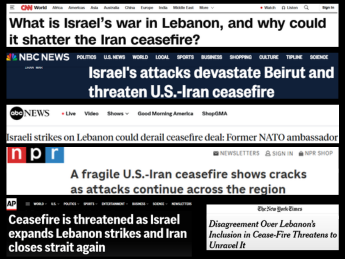
NBC, ABC and NPR reported last week on Israel's intensified strikes in Lebanon and how they might interfere with a potential ceasefire deal between the United States and Iran. The reports gave only half the story, omitting mention of Hezbollah's conduct.
Following the April 8, 2026, U.S.-Iran ceasefire, major western outlets manufactured a false narrative accusing Israel of violating the deal based on unconfirmed claims from Tehran and Islamabad.
NPR has a long-standing formula. Both in 2009 and 2026, it ran stories about the same man in the same area in Jerusalem. Then and now, NPR used anti-Israel human rights organizations and Israeli activists to make false claims about the demolition of illegally built homes and to call the building permit process discriminatory.
In presenting "the Nakba," NPR's listeners heard activism, not journalism. Its audience was not told that Palestinian Arabs rejected the proposed UN Partition Plan or that neighboring Arab countries declared war on the new State of Israel. NPR's one-sided narrative also ignored the 150,000 Arabs who remained in Israel during the war, who make up roughly 20 percent of the Israeli population today.
A superficial, softball interview of Irish hip hop band Kneecap ignored the group's hateful, inflammatory, anti-Israel rhetoric. NPR abandoned journalistic integrity in favor of cool vibes.
NPR surveyed the damage in southern Lebanon while escorted by a Hezbollah propagandist. Its report ignored Hezbollah's human shield strategy, attacks on Israel and how the terror group's tactics mirror those of Hamas.
Former Department of Homeland Security official Fayrouz Saad spoke with NPR about her family's connection to Bint Jbeil, Lebanon, following the destruction of her family's "ancestral home" there. Referring to the village as quaint, Saad omitted any reference to PLO control at the time her parents left Lebanon or to Hezbollah presence there in the last several decades.