
Introduction
In their edited volume, Being Christian After the Desolation of Gaza, Bruce N. Fisk (Senior Research Fellow with the Network of Evangelicals for the Middle East and retired Professor of New Testament at Westmont College) and J. Ross Wagner (Anglican Priest and Associate Professor of New Testament at Duke Divinity School) have assembled essays written by American, Latin American, Jewish, and Palestinian Christians “who,” readers are told, “have spent years listening, laboring, and praying for a durable, equitable peace between Palestinians and their Jewish neighbors.” While this description of the volume’s contributors sounds evenhanded, the essays are overwhelmingly one-sided against the State of Israel and its supporters. In framing their denunciations of the Jewish State in religious terms, these self-styled modern prophets rebuke a wayward Israel and her supporters for having sinfully gone astray in pursuit of worldly power and domination. While the Jewish State’s alleged misbehavior and the support shown for her by Christian Zionists following the heinous massacre, rape, and kidnapping of Israelis on October 7, 2023 are what occasioned the publication of this volume, the monstrous portrait of Zionism and the State of Israel painted in its pages makes clear the volume’s contributors believe the sinful behavior began long before the crimes of Hamas and associated Palestinians were committed.
In cataloguing Israel’s alleged sins, the contributors:
- Misrepresent Zionism as a European settler-colonial movement based on Jewish supremacy aiming to ethnically cleanse, expel, and eliminate Palestinians by:
-
- Erasing non-European Jews from Zionist history.
- Mischaracterizing Zionist decolonization as a manifestation of imperialism.
- Maligning Zionists as non-integrationist and ethnically exclusivist.
- Falsely accuse:
- “Proto-Zionist Christians” of promoting a genocidal ideology.
- The Jewish State of engaging in genocide.
- Draw inappropriate comparisons between Nazis and Israelis while:
- Using dehumanizing rhetoric.
- Engaging in supersessionist interpretation.
- De-Judaizing Jesus.
- Cast Israelis and their partners as New Testament villains, including:
-
- Murderous King Herod.
- Hypocritical Pharisees.
- Eliminationist chief priests and Pharisees.
- Puritanical and legalistic priests and Levites.
- Corrupt high priests and Judas.
- Misrepresent Christian Zionists as responsible for:
-
- Blocking the spread of the gospel.
- Rebuilding “walls of hostility” between Jews and Gentiles.
- Sanctioning Jewish acquisition of all territory of the Holy Land by any means.
- Promoting heretical beliefs.
- Misconstrue the Apostolic Message by:
- De-Territorializing Jesus’ eschatological jubilee.
- Downplaying New Testament expectations of restored Jewish sovereignty over the land of Israel.
- Prioritizing diaspora identity over national existence.
- De-Territorializing Paul’s vision of Israel’s salvation.
- Deny the ancient roots of Jewish peoplehood.
- Stigmatize American and Israeli Jews.
- Deflect Hamas and Palestinian Islamic Jihad culpability for October 7, 2023.
- Misrepresent Hamas by:
-
- Inaccurately describing Izz ad-Din al-Qassam.
- Misrepresenting an apocalyptic hadith in the Hamas charter.
- Misrepresenting Israel’s blockade on the Gaza Strip.
- Inaccurately identifying a 2017 Hamas policy document as a “charter.”
- Falsely claiming that Hamas clarified its position against antisemitism.
- Mischaracterizing Hamas as accepting a two-state solution.
- Downplaying the Hamas threat to Israel.
- Misleadingly comparing jihād to “Just War.”
- Inaccurately claim consistent Palestinian Christian nonviolent advocacy.
- Misrepresent historical events:
-
- 1929 – Riots
- 1948 – 1948 War
- 1948 – Egyptian Army Drives Out Kfar Darom Residents
- 1967 – 1967 War and Mughrabi Quarter
- 1971 – Gaza Economy
- 2000 – Muhammad al-Durrah
- 2002 – Operation Defensive Shield
- 2012 – Operation Pillar of Defense
- 2023 – Al-Ahli Arab Hospital
- 2023 – Church of Saint Porphyrius
- 2023 – Al-Shifa Hospital
- 2023 – Israeli Conduct
- Promote biased and extremist organizations:
-
- Jewish Voice for Peace
- Breaking the Silence
- Churches for Middle East Peace
- Musalaha
- IfNotNow
- Council on American-Islamic Relations
Misrepresenting Zionism as a Settler-Colonial Movement
The book’s contributors misrepresent Zionism as a settler-colonial movement of European Jews intent on creating an exclusively Jewish State. An example of this misrepresentation can be found in Chapter 11, “Missiology After Gaza: Christian Zionism, God’s Character, and the Gospel,” where Anton Deik describes the emergence of Zionism in the following terms:
In the late nineteenth and early twentieth centuries, European Jews sought to mirror the settler-colonial paradigm that their Christian compatriots had followed in the Americas, Oceania, and parts of Africa. These European Jews began a movement known as Zionism, spearheaded by Theodor Herzl, an Austro-Hungarian journalist. The goal of Zionism was to address Europe’s entrenched antisemitism by establishing what Herzl called der Judenstaat (“the Jewish State”) (Being Christian After the Desolation of Gaza, p. 217).
Erasing Non-European Jews from Zionist History
Deik’s reference to Zionists as “European Jews” leaves readers with the false impression that only Jews living in Europe were Zionists. Similarly, Yousef Kamal AlKhouri in Chapter 9, “Theologizing and De-theologizing Genocide,” leaves readers with the false impression of Zionism as a strictly “European” movement when he states, “[T]he majority of Zionist Jews are Europeans, colonizers, or refugees who migrated to Palestine in the nineteenth centuries” (Ibid., p. 191) without identifying non-European countries from which Jews fled to seek refuge in the newly established Jewish State.
Contrary to the false impressions created by Deik and AlKhouri, Zionism from its inception appealed to non-European Jews, including Sephardim and Mizrahim. In 1898, Zionist groups formed in Morocco and Egypt, where hundreds of Jews became members of the World Zionist Organization. According to the late University of Oxford historian Sir Martin Gilbert, the Zionist belief in a “return of Jews to their ancient homeland, where they would have sovereignty,” deeply appealed to Jews living in a poor community in Fez (In Ishmael’s House: A History of Jews in Muslim Lands, p. 136). Following the establishment of the State of Israel in 1948, 850,000 fled Arab countries seeking refuge in the State of Israel with a majority of Israeli Jews having roots in Arab countries.
Mischaracterizing Zionist Decolonization as a Manifestation of Imperialism
Deik’s description of the emergence of Zionism as a settler-colonial movement represents a distortion of the historical record. Far from constituting an example of settler-colonialism, Zionism represents what the late Hebrew University Professor of European and Jewish History and antisemitism scholar Robert S. Wistrich called “the first successful anti-colonial liberation struggle in the Middle East” (From Ambivalence to Betrayal: The Left, the Jews, and Israel, p. 512). This “anti-colonial liberation struggle” in the 1940s became “a leading pioneer of postwar decolonization and the liberation of oppressed peoples in the Third World” (Ibid.). Zionist struggle against British colonial rule in Palestine helped ensure the movement’s survival (Ibid., p. 513). Contrary to Deik’s false claim that Zionists, “instead of legally buying and selling land, use[d] violence” (Being Christian After the Desolation of Gaza, p. 221), David Ben-Gurion, a leader of the Jewish Agency for Palestine and Israel’s first prime minister, delivered a speech in 1915 in New York on the subject of “Earning a Homeland” in which he explicitly rejected the imperialist practice of “[seizing] land by force of arms,” insisting that the Jewish people’s ancestral homeland must be earned “with the sweat of the brow.” Indeed, the Middle East historian Daniel Pipes has highlighted the exceptionally peaceful approach adopted by Zionists:
[T]he building of Israel represents the most peaceable in-migration and state creation in history […] Against th[e] tableau of unceasing conquest, violence, and overthrow, Zionist efforts to build a presence in the Holy Land until 1948 stand out as astonishingly mild, as mercantile rather than military.
The funding used by the Jewish National Fund to buy land was not provided by “colonialist” organizations, but derived from “millions of petty Jewish artisans, shopkeepers, workers, and professional people” (From Ambivalence to Betrayal, p. 523).
In contradistinction to other colonial movements, Zionists intentionally refrained from engaging in “the capitalist exploitation of indigenous labor and the acquisition of private property,” aiming “to work and plow areas which were largely wasteland, to drain swamps and marshlands, to forest the dunes, and water the desert” (Ibid). The philosopher and Zionist Martin Buber observed: “Our settlers do not come here as do the colonists from the Occident, to have natives do their work for them; they themselves set their shoulders to the plow and they spend their strength and their blood to make the land fruitful” (The Zionist Idea, p. 464). Harvard University William Lee Frost Professor of Jewish History Derek Penslar has also observed that Jews who returned to their ancestral homeland did so
not for its strategic value, natural resources, or productive capabilities but rather because of what Jews believed to be historic, religious, and cultural ties to the area known to them as the Land of Israel. Zionism was based in concepts of return, restoration, and re-inscription (Israel in History: The Jewish State in Comparative Perspective, p. 108).
Contrary to Deik’s representation of Zionism as an expression of imperial ambitions, University of Maryland Distinguished University Professor Emeritus historian Jeffrey Herf has observed, “Had it been up to the British Foreign Office or the U.S. State and Defense Departments and the CIA—the usual malefactors of Western imperialism—the Jewish state would have been stillborn” given their “overwhelming hostil[ity]” to the establishment of the State of Israel.
Maligning Zionists as Non-Integrationist and Ethnically Exclusivist
Having misleadingly characterized Zionism as a European settler-colonial movement, Deik proceeds to malign Zionists and Jews settling in their ancestral homeland as immigrants who did not wish to integrate with Arabs residing in the land:
With the support of Western powers, the Zionist movement began promoting and facilitating the mass migration of Jews from Europe to Palestine. These settlers did not arrive as immigrants intending to integrate with us but as colonizers seeking to establish an ethnostate—an ethnically exclusive Judenstaat—on a land inhabited by Palestinians (Being Christian After the Desolation of Gaza, pp. 217-218).
Deik’s claim that Zionists did not wish to integrate with non-Jews in the land is belied by the evidence. In his novel, Altneuland, Herzl envisioned Arabs and Jews with equal rights thriving in a Jewish State. Herzl thought a flourishing Jewish State would benefit not only Jews, but also Gentiles: “The world will be freed by our liberty, enriched by our wealth, magnified by our greatness. And whatever we attempt there to accomplish for our own welfare, will react powerfully and beneficially for the good of humanity.”
Ben-Gurion thought that Arabs and Jews need one another, arguing that there was “no conflict of interest between the Jewish people as a whole and the Arab people as a whole….We need each other. We can benefit each other” (In Ishmael’s House, pp. 172-173). In addition, Ben-Gurion maintained that the success of Zionism would benefit both Arabs and Jews: “[A] great Jewish community, a free Jewish nation in Palestine, with a large scope for its activities, will be of great benefit to our Arab neighbours, and from the recognition of this fact will come a lasting peace and lasting cooperation between the two peoples” (Ibid., p. 173).
The Twelfth Zionist Congress resolved,
[T]he determination of the Jewish people to live with the Arab people on terms of unity and mutual respect, and together with them to make the common home into a flourishing community the upbuilding of which may assure to each of its peoples an undisturbed national development (Quoted in “Palestine: Correspondence with the Palestine Arab Delegation and the Zionist Organization,” Cmd. 1700).
Not one of the Zionist organizations surveyed by the UN Special Committee on Palestine expressed a desire to remove Palestinians. Instead, these Zionist organizations respected individual property rights (Israel Studies: Word Crimes: Reclaiming the Language of the Israeli-Palestinian Conflict, pp. 33-44). In other words, Zionists sought to live alongside Palestinian Arabs in the land rather than to steal Palestinian property or to expel Palestinians from the land as suggested by Deik.
Libeling “Proto-Zionist Christians” and the State of Israel as Genocidal
Falsely Accusing “Proto-Zionist Christians” of Promoting a Genocidal Ideology
AlKhouri erroneously contends that Scottish clergyman Keith Alexander and British statesman Lord Shaftesbury helped to propagate a genocidal ideology against Palestinians long before the establishment of the State of Israel. AlKhouri states that Alexander,
arguing for the restoration of the Jews to Palestine, reported to European Protestant monarchs on behalf of the Church of Scotland that Palestine “is in a great measure a country without a people,” a wildly misleading notion that eventually morphed into the infamous slogan, “a land without people for a people without a land” (Being Christian After the Desolation of Gaza, p. 195).
A relevant portion of a quotation from Shaftesbury that AlKhouri references is the following:
No one can say that we are anticipating prophecy; the requirements of it (prophecy) seem nearly fulfilled; Syria “is wasted without an inhabitant […] There is a country without a nation; and God now, in His wisdom and mercy, directs us to a nation without a country. His own once loved, nay, still loved people, the sons of Abraham, of Isaac, and Jacob” (Ibid., p. 196).
AlKhouri adduces these statements from Alexander and Shaftesbury to make the following claim:
The examples of Alexander and Shaftesbury show that the Palestinians, as a people indigenous to their ancestral homeland, were perceived as non-existent or inferior in comparison to the European Zionist settlers. The narratives and stories that Western and imperial powers and Zionist Christians constructed to justify the colonization of Palestine are genocidal in nature” (Ibid.).
In fact, Alexander and Shaftesbury were aware of the presence of Palestinian Arabs in the land, as AlKhouri himself acknowledges. The historian Diana Muir observes, “Keith was aware that the Holy Land was populated because he had traveled to Palestine in 1839 on behalf of the Church of Scotland and returned five years later with his son, George Skene Keith, believed to be the first photographer to visit to the Holy Land.” In a speech to the Palestine Exploration Fund Society, Shaftesbury, too, acknowledged the presence of inhabitants resident in the land, describing Palestine as “almost without an inhabitant—a country without a people, and look! Scattered over the world, a people without a country” (A Short History of Christian Zionism: From the Reformation to the Twenty-First Century, pp. 119-120).
While AlKhouri falsely claims, “[S]ince its earliest days, the settler-colonial project of Zionism aimed at the elimination of the native Palestinian people, in whole or in part, in order to replace them with Zionist settlers” (Being Christian After the Desolation of Gaza, p. 196), statements by Alexander and Shaftesbury do not imply that those residents in the land would be required to leave. Muir explains how such rhetoric of advocates of Jewish return to the land of Israel should not be viewed as indicating lack of recognition of residents in the land or an intention to displace these residents:
Nineteenth-century Westerners associated peoples or nations with territory, and so to be a land without a people did not imply that the land was without people, only that it was without a national political character […] Advocates of a Jewish return to Israel, when they thought about the Arab inhabitants at all, assumed the existing Arab population would continue in residence after a Jewish state was established. This outcome appeared workable[,] since all nation-states include ethnic minorities among their citizens.
Falsely Accusing the State of Israel of Engaging in Genocide
AlKhouri falsely claims that the State of Israel is committing genocide in Gaza. He states:
Today, the State of Israel, armed with its settler-colonial ideology, is actively committing a genocide, one that is incited by Israel’s highest-ranking officials, live-streamed by its military, prosecuted with Western weapons, permitted by Western powers, and defended and justified by the powerful Christian Zionist lobby. That the war on Gaza amounts to genocide has been argued by many officials of the United Nations, by international human rights organizations, by the Lemkin Institute for Genocide Prevention, and by scholars of genocide. Moreover, the charge of genocide has also been made in the South African application before the International Court of Justice, and the University Network for Human Rights has recently offered a thorough legal analysis that makes a solid case for classifying the Israeli campaign in Gaza as a genocide” (Ibid., pp. 193-194).
The only Israeli government official AlKhouri references by name in his chapter is Israeli Prime Minister Benjamin Netanyahu. AlKhouri falsely suggests that Prime Minister Netanyahu’s references to “sons of light and sons of darkness” (Ibid., p. 192) and “Amalek” (Ibid., p. 198) in his speeches constitute evidence of genocidal intent on the part of Israeli government officials.
However, the context of the speeches in which such references appear makes clear that the Prime Minister is speaking of Hamas specifically, not the Palestinian people generally. The context of the excerpt of the prime minister’s remarks where the “sons of light and sons of darkness” is found makes clear that the Prime Minister explicitly identifies Hamas, not Palestinians generally, as its intended military target (Hamas references are indicated in bold):
This is a moment of genuine struggle against those who have risen up against us to destroy us. Our goal is victory – a crushing victory over Hamas, toppling its regime and removing its threat to the State of Israel once and for all.
There are many questions about the disaster that befell us ten days ago. We will investigate everything thoroughly. We have already begun to apply immediate lessons. However, now we are focused on one goal: Uniting our forces and storming forward to victory.
To this end, determination is required because victory will take time. There will be difficult moments. There will be pitfalls. Sacrifice will be necessary. But we will win because this is our very existence in this region, in which there are many dark forces.
Hamas is part of the axis of evil of Iran, Hezbollah and their minions. They seek to destroy the State of Israel and murder us all. They want to return the Middle East to the abyss of the barbaric fanaticism of the Middle Ages, whereas we want to take the Middle East forward to the heights of progress of the 21st century.
This is a struggle between the children of light and the children of darkness, between humanity and the law of the jungle. We saw this in the horrors that the reprehensible murderers perpetrated in Kibbutz Be’eri, in Kfar Aza, in the other communities of the area adjacent to the Gaza Strip, and in the killing field of young people at a festival in Re’im.
Many people around the world now understand who stands against Israel. They understand that Hamas is ISIS. They understand that Hamas is the new version of Nazism. Just as the world united to defeat the Nazis and ISIS, so too will it unite to defeat Hamas.
The context of a November 3, 2023 letter in which Netanyahu also references “children of light and children of darkness” also makes clear this identification of Hamas as the enemy:
In their name and on their behalf, we have gone to war, the purpose of which is to destroy the brutal and murderous Hamas-ISIS enemy, bring back our hostages and restore the security to our country, our citizens and our children.
This is a war between the children of light and the children of darkness.
In terms of Netanyahu’s references to “Amalek,” a brief explanation of how “Amalek” has been understood in Jewish tradition as summarized by CAMERA Communications Director Gilead Ini is helpful to keep in mind:
“Amalek” has become a stand-in for evil in the contemporary Jewish tradition, including the evils of the Holocaust. Not only does the concept of “remembering what Amalek did,” as called for by Holocaust victims, feature in an exhibit at Yad Vashem, Israel’s Holocaust remembrance museum, but it was also part of the inspiration for the museum’s creation, and continues to be cited as part of its raison d’être. It features in other Holocaust memorials as well, such as The Hague’s memorial sculpture.
AlKhouri seems to allude to an October 28, 2023 speech delivered by Prime Minister Netanyahu given that AlKhouri says “Netanyahu made his own remarks” soon after a statement published on October 26, 2023 (Ibid., p. 198). AlKhouri claims that Netanyahu’s remarks “invok[ed] the divine command to ‘blot out the remembrance of Amalek from under heaven’ (Exod[.] 17:14; Deut[.] 25:19; cf. 1 Sam[.] 15:3) in order to portray the settler-colonial genocide against the Palestinians as a holy war” (Ibid.).
However, in his October 28 speech, the only biblical citation provided is Deuteronomy 25:17 (“Remember what Amalek did to you.”). This biblical quotation is a call for the people of Israel to engage in an act of remembrance, not an act of genocide. Fisk in Chapter 2, “Israel’s Christian Armada Sets Sail,” notes that Netanyahu’s speech included the words “Remember what Amalek did to you. We remember and we fight” (Ibid., p. 63). However, Fisk omits the fact that in the same speech, Netanyahu clearly distinguishes between the terrorist organization Hamas and the civilian Palestinian population while decrying the Hamas practice of using civilians as human shields:
This is the second stage of the war, the goals of which are clear: Destroying Hamas’s military and governing capabilities, and bringing the captives back home […] The IDF does everything to avoid harming non-combatants. I again call on the civilian population to evacuate to a safe area in the southern Gaza Strip. In contrast, the cynicism of the enemy knows no bounds. He carries out war crimes by using civilians as human shields, by using hospitals as terrorist command centers and to supply fuel to its war machine.
Approvingly quoting A. Dirk Moses, Fisk falsely suggests that Israel is responsible for “[c]ountless innocents” being “sacrificed” upon “the altar of ‘permanent security’” (Ibid., p. 63) despite Israel’s efforts to avoid civilian casualties. Fisk dismissively accuses those who acknowledge such Israeli efforts while pointing out the deliberate strategy of the terrorist organization Hamas of using human shields of “uncritically repeat[ing] memes” (Ibid., p. 4).
The book’s contributors attempt to give the genocide charge credibility by inaccurately claiming that international legal institutions, like the International Court of Justice, have leveled a similar charge against the State of Israel. For example, David M. Crump in Chapter 4, “Prisoner Abuse and Evangelical Indifference,” falsely claims, “The International Court of Justice ruled in January 2024 that the South African indictment brought against Israel made a compelling case that Israel is plausibly committing genocide in Gaza” (Ibid., p. 105). In fact, the president of the court, Joan Donoghue, denied this claim: “I’m correcting what’s often said in the media – it [the court] didn’t decide that the claim of genocide was plausible.” Many Holocaust, genocide, and legal scholars have condemned a resolution falsely charging that Israel has committed genocide in Gaza.
Drawing Inappropriate Comparisons Between Nazis and Israelis
Contributors draw inappropriate comparisons of Nazis to Zionists and Israelis. For example, Wagner in Chapter 18, “Being Christian After the Desolation of Gaza,” suggests that Zionists have told “nationalist narratives of blood and soil” (Ibid., p. 320), tying the English translation of the ugly Nazi slogan Blut und Boden to the national liberation movement of the Jewish people to restore Jews to their ancestral homeland and provide Jews fleeing persecution a place of refuge. In an Across The Divide podcast episode, Wagner compares how Dietrich Bonhoeffer addressed the exclusion of Jewish clergy from the church under the Nazis to how he thinks Christians today should confront the Jewish State’s alleged efforts to destroy the Palestinian people:
For Dietrich Bonhoeffer, the Aryan Paragraph, the exclusion of Jewish clergy from the church […] I think it’s arguable that we’re at a place like that, too, in the current time, if the church is cheering on the erasure of the Palestinian people from Gaza, if the church is supporting the destruction of a people, of a way of life, in the name of the Gospel, I think this is a dividing line […] As complicated as much of the whole situation in the Middle East is, this doesn’t seem like a complicated situation to me.
Crump in Chapter 16, “Worshipping Jerusalem: Christian Colonizers and Colonized Christians,” uncritically accepts as veridical his Palestinian interlocutor’s claim that Jewish Christians promote “Jewish supremacy”—an accusation leveled by Nazis and White Supremacists against Jews. It is not surprising that Crump accepts the truth of this claim given his own comparisons of Zionists to Nazis in his book, Like Birds in a Cage: Christian Zionism’s Collusion in Israel’s Oppression of the Palestinian People, where he writes: “American evangelicalism is helping to finance political Zionism’s flagrant imitation of Nazi Germany” (Like Birds in a Cage: Christian Zionism’s Collusion in Israel’s Oppression of the Palestinian People, p. 39). It is worth noting in this regard that the International Holocaust Remembrance Alliance working definition of antisemitism used by the U.S. State Department considers “drawing comparisons of contemporary Israeli policy to that of the Nazis” to be antisemitic.
At other times, the book’s contributors compare Israeli behavior to that of the Nazis while simultaneously acknowledging that the two are not, in fact, equivalent. For example, Daniel Bannoura in Chapter 5, “Hamas and Violence: Ideology, Militarism, and the Quest for Liberation,” compares the internationally designated Palestinian terrorist organization Hamas-led massacre, rape, and kidnapping of Israelis on October 7, 2023—the deadliest day for Jews since the Holocaust—to Jewish resistance to the Nazis during the Holocaust: “Moving forward, we understand why […] European Jews staged prisoner revolts and ghetto uprisings against Nazi forces during World War II […] How is Hamas different” (Being Christian After the Desolation of Gaza, p. 135)? However, in the same chapter, Bannoura asserts, “The conflation of Jews with Nazis is inappropriate considering the Holocaust and Nazi treatment of European Jews in the twentieth century” (Ibid., p. 126).
Similarly, Fisk in the Introduction, “The Wrong Sort of Christians,” references Daniel Jonah Goldhagen’s call for “the Roman Catholic church and its clergy to confront their complicity in the Holocaust” (Ibid., p. 5) while proceeding to note, “It is not lost on me that ‘the evildoers’ in Goldhagen’s original question are Nazis, and ‘the evildoers’ in my formulation are Israeli Jews (albeit enabled by Americans and Europeans)” (Ibid., p. 6). It should be noted that those who serve in the IDF are not only Jews, but also Christians as well as other religious and ethnic minorities, yet Fisk singles out Israeli Jews as “the evildoers” here. Fisk also indicates that he does not view the behavior of Israeli Jews and Nazis as equivalent.
If these contributors know that what Israelis are doing is not equivalent to what the Nazis did to Jews during the Holocaust, then why do they nevertheless draw such comparisons? The Middle East historian Martin Kramer argues that the drawing of such comparisons is a “despicable tactic” that is “exploitative” in that it “plays on the vulnerabilities of the Jews, on their propensity for moral self-flaggelation” (The War on Error: Israel, Islam, and the Middle East, p. 300). According to Kramer, those who employ such a “despicable tactic”
do[n’t] believe that there is an actual equivalence between Israel and the Nazis. The Holocaust inverter knows perfectly well the history and scale of the Holocaust […] The Holocaust inverter even knows that the analogy is, in some sense, “abhorrent” and “reprehensible.” But he or she knows that by making the analogy, the defendant—the supporter of Israel—will be compelled to enumerate all the dissimilarities, and in so doing, leave exposed some superficial similarities […] That is, Auschwitz and Beirut, or Auschwitz and Gaza, are obviously not equivalents, but they belong to the same moral category (Ibid., p. 298).
Fisk claims that his “aim here is not to equate Nazi and Israeli behavior, though it seems obvious to me that we might learn much by comparing and contrasting various episodes of mass killing” (Being Christian After the Desolation of Gaza, p. 6). While there are certainly lessons one can learn from the Holocaust, the book’s contributors seem not to have fully internalized them.
Using Dehumanizing Rhetoric
While Fisk decries alleged Israeli “dehumaniz[ation] of Gazans” (Ibid., p. 36), he himself has compared Jews to an animal. For example, in his book, A Hitchhiker’s Guide to Jesus: Reading the Gospels on the Ground, Fisk compares religiously observant Jews in the Jewish Quarter of the Old City of Jerusalem walking home for Shabbat dinner to his dog named Gimli after the dwarf with that name in the The Lord of the Rings books and movies:
Friday afternoon found me in the Jewish Quarter. I surveyed the sea of men bobbing in prayer at the wall and then explored a maze of tidy stone alleyways where tidy families marched in tidy processions toward the homes where they would share a Shabbat meal. Reminded me of Gimli circling the carpet before her nap (A Hitchhiker’s Guide to Jesus: Reading the Gospels on the Ground, p. 40).
Fisk’s comparison of Jews to his dog echoes instances in church history of Christians calling Jews “dogs.” New Testament scholars have frequently charged that Jews in antiquity used the term “dogs” as a pejorative to refer to Gentiles. However, the University of Kansas New Testament scholar Mark D. Nanos has pointed out, “[T]here is no evidence predating Paul that Jews had called gentiles dogs. And it is also not used in the later rabbinic tradition to describe gentiles, or Christians, or Christianity” (Reading Corinthians and Philippians within Judaism: Collected Essays of Mark D. Nanos, vol. 4, p. 114).
However, Hartford International University for Religion & Peace and New Testament scholar Amy-Jill Levine points out that Christians calling Jews “dogs” is frequently attested in patristic literature and during the Middle Ages:
The irony is that patristic writers, the church fathers whose writings are contemporary with the texts of rabbinic Judaism, the Mishnah and the Talmud, called Jews “dogs.” John Chrysostom, writing in Antioch ca. 387, affirms in his Homilies Against the Jews that “although those Jews had been called to the adoption as sons, they fell to kinship with dogs….Once the Jews were the children and the Gentiles dogs. But see how thereafter[,] the order was changed about: they became dogs, and we became the children.” This motif of Christians calling Jews “dogs” continued into the Middle Ages (Jesus for Everyone: Not Just Christians, pp. 155-156).
Nanos notes comparisons of Jews to dogs also appear in Palestinian society: “Apparently[,] certain Palestinians and some other Muslims chant to this day, ‘the Jews are our dogs’ (‘Al Yahud Kelabna’)” (Reading Corinthians and Philippians within Judaism, p. 116).
In presenting Palestinian victims of alleged Israeli oppression, the book’s contributors exclude dehumanizing rhetoric Palestinians have employed to describe Jews, Israelis, and Zionists. For example, Fisk in the Appendix, “A Gaza Timeline,” describes Ahed Tamimi as one of the “180 prisoners, mostly women and children,” Israel released in exchange for 69 Israeli hostages held by Hamas (Being Christian After the Desolation of Gaza, p. 364). Fisk not only fails to note that Tamimi acknowledged having engaged in “the aggravated assault of an IDF soldier, incitement to violence, and disrupting soldiers on two other occasions,” but also neglects to mention that Tamimi told Jews: “We are waiting for you in all the West Bank cities from Hebron to Jenin – we will slaughter you and you will say that what Hitler did to you was a joke.” In addition, she told Israelis, “We will drink your blood and eat your skull. Come on, we are waiting for you.”
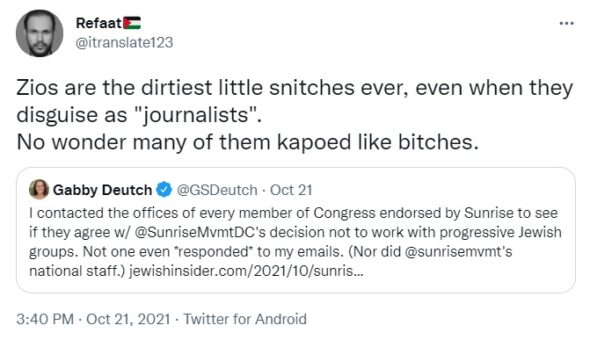
Similarly, Dr. Refaat al-Areer, who was killed in an Israeli airstrike on the Shejaiya refugee camp, is described simply as “a Palestinian writer and professor at the Islamic University of Gaza” (Ibid., p. 365). Fisk does not mention that al-Areer referred to Zionists as “the most despicable filth” and described Zionism as “a disease,” featuring language reminiscent of language used by Nazis to describe Jews.

An example of the kind of dehumanizing rhetoric Bannoura excludes from his discussion of Hamas is the following message directed at Jews that was released by a departing Hamas suicide bomber two weeks after Hamas’ landslide win in the Palestinian parliament in 2006:
My message to the loathed Jews is […] we will chase you everywhere! We are a nation that drinks blood, and we know that there is no blood better than the blood of the Jews. We will not leave you alone until we have quenched our thirst with your blood, and our children’s thirst with your blood (A Lethal Obsession: Anti-Semitism from Antiquity to the Global Jihad, p. 757).
Engaging in Supersessionist Interpretation
The Woolf Institute of Abrahamic Faiths Founder and Executive Director and St. Edmund’s College, Cambridge Fellow Edward Kessler defines “supersessionism” or “replacement theology” as “the traditional Christian teaching that with the coming of Jesus Christ[,] the Church has taken the place of the Jewish people as God’s elect community” (An Introduction to Jewish-Christian Relations, p. 233).
After the Holocaust, several prominent Christian denominations in the Western world distanced themselves from this theology, with many Christians believing it served as “an intellectual accomplice to the Holocaust” (God Draws Near: Rethinking the Biblical Theology of Mission, p. 177).
In more recent years, this reevaluation of Christian teaching has led to the establishment of the Society for Post-Supersessionist Theology that aims “to promote research and discussion that advances post-supersessionist thought.” The reevaluation of supersessionism has also led to the publication of the New Testament After Supersessionism book series published by Cascade Books—the same publisher of Being Christian After the Desolation of Gaza—which aims to reinterpret each book of the New Testament along post-supersessionist lines.
A supersessionist framework holds sway among a number of the book’s contributors. For example, Deik suggests he finds this framework persuasive:
When I was a high school student at the Lutheran school in Bethlehem, I often found myself troubled by the biblical notion of election. I once asked our religious education teacher, “Why did God choose the Jews over everyone else?” His answer was simple yet to my mind persuasive: “God chose a particular tribe to prepare them for the coming of Christ […] [N]ow that Jesus has come, how can God maintain a special relation with a particular tribe, granting them divine rights to a land already inhabited by others, and still be good and just” (Being Christian After the Desolation of Gaza, p. 216)?
Deik suggests here that God only chose the Jewish people to fulfill an instrumental role in preparing for the coming of Jesus.
Whereas Deik questions why anyone “would want to worship a god” (Ibid., p. 221) endorsing the caricature of Zionism he describes, Emory University Candler School of Theology Professor of Systematic Theology R. Kendall Soulen questions how anyone would find attractive a god who only relates to his chosen people in such an instrumental way:
[A] god who uses god’s chosen people in a purely instrumental way is unlikely to prove very attractive to anyone. A constant refrain of the literature of missiology and evangelism is that the mission of God in which Christians participate cannot be adequately conceived in functional, instrumental, and pragmatic terms alone. Effective mission and ministry are relational, not transactional […] It is only if Christians first recognize that Y[-]H[-]W[-]H’s love for Israel is not merely instrumental that they can plausibly maintain that God has assigned her an instrumental role in the blessing of the nations (Irrevocable: The Name of God and the Unity of the Christian Bible, p. 82).
The idea that the Jewish people’s instrumental role for the sake of others in the divine economy exhausts its vocation such that God relates to all nations equally following the coming of Jesus is critically explained by Fuller Theological Seminary Assistant Professor of Bible and Mission Collin Cornell:
Israel, the specific covenant people descended from Abraham, is preliminary to this all-nations goal. Israel is an interlude, temporally. They are a jumping-off point, geographically. They are an instrument, theologically. They are thus made to be superseded, departed from, used. Obsolescence wreathes Israel on every side (God Draws Near, p. 164).
This obsolescence framework for understanding why God chose the Jewish people not only risks endangering the lives of real Jewish people, but also distorts Christian theology and missiology. As Cornell explains:
The idea that the Jewish people are disposable relative to God’s purpose in the world helped make them disposable in real, genocidal human terms. This weighty history is reason enough to interrogate and rework Christian discourse concerning “Israel according to the flesh” (1 Cor. 10:18 NABRE; cf. Rom. 9:3) […] A theology of Israel’s obsolescence is a danger to Jewish communities. It is also a surge of lethal radiation inside of biblical theologies of mission. It undermines Christians’ spiritual security; it foils evangelistic enterprise; it besmirches the character of God. Configuring God’s beloved people as throwaway opens the theological door to all kinds of other throwing away (Ibid., p. 13).
Deik suggests that “Zionist theologians” who affirm that “God can still have a special relationship with a particular nation or race—one that includes giving them land inhabited by other people”—are “racist” (Being Christian After the Desolation of Gaza, p. 216). However, Zionists, including theologians, have long sought to share the land with others as explained previously. In fact, Israelis do share the land with members of other ethnic and religious minorities who are citizens of the Jewish State, including Christians and Muslims.
While Deik dismisses the possibility of God having “a special relationship” with Jews following the coming of Jesus, contemporary Christian theologians and scholars have affirmed that the biblical witness attests to a special relationship between God and Israel while arguing that painting a portrait of God that denies this special relationship distorts the character of God. For example, Soulen affirms that there are multiple biblical passages that attest to God’s special love for Israel, including Deut. 4:37; 1 Kgs. 10:9; Isa. 43:1; and Isa. 49:14-16.
This special love of God for Israel need not imply that other peoples or individuals might not be similarly chosen by God for special purposes of their own. Former Chief Rabbi of the United Hebrew Congregations of the Commonwealth Lord Immanuel Jakobovits argued that others are similarly chosen: “I believe that every people—and indeed, in a more limited way, every individual—is ‘chosen’ or destined for some distinct purpose in advancing the designs of providence.”
Similarly, the University of Haifa philosopher and rabbi Samuel Lebens explains, “God is telling multiple, consistent, and overlapping stories all at once. In some of these stories, one nation is chosen, for it is the story of that nation. In others, another nation is chosen, for it is the story of that nation” (The Principles of Judaism, p. 138).
Fisk misleadingly catalogues similarities he thinks he sees between Zionism and Christian nationalism in the United States:
Christian nationalists in America organize to marginalize religious and non-white ethnic minorities. Zionists in Israel today likewise promote social and cultural hierarchies, and enforce legal separation from Palestinians. In both movements[,] everyone is either insider or intruder, either family or foreigner. The Other is simply “too alien, too wild, too retrograde and unyielding” to be granted equal standing (Being Christian After the Desolation of Gaza, p. 74).
He neglects to mention facts that distinguish Christian nationalism from Zionism. For example, Christians are followers of a universal religion, whereas Jews are a people. Fisk’s comparison mistakenly makes Israel out to be a strange religious state, effectively making the State of Israel “an anomaly in the international democratic order,” rather than a safe haven for a people whose security has been imperiled through centuries of persecution in Christian-ruled countries. Distinguishing between Christian nationalism in the United States and Zionism, Georgetown University School of Foreign Service Professor in the Practice of International Affairs Paul D. Miller explains:
[M]any American Christians feel like a persecuted minority, and use that to argue for Christian nationalism. It’s true that traditional Christianity is often the butt of ridicule, mockery, and ostracism in secular and elite circles, and the demographic decline of Christianity (especially white Protestantism) in America is real. Does that justify Christian nationalism? No, I don’t think so. Cancel culture and ostracism are bad, but they are not the moral equivalent of the Holocaust […] American Christians are not a minority[,] and conservatives are, in fact, winning many important culture war battles, such as those over abortion and religious liberty.
The State of Israel is a pluralistic country comprised of various ethnic and religious minorities who have Israeli citizenship and serve in various sectors of society. Israeli Arabs comprise approximately 20 percent of the state’s population.
In addition, other political analysts attribute support for Israel among American nationalists, including Christians, to somewhat different factors than those Fisk identifies while observing a decline in such support that is anticipated to increase as time elapses given a fundamental incompatibility between such American nationalism and Zionism. For example, Nick Catoggio, a staff writer at The Dispatch, argues:
Trump-era nationalists have remained well-disposed toward Israel and Jews thus far for several reasons. The trauma of 9/11 bound America closer to Israel on “enemy of my enemy” grounds; some Christian voters feel a special duty to help protect the nation of God’s chosen people; antisemitism remains enough of a social taboo (although a weakening one) that nationalists feel obliged to soften their views in public for fear of financial consequences. Even the fact that Donald Trump’s beloved daughter is a convert to Judaism, with Jewish children, might temper certain atavistic populist impulses toward more aggressive scapegoating.
However, Catoggio anticipates that such support for Israel cannot endure in the long-term due to a fundamental incompatibility:
[I]t can’t last. A tribe consumed with purifying the nation by purging alien elements who threaten its dominance will never fully reconcile itself to Jews. Familiar antisemitic critiques will creep in: Jews are too distinct and insular a tribe in their own right to ever assimilate into another. And they’re waaaaay too influential in the nation’s culture and industry given their meager numbers. Why should the dominant tribe tolerate them having such a prominent role in a country that belongs to its rightful rulers? If they’re “real Americans,” why are they so defensive on Israel’s behalf? Why is our government so supportive of that country, anyway? Don’t most American Jews vote Democratic? There was a whiff of the “dual loyalty” smear in [Tucker] Carlson’s and [Candace] Owens’ complaints about people showing more “emotion” over October 7 than over certain American tragedies, like the fentanyl epidemic. But other commentators popular with populists offered more than a whiff.
Catoggio published that analysis a little over a month after October 7, 2023, but his anticipation of a growing divide on the right with such Christian nationalists as Carlson and Owens has increasingly been borne out, with individuals whom Catoggio identified, such as Carlson and Owens, becoming even more vocal in not only expressing hostility to Israel, but also platforming Holocaust revisionists, spreading anti-Jewish conspiracy theories, and propagating anti-Jewish libels.
Fisk neglects to mention that the experience of the Jewish people returning to their ancestral homeland has inspired other communities. For example, University of Haifa Ruderman Program in American Jewish Studies Visiting Professor and Comper Center for the Interdisciplinary Study of Antisemitism and Racism Senior Researcher Sara Yael Hirschhorn notes that the NAACP
adopted a resolution on 26 June 1948 that “the valiant struggle of the people of Israel for independence serves as an inspiration to all persecuted people throughout the world. We hail the establishment of the new State of Israel and welcome it into the family of nations.”
Bannoura invokes Martin Luther King Jr. to explain Palestinian violence, but neglects to mention that Martin Luther King Jr. supported the right of the State of Israel to exist when he stated: “Israel must exist, and has a right to exist, and is one of the great outposts of democracy in the world.” Many others involved in the civil rights movement have also supported Israel. In addition, indigenous communities have expressed admiration for the successful return of the Jewish people to their ancestral homeland, establishment of a Jewish State, and revival of the Hebrew language, which, in turn, has inspired efforts to revive aboriginal Australian languages nearing extinction.
De-Judaizing Jesus
Dartmouth College Eli M. Black Distinguished Professor of Jewish Studies Susannah Heschel discusses how the demonization and dehumanization of Jews in Nazi Germany was accompanied by a phenomenon among Protestant theologians in Nazi Germany involving the transformation of the figure of Jesus from a Jew into an Aryan:
During the Third Reich, a group within the Protestant church, hoping to preserve Protestantism for Nazis, sought to dejudaize Christianity and transform it from a religion focused on a Jewish savior, Jesus, into a religion whose goal was the eradication of everything Jewish. [The German Protestant theologian and professor of New Testament Walter] Grundmann warned that no Nazi could worship a Jewish God, but his answer was not to give up on Christianity, but rather to argue that Jesus was not a Jew, but an anti-Jewish Aryan whose true identity had been concealed by Jews who entered the early church and falsified the Gospels.
The Christian Zionist historian Paul Richard Wilkinson argues a similar phenomenon is occurring among those he identifies as “Christian Palestinianists” whereby the figure of Jesus is being transformed from a Jew who was born and died in Judea into a Palestinian who was born and died in Palestine:
[W]e have here the Christian Palestinianist hermeneutic in a nutshell. In the same way that Grundmann’s [Institute for the Study and Eradication of Jewish Influence on German Church Life] redefined and championed Jesus as “a prefiguration for Nazi Germany’s fight against the Jews,” so today within Christian Palestinianism, Jesus is being hailed as the prefigurement of the Palestinian Arab struggle against the State of Israel […] It is not my intention to directly equate the Institute for the Study and Eradication of Jewish Influence on German Church Life with modern-day Christian Palestinianism, but there are clear parallels (Israel Betrayed: Volume 2: The Rise of Christian Palestinianism, pp. 451-452).
Suzanne Watts Henderson in Chapter 15, “A Tale of Two Trips,” does something similar in ahistorically referring to Jesus as a “Jewish-Palestinian rabbi” (Being Christian After the Desolation of Gaza, p. 286). Boston University Aurelio Professor of Scripture Emerita, Hebrew University of Jerusalem Comparative Religion Professor, and New Testament scholar Paula Fredriksen has pointed out that the identification of Jesus as a “Palestinian” or “Palestinian Jew” (or, in this case, a “Jewish-Palestinian rabbi”) distorts history by suggesting Jesus, who was born and died a Jew in Judea, lived in a territory called “Palestine” a century before the region was designated “Syria-Palestina” by imperial Rome in an effort to “de-Judaize” the region to punish Jews for resistance to Rome during the Bar Kochba Revolt in 132-135 CE.
One can even arguably see this de-Judaizing of Jesus in Henderson’s description of Jesus’ “welcoming lepers” as “br[eaking] established protocols” (Ibid.) followed by Jesus’ fellow Jews. In fact, the actions of Jesus demonstrate his compliance with Jewish law. As McMaster University Religious Studies Associate Professor and New Testament scholar Matthew Thiessen explains:
Like Moses and Elisha, then, the Jesus that the Gospel writers portray is one endowed with great power […] What is not open to debate, though, is the fact that Jesus, as these writers portray him, inhabited and was shaped by a world that was governed by the concerns of Jewish ritual purity. The Gospel writers depict Jesus acting in a way that fits perfectly with the laws of Leviticus 13-14. After cleansing people of their lepra (cf. Lev. 14:2), Jesus commands them to go to the temple to undergo the rituals necessary to remove the ritual impurity that continues to exist after the lepra leaves (Lev. 14:8, 9, 20) (Jesus and the Forces of Death: The Gospels’ Portrayal of Ritual Impurity within First-Century Judaism, p. 68).
By identifying Jesus as a “Jewish-Palestinian rabbi,” Henderson effectively casts Israelis as a contemporary equivalent to imperial Rome acting in opposition to Jesus. She makes this identification of Israelis with imperial Rome explicit in recounting how one of the members of a group of college students on a trip she led in Jerusalem “went on to connect his experience of the Israeli occupation of Palestine today with what he had learned about the Roman occupation of Palestine in Jesus’s day” (Being Christian After the Desolation of Gaza, p. 285).
Henderson goes so far as to suggest comparing the cries of “hosanna” with palm branches greeting Jesus as he entered the city of Jerusalem to the contemporary slogan “free Palestine”: “People suffering under Roman rule hailed this new ‘king’ with palm branches and cries of ‘hosanna’ (literally, ‘save us’), a cry that some today might compare to ‘free Palestine’” (Ibid.)!
Transforming a Jewish cry for salvation anticipating the Jewish acclamation of the Jewish king in an eschatologically restored Jewish homeland into a Palestinian slogan used to call for the ethnic cleansing of Jews from their ancestral homeland and uttered by the murderer Elias Rodriguez as he gunned down innocent Israeli embassy staff members Sarah Milgrim and Yaron Lischinsky outside a Jewish event at a Jewish museum is quite a feat.
Similarly, Bannoura compares the Hamas massacre, rape, and kidnapping of innocent Israeli civilians in aspiring to destroy the Jewish State to Jewish revolts waged to achieve national autonomy from Rome:
It is no surprise then that history is replete with examples of violence by the oppressed. Consider, for instance, the […] various Jewish uprisings[,] like the Bar Kokhba revolt (132-136 CE), the Gallus revolt (351-352), and the Jewish revolt against Heraclius (614-617) that sought to establish Jewish autonomy in Palestine […] How is Hamas different” (Ibid., pp. 134-135)?
While Ruth Padilla DeBorst in Chapter 10, “Doing Justice: The Unequivocal Calling of God’s People,” decries “politics masquerading as theology” (Ibid., p. 209), those casting Israelis as imperial Rome are guilty of doing precisely this. As Fredriksen observes:
Calling Jesus a “Palestinian” or even a “Palestinian Jew” is all about modern politics. Besides being historically false, the claim is inflammatory. For two millennia, Jews have been blamed for Jesus’ execution by the Romans; casting him as a Palestinian just stokes the fires of hate, using Jesus against Jews once again. It is, further, an act of cultural and political appropriation — and a clever rhetorical move. It rips Jesus out of his Jewish context. And it rips 1st-century Jews — and 21st-century Israeli Jews — out of their ancestral homeland, turning them into interlopers. This is polemic masquerading as history.
Brother Gilbert (Athol) Bloomer, who holds a Master of Arts in Theological Studies from Notre Dame University and a Master of Theological Studies from the Australian Catholic University, has similarly observed: “[A]bstracting Jesus from His Jewish covenantal identity and situating Him instead as a transhistorical symbol of resistance […] empties Christology of its incarnational specificity and turns the Son of God into a moral mascot for a political cause.”
Casting Israelis and their Partners as New Testament Villains
The book’s contributors not only compare Israelis to imperial Rome, but also cast Israelis and their partners as New Testament villains. Saint Joseph’s University Institute for Jewish-Catholic Relations Director and Associate Professor of Jewish Studies Adam L. Gregerman and Harvard University Albert A. List Professor of Jewish Studies Jon D. Levenson have observed how contemporary Christians critical of Israel have recycled older anti-Jewish tropes in criticizing the State of Israel. Anti-Jewish tropes of Jews as bloodthirsty, deicidal, hypocritical, legalistic, puritanical, and greedy reemerge, but with Israelis and their allies cast in the villainous roles of the murderous King Herod, hypocritical Pharisees, eliminationist chief priests and Pharisees identified as “children of the devil,” puritanical and legalistic priests and Levites, and corrupt high priests who collaborate with Judas to have Jesus executed.
Israelis as Murderous King Herod
University College London Faculty of Laws Professor Anthony Julius as well as Middle East historian and former Israeli Ambassador to the United States Michael B. Oren have observed that accusations leveled against the State of Israel echo claims made about King Herod’s Massacre of the Innocents to prevent the king of the Jews from being born in Bethlehem.
At the beginning of the book, a poem is presented in which Israel’s matriarch, Rachel, is presented as “weep[ing] over the children of Gaza” as she had wept for “Israel’s exiles” in Jeremiah and “Bethlehem’s innocents” in Matthew, suggesting that the role assigned to the contemporary Jewish State here is that of King Herod (Ibid., XI).
Similarly, Mercy Aiken in Chapter 13, “Living the Future We Hope For: Christians, Jews, and Muslims at the Gaza Border,” relates her “prayer for Palestinian refugees,” which suggests that the New Testament account of Jesus fleeing a murderous King Herod parallels the experience of Palestinians fleeing in the face of alleged Israeli aggression:
We remember those who have been made refugees in the past few months, whose homes have been demolished, who have been evicted, or who are unable to safely return and are internally displaced. Jesus, you were also a refugee. We remember that your family rested in Gaza on the flight to Egypt. In Gaza[,] you also wept and giggled and perhaps took your first steps with death looming over your head (Ibid., pp. 253-254).
Aiken, here, implies that just as a murderous plot by King Herod hovers in the background of the flight of Jesus to Egypt, so, too, contemporary residents in Gaza are fleeing and suffering due to similarly murderous Israeli military activities.
While Aiken alludes to the biblical narrative in suggesting murderous Israelis are causing Gazans to flee, the New Testament narrative about the flight of Jesus from Israel to Egypt with its allusions to Genesis and Exodus arguably suggests a prophetic vision of the people of Israel in their land relating to the Gentile world through the land of Israel. As University of Bristol Associate Professor Isaac Vikram Chenchiah, who holds an MA in systematic and philosophical theology, argues, the flight of Jesus to Egypt represents a “recapitulation” of “what could have been” with the exodus of the children of Israel from Egypt (Contemporary Catholic Approaches to the People, Land, and State of Israel, p. 67). Informed by Rabbi David Fohrman’s analysis of Genesis and Exodus texts, Chenchiah argues that Israel was supposed to be “accompanied by Egypt, which was then the great power of that region,” thereby “obviat[ing] any need for a conquest of Canaan.” In the ideal scenario, “the Israelites would have reached a negotiated settlement, perhaps a three-way settlement also involving Egypt, that would have allowed them to claim the promised land without bloodshed.” Since “the Israelites […] lack[ed] Egyptian backing, [they] could neither persuade the Canaanites to negotiate with them nor offer them anything in exchange for the land” (Ibid., p. 71).
In this reading, Pharaoh’s refusal to assent to Moses’ plea for the people of Israel to go and worship God and thereafter enter the land of Canaan constituted a “rejecti[on] [of] the word of God” (Ibid., p. 72). Chenchiah believes that this reading of the biblical narrative aligns with rabbinic texts describing God’s presentation of the Torah to the nations, represented by Egypt as “the paradigmatic Gentile nation” (Ibid., p. 73). According to Chenchiah, this reading suggests “that the divine purpose includes the Chosen People relating, through their land, qua people, to other peoples. Thus, the gift of land, far from isolating Am Yisrael from other peoples, is a gift of a medium of relationality to other peoples” (Ibid., p. 74).
Israelis and Christian Zionists as Eliminationist Pharisees and Chief Priests
The Israeli journalist Yossi Klein Halevi has described how anti-Jewish understandings of Pharisees as hypocrites and Judas as a betrayer of Jesus inform hostile attitudes toward the Jewish State today, specifically referencing this trope in connection with the false charge that the State of Israel is committing genocide against the Palestinians.
Contributors to the book explicitly compare Israelis and their Christian Zionist allies to chief priests and Pharisees. For example, Crump compares Israelis and their Christian Zionist allies supporting Israel’s actions in Gaza to the “chief priests and Pharisees” who sought to have Jesus killed:
Jesus reminds us that sometimes[,] our opposition will come from within the family of faith, even from those who appear especially devout. Jesus remained undeterred by the fact that his opponents were keeping score, knowing he would pay a price for his words of judgment when the chief priests and Pharisees determined that he must be eliminated […] Christian discipleship requires us to overcome whatever obstacles are keeping us silent. If that silence is due to the moral anesthesia of Christian Zionism, we must wake up and speak out in defense of those under attack […] In the midst of Israel’s war on the people of Gaza, Christians cannot remain silent (Being Christian After the Desolation of Gaza, p. 112).
Crump approvingly references Jesus’ identification of “hostile religious authorities” as “children of the devil” in connection with the chief priests and Pharisees (Ibid.) who Crump compares to Israelis and Christian Zionists. Given how the identification of Jews as “children of the devil” has been used historically to “justify Church hostility to Jews,” Crump’s decision to reference “children of the devil” in connection with Israelis and Christian Zionists displays if not outright malice then profound ignorance of, insensitivity to, or indifference about how this “children of the devil” identification has been weaponized historically against Jews.
Benjamin Norquist in Chapter 14, “Passing By on the Other Side: Christianity Today Since October 7,” compares Israelis to Pharisees seeking to execute an adulterous woman to suggest that Christians today should adopt a more critical attitude toward Israeli justifications of self-defense in Gaza:
Some of Jesus’ harshest rebukes targeted those who thought they had cornered the market on moral clarity, like some among the Pharisees whom Jesus called hypocrites and blind guides. Confronted by a crowd of people ready to stone a woman for adultery, Jesus wrote in the dirt with his finger and said, “Let any one of you who is without sin be the first to throw a stone at her” (John 8:7 NRSV). Would-be executioners—ready to engage in “justified” violence—dropped their stones and drifted away. Clarity turned to complexity. Or perhaps to a deeper moral clarity, precisely what CT could—and should—be inviting its readers to enter into (Ibid., pp. 268-269).
Contrary to Norquist’s contention that the Pharisees in this episode were “ready to stone a woman for adultery,” Levine has pointed out that “no one is carrying stones” (Jesus for Everyone, p. 243) in the story and “the woman’s accusers are not about to stone her” (The Pharisees, p. 419) in the Gospel account. In fact, these “Pharisees are seeking to prod Jesus into saying something silly, unfortunate, or illegal” (Jesus for Everyone, p. 245), not to execute the woman. In addition to inaccurately recounting this New Testament account, Norquist’s comparison effectively portrays Christian Zionists as enablers of cruel, legalistic, trigger-happy Israeli executioners lacking in mercy and thoughtfulness.
Christian Zionists as Puritanical and Legalistic Priests and Levites
Norquist also casts Christian Zionists as priests and Levites who are more concerned about maintaining their own purity than saving human life:
Others were “clear” that guarding ritual purity might preclude caring for others […] Luke’s gospel tells us that Jesus, when asked who is my neighbor? (i.e., who am I obliged to love?), told a story. A man is robbed and left for dead in the ditch. Two people with moral clarity and authority (a priest and a Levite) walk on past without lending aid. Only a despised Samaritan stops to care for the victim. In our day, the ditch is filled with Gaza’s civilians, wounded, homeless, starving, and we are passing by on the other side of the road, whispering about just war or self-defense or Hamas terror or biblical covenants, while sending Israel weapons to bomb children in Gaza. Alas, CT has been helping us justify our decision to pass Palestinian victims by (Being Christian After the Desolation of Gaza, pp. 268-269).
Aside from neglecting to mention that the Israeli government has regularly facilitated the distribution of humanitarian aid in the Gaza Strip, Norquist asserts that “Jews and Samaritans hated one another” (Ibid., p. 268), inaccurately framing Jews as a foil to Jesus. Levine suggests that the New Testament attests to the fact that not all Jews other than Jesus hated Samaritans. For example, a parable in Luke 10 features a Samaritan who “found himself on the Jerusalem-to-Jericho road” and “was able to find an open inn in the Judean city of Jericho.” The fact that the parable envisions Samaritans “travel[ing] to Judea” and being shown hospitality by Jews there indicates that the New Testament does not regard all Jews other than Jesus as hating Samaritans (Jesus for Everyone, p. 163).
Norquist’s suggestion that the priest and Levite in the so-called parable of the Good Samaritan are placing concerns about ritual purity above care for others misrepresents the parable. As Levine explains:
There is nothing impure about touching a person who is “half-dead.” Nor is there any sin involved in burying a corpse; to the contrary, the Torah expects corpses to be interred […] To follow Torah, the priest should have checked to see if the man was alive and, finding him alive, should have helped him. Should he have discovered a corpse, he should have covered it and then immediately gone for help […] Samaritans were also bound by laws concerning corpse contamination; just as the Samaritan found the question irrelevant, so should we in our attempt to understand the parable. Even the parable itself undercuts the possibility that the motive of priest and Levite stems from purity regulations. Had the priest been going up to Jerusalem […], where he would be engaged in Temple activities, he may well have been concerned about purity. However, the parable obviates that explanation immediately; it tells us that the priest is going “down” from Jerusalem. Thus, he need not be in a ritually pure state […] When Luke wants to make a point about purity, Luke mentions Pharisees and scribes. None appears in our parable (Short Stories by Jesus: The Enigmatic Parables of a Controversial Rabbi, pp. 92-94).
Norquist, thus, misrepresents not only the reality on the ground in the Gaza Strip today, but also how Jewish ritual purity regulations were understood in antiquity.
Israelis as Corrupt High Priests and Palestinian Partners as Judas Iscariot
In his book, A Hitchhiker’s Guide to Jesus, Fisk compares Palestinians who provide Israel with information to prevent terrorist attacks to Judas Iscariot, the disciple of Jesus who betrayed Jesus by handing him over to the authorities. Fisk states: “Judas Iscariot is the poster boy for collaborators,” indicating he feels sorry for such “collaborators,” as they cannot return after they have passed along such information. He states: “The high priests of espionage never take back the shekels” (A Hitchhiker’s Guide to Jesus, p. 220). As former CAMERA Christian Media Analyst Dexter Van Zile has explained, “Fisk portrays the Palestinian cause in the same vein as the work of Jesus Christ, and Israeli self-defense against terror attacks with Christ’s murder.”
The aforementioned comparisons of Israelis and their friends to New Testament foes of Jesus not only misrepresent ancient and modern realities, but also simplistically reduce Israelis and their allies to cartoonish depictions that demonize the Jewish State and its partners. This demonization of the State of Israel and its allies risks imperiling the lives of those being caricatured. In this respect, such contributors would do well to heed the words of the ancient Judaism and rabbinics scholar Yehuda Kurtzer:
I identify neither with the imagined Jew of the evangelical prosperity gospel […] nor as the moneychanger object of Jesus’ scorn in the Temple, as many progressives seem to want to see Zionists […] Christians bear the responsibility to exhibit the humility of not casting as protagonists and antagonists the real human beings between the river and the sea.
While the book’s contributors claim to want a peaceful resolution to the Israeli-Palestinian conflict, it is unclear how demonizing Israelis, their Palestinian partners, and Christian Zionists contributes to peace.
Misrepresenting Christian Zionists
Christian Zionists as Blocking the Spread of the Gospel
Deik claims that some of Jesus’ earliest followers—his Jewish ones—subscribed to an incipient form of something like Christian Zionism. According to Deik, discarding this mistaken theology enabled the spread of the gospel message. By identifying the renunciation of this “Christian Zionist” theology as a prerequisite for the spread of the gospel message, Deik suggests that those followers of Jesus who fail to renounce this belief system are impeding the propagation of the Apostolic Message. As Deik relates:
The earliest Christians grappled with something comparable to Christian Zionist theology. Jesus’s Jewish followers faced the strong nationalist theology of Second Temple Judaism. Like other Jewish sects at the time (cf. Matt[.] 3:7-9), they regarded themselves as special because of their ethnicity. They did not fully understand at first that the gospel included gentiles […] Before Peter could start declaring the good news about Jesus to Cornelius and his household, he had something to confess: “I truly understand that God shows no partiality, but in every nation anyone who fears him and does justice [dikaiosynē] is acceptable to him” (Acts 10:34-35, translation mine) (Being Christian After the Desolation of Gaza, p. 227).
Deik proceeds to explain:
This theological statement is not new; Deuteronomy clearly taught that God is not partial (Deut[.] 10:17). Peter’s assertion, therefore, is a type of theological repentance—a return to the right conception of God and God’s justice: God is not tribal, God does not show favoritism, and anyone who does justice is acceptable to him. This kind of repentance is a prerequisite to proclaiming God’s love to the world (Being Christian After the Desolation of Gaza, p. 227).
Deik neglects to mention that only four verses after the Acts episode he describes, Peter in a speech to Cornelius identifies the land as “the region of the Jews and Jerusalem” (Acts 10:39). Indeed, the author of Acts regards the ancestral homeland of the Jewish people as continuing to play an important role following the resurrection of Jesus. The following are only some examples of the land’s continuing importance identified by The King’s University Theological Studies Department Chair, Master of Theological Studies Program Director, and Biblical Studies Assistant Professor Jason F. Moraff:
Acts, through the Way and Paul, retains the links to the ancestral Jewish homeland of Judea and mother-city of Jerusalem (8:1; 22:3). Stephen reminds his accusers of God’s promise of land to Abraham and his descendants (7:3-7, 45) […] The apostles maintain a connection with Jerusalem (8:1). Its community and leaders become chief among the Way, most clearly evinced in the Jerusalem Council (15:2, 13; 21:17-26). Paul, though from Tarsus, was raised in Jerusalem (22:3), a point he uses to build credibility before his accusers. By introducing this detail, Paul can better refute claims that he teaches against the city and its temple (21:27-36). Luke affirms the Way’s and Paul’s continued connections to the Jewish civilization’s homeland and central city (Reading the Way, Paul, and “The Jews” in Acts within Judaism: “Among My Own Nation” (The Library of New Testament Studies), p. 42).
In addition, Deik’s assertion that Peter is simply acknowledging a truth that had previously been disclosed in the Torah fails to adequately explain the surprise with which Peter greets this new development of Gentile inclusion within the Jesus movement and how what is taking place in his own time differs in significant respects from how the Hebrew Bible represents how Jews and Gentiles relate to one another. As Cornell notes:
This is a different form of inclusion than we find in the Old Testament. Ruth the Moabite, for instance, literally and physically joined the family of Judah; Rahab, similarly, married into the lineage of Abraham (Matt. 1:5). They and other gentiles came not only to worship Israel’s God but to participate wholly in the people of Israel with all that entailed—namely, leaving behind their own gods but also their own families, lands, and languages. In the New Testament, however, gentiles are called into a new and anomalous identity: we become worshipers of Israel’s God and we renounce the gods of our own nations. We become readers of Israel’s scriptures. But we do not thereby become Israel; we remain non-Jews (God Draws Near, p. 177).
While Deik suggests the spreading of the gospel message is predicated on denying God’s special relationship to the Jewish people, the biblical text highlights Cornelius’ special devotion to the Jewish people as a normative expectation of Gentiles wishing to draw near to Israel’s God. As Near Eastern Studies scholar Mark S. Kinzer observes:
[T]he evidence suggests that he [Luke] also expected Gentile Yeshua-believers to maintain a special love for the people of Israel […] It is clear that “the people” to whom Cornelius gives alms are the Jewish people. This Gentile fears the God of Israel, observes the times of prayer customary among devout Jews, and provides financial assistance to needy Jews. Like his comrade in Capernaum, he demonstrates his worth in part through his evident concern for the welfare of the Jewish people (Postmissionary Messianic Judaism: Redefining Christian Engagement with the Jewish People, pp. 114-115).
Deik incorrectly suggests that Christian Zionism hampers Christian mission and distorts the character of God, but Deik’s supersessionist understanding of the Jewish people arguably imperils the integrity of Christian mission and renders the basis of the Christian doctrine of the Incarnation incoherent. Cornell explains how a supersessionist understanding of Israel that renders the Jewish people obsolete distorts Christian mission:
The cross-purposes are stark: on this reparative reading of Israel’s vocation, God set a task for God’s beloved people, but God then moved on in some way from them once they had completed (or failed) the task. Perhaps God tried over, restarting the mission with the sending of the Son. Perhaps, having succeeded in their appointment, Israel lingers on. But regardless, Israel’s uncertain and obsolete status looms. It hangs over God’s mission story. It suffuses it with anxiety. If this is how God treats Israel, the premier covenant partner in the Old Testament, on what grounds does anyone expect better from God now” (God Draws Near, p. 12)?
Cornell also contends that this understanding of Israel risks making the basis of the Christian doctrine of the Incarnation incoherent:
A mission of repair always already holds its terminus inside of it, and this is no less true for the mission of the Son. If his drawing near to us in Incarnation answers exclusively to the divine goal of restoring creation, then this is an achievable goal, and one we trust that Christ will[,] in fact[,] achieve. In that happy event, Christ will thereby exhaust the rationale for his becoming flesh. It may be that Christ remains incarnate, but the basis of his Incarnation will no longer obtain. Conceptually, if not actually, the Incarnation will then be stranded: a vocation fulfilled and, in lieu of some other, further, fuller theological basis, adrift. The analogy with Israel tracks closely. It is a public fact that the Jewish people still exist, but for much Christian theology, including many biblical theologies of mission, their continuing existence is a theological surd, a holdover without explanation. So also with postredemption Incarnation (Ibid., p. 14).
Subscribing to a view of the Jewish people that renders them obsolete or vocationally adrift, thus, has a cascading negative effect, imperiling the integrity of foundational Christian beliefs.
Christian Zionists as Rebuilders of “Dividing Walls of Hostility”
Crump claims that although the New Testament book of Ephesians describes Jesus as having “destroyed the barrier, the dividing wall of hostility” (2:14-16) between Jews and Gentiles, Jewish Christian Zionists and Messianic Jewish Zionists are re-erecting walls by retaining their Zionist commitments and making their fellowship with Palestinian Christians conditional on Palestinian acceptance of Zionist claims. As Crump states:
The problem, as it was described to me, was that the Jewish church in Israel has expanded its circle of doctrinal essentials well beyond the historic Christian faith as represented by the Nicene Creed, with its focus on Jesus Christ and his redemptive work. This wider theological circle now includes political Zionist elements, especially the right of Jews as God’s chosen people to all the land of Israel. As Salim Munayer, founder of Musalaha, a Palestinian reconciliation organization, explained to me, “They [Jewish Christians] are highly nationalistic and promote Jewish supremacy. We [Palestinian Christians] are told that we must accept their end times theology about the Jewish claim to the land before we can have real fellowship.” Christ may have taken down first-century religious barriers separating Jews from gentiles, but Israeli Jewish Christians have erected their own ethnic, nationalistic, territorial “walls of hostility” (Being Christian After the Desolation of Gaza, p. 294).
In this passage, Crump misconstrues Zionism, falsely identifying “the right of Jews as God’s chosen people to all the land of Israel” as “political Zionist elements.” Similarly, Bannoura describes Israel as “adher[ing] to a religious definition of statehood” (Ibid., p. 122). In fact, while the unconditional promise of the land to Abraham’s descendants in Genesis suggests that Jews have continuously held title to the land even while not in residence there and would at some point be restored to the territory, political Zionism as a movement was mostly secular from its inception while the State of Israel is also secular. Some settlers believe they should be able to settle anywhere in Judea and Samaria where biblical events are believed to have taken place, but many Israelis choose to live in the West Bank not for theological reasons, but because housing there is more affordable. The doctrine of divine election has traditionally been interpreted by Jews not as indicating Jewish racial superiority, but rather as suggesting a special sense of obligation and responsibility incumbent on Jews whose covenantal faithfulness is enacted through Torah obedience.
Crump refers to “Judea and Samaria” as “the Israeli terms of reference for the occupied West Bank,” neglecting to mention that the New Testament calls the territory “Judea and Samaria” (e.g., Acts 1:8) centuries before the area was labeled the “West Bank.” Oddly, Crump insinuates that worshippers reciting a verse from the biblical book of Isaiah describing God “mak[ing] Jerusalem a praise in the earth” uncomfortably approximates idolatry: “Worshiping Jesus had morphed into the adoration of an idealized Jerusalem. Over and over, we were led to ask God (again, in English) to make Israel and Jerusalem ‘a praise in the earth’” (Being Christian After the Desolation of Gaza, p. 292). Christians reciting a biblical text during prayer—how scandalous!
When Crump encounters a Palestinian pastor at a Messianic Jewish service in Jerusalem who points out the terrorist threat emanating from Gaza and defends the humanity of Israeli soldiers and their protocol of responding in self-defense, Crump, rather than accepting at face value that these are the pastor’s genuinely held beliefs at odds with Crump’s preferred anti-Israel narrative, dismisses the pastor as a Palestinian who has been colonized by his Zionist colonizer: “I had never met anyone who had so completely assimilated to his colonizer’s perspective on the colonized […] Over decades, Pastor Sayid’s mind had become as colonized as was his homeland” (Ibid., p. 299).
This perspective on Palestinian Christians who do not express a univocally hostile attitude toward Israelis or Zionism is echoed by other contributors to the volume who cannot seem to fathom Palestinian Christians reaching such conclusions absent some nefarious Israeli influence or intimidation. For example, Deik implies as much in suggesting that those who would deny negative charges against the State of Israel can only do so “by ignoring and discrediting […] the testimony of Palestinian Christians” (Ibid., p. 194). Similarly, Norquist laments “minimiz[ation] [of] the lived experiences of displaced Palestinians and those suffering under the systemic, hidden brutality of the occupation” (Ibid., p. 266).
These descriptions of Palestinians erase Palestinian frustrations with Palestinian leadership and Palestinian Christian voices that have expressed concerns about living under Palestinian rule in the West Bank. For example, the historian of religion Paul Charles Merkley notes:
After the Palestinian Christians came under the regime of the PA (following implementation of the Oslo Accords), […] Arab Christians will speak [to reporters] only anonymously, out of fear of retribution. Christian Arabs told Israeli journalist Judith Sudilovksy that […] they were experiencing ever mounting distrust: “In a society that is becoming more Islamic […] many Christians feel like outsiders. They are more likely to identify with Europe and the West—and in some ways even with the liberal community in Israel … [They say:] ‘To the Israelis[,] we are Palestinians and to the Palestinians[,] we are Christians, Crusaders’” (Christian Attitudes towards the State of Israel, pp. 83-84).
The above passage is quoted in a book published in 2001, but more recent data from 2020 suggest that similar sentiments prevail among a sizable percentage of the Palestinian population. For example, a public opinion poll conducted by the Palestinian Center for Policy and Survey Research and The Philos Project found that Christians sought to emigrate at a significantly higher rate than Palestinian Muslims. In addition, the poll found that a significant percentage of Palestinian Christians held that “most Muslims do not wish to see them in the country;” a fifth to a quarter of Palestinian Christians indicated they “feel discrimination when searching for jobs or when seeking PA [(Palestinian Authority)] services;” while three out of ten Palestinian Christians said they “do not see themselves integrated or feel hated by the Muslim citizens.”
While Crump shares his perceptions of Zionists as hate-filled oppressors of non-Jews while effectively expecting Jewish Christians and Messianic Jews to disclaim their belief in the right of the Jewish people to national self-determination in their ancestral homeland, nowhere does he express any expectation that Palestinians similarly refrain from their desire for national self-determination or refrain from demonizing Jews in their educational materials and media. Many examples of such demonization of Jews have been documented by Palestinian Media Watch (PMW).
Crump indicts Jewish Christian Zionists for erecting a barrier comparable to that which Jesus in Ephesians 2:14-16 is described as having destroyed. Ironically, Ephesians endorses the continuing value of Jewish distinctives that Crump would have Jewish Christians renounce. For example, Ephesians honors Jewish distinctives in stating:
Remember, then, that in the past [and] in the realm of flesh you, the Gentiles—called the Uncircumcision by those who call themselves The Circumcision, that handmade operation in the realm of the flesh…[Remember] that at that time[,] you were apart from the Messiah, excluded from the citizenship of Israel, strangers to the covenants based upon promise. In this world[,] you were bare of hope and without God (Ephesians 2:11-12).
Franz Mussner argues that formulating these propositions positively toward Israel would read: “Israel possesses the hope of the Messiah. Israel forms a ‘commonwealth’ (politeia): the qehal Y[-]H[-]W[-]H. To Israel belong the covenants of the promise. Israel possesses thereby hope. Israel lives in community with God and in the knowledge of God in the world” (Tractate on the Jews, p. 25). This formulation echoes the language used by Paul in Romans to describe Israel’s privileges, including implied reference to land given to Israel by God:
The people of Israel. Theirs is the adoption to sonship; theirs the divine glory, the covenants, the receiving of the law, the temple worship, and the promises. Theirs are the patriarchs, and from them is traced the ancestry of the Messiah, who is God over all, forever praised! Amen (Romans 9:4-5).
Given that Paul regards these privileges as still belonging to the Jewish people, these gifts cannot be distinctives eliminated when Jesus destroyed the “wall of hostility” between Jews and Gentiles. If anything, it is Paul’s Gentile interlocutors whom Paul urges not to be arrogant toward the Jewish people. Blaming ecclesial disunity on Jewish followers of Jesus just for being who they are and insisting they renounce what Paul elsewhere calls “[irrevocable] gifts” from God to the Jewish people demonstrate the kind of arrogance Paul decries.
In fact, contrary to how Crump weaponizes the language of Ephesians to insist that Jewish Christians and Messianic Jews renounce their Jewish national commitments, The King’s University Assistant Professor of Biblical Studies Andrew Remington Rillera observes how Ephesians does not entail renouncing Jewishness, but rather cautions Gentiles against colonizing Jewishness:
The text centers not on dismantling Jewishness, but on reimagining the sociopolitical relationship between Israel and the nations, particularly by asserting that Jesus’ death has brought about a change in citizenship for gentiles qua gentile vis-à-vis Israel (Eph. 2:13, 19). The text says that those who were far (the nations) were brought near (2:13), not that those who were near (Jews) abandoned their necessarily hostility-ridden torah observance […] For baptized gentiles to colonize the circumcision by pressuring baptized Jews into abandoning Jewishness would be to paradoxically erect a new border of hostility by choosing to remain estranged and hostile to Jewish practices (“Tertium Genus or Dyadic Unity? Investigating Sociopolitical Salvation in Ephesians,” pp. 42-43, 45).
Crump’s identification of Messianic Jews as “colonizing Zionist[s]” (Being Christian After the Desolation of Gaza, p. 293) inaccurately, reductively, and imperiously imposes on them a caricatured identity with which most do not identify. Far from following an imperialistic or colonizing approach and more representative of Messianic Jewish sentiments relating to Israel is the following passage authored by Messianic Jewish leaders Russell L. Resnik and Mark S. Kinzer:
Instead of unquestioning support for everything the Israeli government does, our attitude should be one of solidarity with the people who elected the particular government in power and whose continued assent provides it with legitimacy. A disciple of the Jewish Messiah cannot retreat to a neutral posture in thinking about Middle-East politics, standing at an equal distance from all parties and giving the benefit of the doubt to none. Instead, we stand in solidarity with the people of Israel, even if we must at times disagree with specific Israeli policies (Besorah: The Resurrection of Jerusalem and the Healing of a Fractured Gospel, p. 146).
The inaccurate identification Crump makes also fails to reflect the complex ways in which Messianic Jews in Israel negotiate their identity with a Jewish State and wider Jewish community with which they have disagreed. In addition, this label obscures how Messianic Jews have at times creatively diverged from “hegemonic” evangelical expressions of faith in Jesus. Thus, a prominent scholar on the subject of Messianic Jews, The University of North Carolina at Chapel Hill Professor of Religious Studies Yaakov Ariel, has noted that while the Messianic movement emerged out of “energetic evangelical engagement with the Jews,” many of its members are “bringing together rites, customs, and ideas from different traditions” while “challeng[ing] long-standing definitions of Judaism and Christianity as well as the conventional wisdom on the relationship between the two religious traditions” (An Unusual Relationship: Evangelical Christians and Jews, p. 236).
The application of the term “colonizing Zionist[s]” to Messianic Jews also obscures the significant percentage of individuals in that community who joined Messianic congregations in Israel after being under the shadow of Soviet Communist imperialism and experiencing Ethiopian persecution. As Ariel has noted:
[T]housands [of Jewish converts to evangelical Christianity] arrived from the former Soviet Union and Ethiopia. Jews (and their non-Jewish spouses) who had converted to Christianity in the former Soviet Union or in Ethiopia often joined Messianic congregations in Israel (Ibid.).
Although Crump wrongly condemns Messianic Jews for being “colonizing Zionist[s],” he arguably adopts an imperialistic approach to Jewish followers of Jesus by insisting they deny their national ties and expressions of solidarity with Israel. Like the formal insistence of the Christian church after it assumed political power and cultural dominance in society that Jews wishing to join the church must renounce Jewish customs and observances, Crump effectively insists that Jewish Christians and Messianic Jews wishing to fellowship with Palestinians must renounce their Zionist commitments. In asserting their identification with the people and State of Israel, such Messianic Jews can be said to be resisting Crump’s effectively imperial demand that they dissolve their national bonds.
Christian Zionists as Sanctioning Jewish Acquisition of Territory by Any Means
Fisk discusses the Christian Zionist focus on land as if remarking on some strange curiosity: “Common to all streams of Christian Zionism, important to note, is a preoccupation with real estate, an eagerness ‘to promote or preserve Jewish control over the geographic area now comprising Israel and Palestine’” (Being Christian After the Desolation of Gaza, p. 76). Fisk singles out Christian Zionists here as especially focused on the land and support for Jewish sovereignty over the land, but this focus is explicable in light of the Bible’s focus on land. As Anglican theologian and Reformed Episcopal Seminary and Jerusalem Seminary Distinguished Professor of Anglican Studies Gerald R. McDermott observes:
[T]here is a great deal of concern for the land in these forty-odd books […] But few realize how central the land is to these Scriptures. As Gerhard von Rad put it, “Of all the promises made to the patriarchs[,] it was that of the land that was the most prominent and decisive.” By one scholar’s count, land is the fourth most frequent noun or substantive in the Tanak. He notes that it is more dominant statistically than the idea of covenant. By my counting, more than one thousand times in the Tanak[,] the land (eretz) of Israel is either stated or implied. Of the 250 times that covenant (b’rit) is mentioned, in 70 percent of those instances (177 times)[,] covenant is either directly or indirectly connected to the land of Israel. Of the 74 times that b’rit appears in the Torah, 73 percent of those times (54) include the gift of the land, either explicitly or implicitly. In other words, when the biblical God calls out a people for himself, he does so in an earthly way, by making the gift of a particular land an integral aspect of that calling (The New Christian Zionism: Fresh Perspectives on Israel & the Land, pp. 48-49).
Go figure that Christians who study the Bible and take it seriously would find one of its central subjects to be of interest. It bears noting that Fisk does not remark upon any comparable Palestinian preoccupation with land.
Crump falsely charges that Christian Zionists endorse Jews acquiring all of the land allocated to them by God by any means necessary:
Christian Zionism maintains that all land between the Jordan River and the Mediterranean Sea belongs to the Jewish people by divine promise. As a result of God’s territorial commitment to the descendants of Abraham, Jews are free to take whatever measures they deem necessary to acquire territory in the Holy Land and displace non-Jews living there (Being Christian After the Desolation of Gaza, p. 108).
The suggestion that Christian Zionist preoccupation with Jewish control over territory in the Holy Land predominates over any other concerns misrepresents all Christian Zionists who hold that God promised the land to Abraham and care about Israel’s security as opposed to political pragmatism or territorial compromise. As Stony Brook University Professor Stephen Spector observes:
The claim that all Christian Zionists adamantly demand that Israel keep every inch of its biblical territory is vastly overstated […] Many born-again Christians have only a very vague notion of Israel’s role in the final days, and even among evangelical elites, there is remarkable diversity and nuance in their beliefs. That, in turn, allows flexibility about the principle of land-for-peace. Indeed, though it flies in the face of the common stereotype, 52% of evangelical leaders are in favor of a Palestinian state on land that God promised to Abraham, as long as it doesn’t threaten Israel! That may surprise people who fear born-again Christians’ obduracy on the question of covenant land. But the explanation, says the University of Akron’s John Green, is simple: They want to see peace in the Middle East (Evangelicals and Israel: The Story of American Christian Zionism, pp. 161-162).
Spector recounts how prominent Christian Zionists have expressed flexibility on Israeli territorial compromise with Palestinians while suggesting that many other evangelicals share this view:
A high White House official asked the Southern Baptist Convention’s Richard Land, for example, how Southern Baptist voters would react if the United States supported Israel’s disengagement from Gaza. Land replied that if the democratically elected government of Israel decides of its own volition to give back territory for peace, most evangelicals will respect that. This political assessment is consistent with Land’s own eschatology, which holds that Israel won’t have possession of all of the covenant land until the second advent of Christ (Ibid., p. 162).
While Crump falsely suggests that all Christian Zionists support acquiring territory in the Holy Land by any means, it is worth noting that organizations associated with “pro-Palestinian” protesters have adopted that kind of language in support of their cause. For example, the American Jewish Committee has noted that “[p]rotesters affiliated with Within Our Lifetime – United for Palestine (WOL)” have “openly support[ed] Palestinian resistance ‘in all its forms. By any means necessary. With no exceptions.’” Similarly, CAMERA has documented a BDS & Palestine Solidarity Working Group Palestine Organizing Toolkit indicating, “You don’t get freedom peacefully. liberating colonized land is a real process that requires confrontation by any means necessary.”
Christian Zionists as Heretics
The volume’s contributors suggest that Christians who express support for the restoration of Jews to their ancestral homeland and the preservation of the Jewish people with sovereignty in that land are committing heresy. For example, Deik states, “Heresies are measured by the distance between our theological center and Jesus. Genuine gospel proclamation does not replace Jesus with a settler-colonial project; Jesus is not in competition with Theodor Herzl” (Being Christian After the Desolation of Gaza, p. 198). CAMERA’s Partnership of Christians and Jews Director Rev. Dr. Tricia Miller has contested the charge that Christian Zionism is heresy. Christian Zionists do not perceive a “competition” between faithfulness to Jesus on the one hand and their Zionist commitments on the other.
Christian Antizionist Heretical Elements?
Whether Christian antizionists are guilty of incorporating elements of heresies into their own theological frameworks is another matter.
Gnosticism and Docetism
The identification of Christians who believe in a territorially restored Israel as heretics not only disregards those in the early church holding similar beliefs, but also arguably significantly compromises Christian faith and identity by incorporating heretical gnostic and docetic elements into a theological framework. As Fuller Theological Seminary Theology Professor and Loyola Marymount University Theological Studies Professor Nicholas R. Brown suggestively asks:
[S]uppose one is persuaded that a de-territorialization of Jesus and the kingdom is not just the regrettable and errant by-product of a flawed form of Christian exegesis, but is instead isomorphic to the tradition itself such that it is impossible to construct a landed interpretation of Jesus and the kingdom without also seriously compromising and damaging the integrity of one’s Christian faith and identity in the process. How does one square that interpretation with the fact that several patristic theologians were vigilantly protective of the chiliastic belief that Jesus would restore a landed kingdom to Israel at the parousia? Furthermore[,] how is such an a-territorial reading of Jesus consistent with Christianity’s sacramental vision that it is not only “theologically necessary to view created things as real promises as well.” And finally, does not countenance of such a supposition lay the foundations for a Gnostic form of Christianity in general and a docetized interpretation of Jesus in particular since both denude us of the very theological and ethical resources necessary to inform a discussion of territorial governance (For the Nation: Jesus, the Restoration of Israel and Articulating a Christian Ethic of Territorial Governance, p. 13)?
Wagner suggests that the territorial promise to Abraham and his descendants is universalized in Paul’s conception of the kingdom of God: “[T]hat is to say, ‘for Paul, the ‘inheritance’ of God’s people was the this-worldly renewal of all things, sometimes expressed as ‘the kingdom of God’ (1 Cor[.] 15:24)’” (Being Christian After the Desolation of Gaza, p. 331).
This claim overlooks a fact pointed out by McDermott: namely, Paul in Acts—after the resurrection of Jesus—while preaching to a synagogue audience in Antioch of Pisidia identifies as an “inheritance” the land God gave to the people of Israel: “[A]fter destroying seven nations in the land of Canaan, God gave this people Israel their land as an inheritance” (Acts 13:16b-17, 19).
By effectively detaching the particular significance of the land of Israel from Paul’s vision of the kingdom of God, Wagner arguably opens himself up to the charge of subscribing to a docetic conception of the kingdom of God that divests the kingdom of God of important territorial features. As Brown explains:
[N]ot only is it impossible to think about a Christian ethic of territorial governance apart from this contentious theo-political context [of the Israeli-Palestinian conflict], but so too is it theologically and ethically irresponsible. For to assert that Jesus does proclaim and embody an ethic of territorial governance within the kingdom, but then abscond when it comes to thinking about how such an ethic would apply both to current territorial conflicts and territorial governance for fear of getting ensnarled in the to and fro of protracted arguments is to commit an iteration of the heresy of docetism and to ask, as [John Howard] Yoder rightfully does, if Jesus is not the norm for Christian ethics[,] then what other norm is there? And yet […] the problem with Yoder’s argument vis-à-vis Jesus and Israel’s land is not that he takes Jesus’ kingdom proclamation seriously enough, but rather that he thinks that it ultimately detaches the kingdom from Israel’s land” (For the Nation, pp. 191-192).
The identification of what Jesus and Paul say about the kingdom of God as sources of proper living for Christians is justified, but eliminating the central role of Israel’s land from these visions effectively paints a docetic portrait of the kingdom of God.
Marcionism
Marcion maintained that the God who gave the people of Israel the law was a different God than the one who gave the gospel. Jeffrey S. Siker summarizes Marcion’s primary teachings as follows:
Marcion was convinced that the good and loving God revealed in Jesus Christ was different from the vindictive God of the Jews who created and ruled this world. The inferior God of the Jews, to whom Jewish scriptures testify, is a jealous and vengeful God who requires sacrifices, commands the slaughter of entire peoples, and is inconsistent. Marcion argued that the loving God of Jesus is essentially antithetical to the God of the Jewish scriptures.
Princeton University legal scholar and political philosopher Robert P. George as well as Witherspoon Institute Director of Academic Programs and Public Discourse Editor-in-Chief R. J. Snell argue that the temptation of the Marcionite heresy has reemerged today as Christian allies of the Jewish people struggle to resist rising antisemitism.
Merkley argues that Palestinian Christian theologians have embraced a Marcionite reading of Scripture that effectively detaches the Old Testament from the New Testament:
Palestinian contextual theology displays its repudiation of the doctrine of God’s election of the Jews—the keystone of Christian theory of history since the mid-second century, when the Church formally denounced as heresy the doctrines of Marcion, which proposed the rejection of all Jewish Scripture (Christian Attitudes towards the State of Israel, pp. 76-77).
Rabbi Dr. Eugene Korn, the former Academic Director of The Center for Jewish-Christian Understanding and Cooperation in Israel, has similarly remarked:
[T]hroughout my interactions with Palestinian Christian religious officials and my reading of their theologies, […] [t]he Palestinian Christian theologies that I encounter are invariably pre-Second Vatican Council forms. That is, they are hard supersessionisms that deny the validity of Judaism today, reject any connection between the covenanted Jews of the Bible and today’s Jews, and deny any de jure Jewish rights to The Land […] This is true for Palestinian liberation theology as well as non-liberation theologies (Catholic-Jewish Engagements on Israel: Holy Land, Political Territory, or Theological Promise?, pp. 171-172).
Even the Palestinian Lutheran clergyman Munther Banayout Isaac, who is not a fan of the State of Israel and is approvingly referenced several times in Being Christian After the Desolation of Gaza, seems to agree with this assessment when he states:
I believe Palestinian Christians have become Marcionites both in practice and belief. Whether it is a Palestinian liberation theology or a spiritualization of the OT, the church has fallen prey to misreading or rejecting parts of the OT. This phenomenon is not limited to Palestinian Christians but is also apparent within other Arab Christian communities. Dutch theologian Bernard Reitsma quotes Arab theologians who speak about a “practical type of Marcionitism in the churches in the Middle East,” and “a great Marcionite revival in [the] East today” (The Land Cries Out: Theology of the Land in the Israeli-Palestinian Context, pp. 218-219).
Merkley identifies Palestinian theologians who he argues have effectively adopted a Marcionite reading of Scripture, including Dar al-Kalima University President Dr. Mitri Raheb, an individual praised by contributors to Being Christian After the Desolation of Gaza, but whose ahistorical observations, inaccurate statements, and anti-Israel bias have been documented by CAMERA.
Prosperity Theology
Detractors of Christian Zionism, like Fisk, accuse certain Christian Zionists of subscribing to a form of “prosperity theology” where “divine favor” is viewed as operating in a “predictable and assured way” (Being Christian After the Desolation of Gaza, p. 75).
However, one need not subscribe to prosperity theology to recognize as historical fact that countries that have fostered an environment conducive to Jewish flourishing and nations that have partnered with the State of Israel have frequently benefited from doing so while those who have not have frequently experienced negative consequences. As Hudson Institute Center for Peace and Security in the Middle East Director Dr. Michael Doran has recently observed regarding how Jewish integration in the United States has benefited the country:
Where Europe closed trades and erected legal barriers to protect less capable competitors, America offered an open field. The result was that skills long compressed by exclusion flowed outward—into commerce, finance, science, medicine, and culture—enriching the society that absorbed them. What had been refined under pressure now compounded under freedom.
Discrimination against Jews, in turn, has frequently been associated with more widespread dysfunction manifested in discrimination against other communities. Thus, a study conducted in eight countries in Europe observed, “[A]nti-Semitism is strongly correlated with homophobia, anti-immigrant attitudes, racism, anti-Muslim attitudes, and sexism” (Why Do People Discriminate Against Jews?, p. 178). In addition, a study by Bar-Ilan University Religion and State Project Director, Professor of Religion and Politics, and Begin-Sadat Center Senior Research Fellow Jonathan Fox as well as University of Haifa Center for Cyber Law and Policy Senior Research Fellow Lev Topor found:
[T]he percentage of a country’s population which believes in conspiracy theories about Jews also predicts levels of discrimination not only against Jews, but also against non-Jewish religious minorities. That prejudice against one minority makes more likely prejudice against other minorities is, as noted, not a new finding. But that prejudices against Jews, including several which are not conspiracy theory-type prejudices, are predictors of real-world discrimination against other religious minorities is to our knowledge an unprecedented finding (Ibid., p. 178).
Fox and Topor also found that “measures of anti-Israel behavior and sentiment are clearly linked to discrimination against Jews outside of Israel […] [A]nti-Israel sentiment and behavior can also lead to actions, more specifically to discrimination against Jews” (Ibid., p. 95).
Doran suggests that the same dynamic regarding countries’ treatment of Jews is evident in how countries have treated the Jewish State:
The alliance with the Jews—first as a people, later as a state—has always been a test of political maturity. Jews are few, visible, and unusually capable; Israel is small, exposed, and unusually effective. A great power that fears and resents talent will make bad strategic choices and will pay dearly for them. That cost remains largely unacknowledged in a debate increasingly dominated by people riddled with resentments and wrestling with demons.
The reasoning frequently employed by Christian antizionists suggests that many of those Christians expressing opposition to the restoration of Jewish people to their ancestral homeland effectively subscribe to a form of prosperity theology. As Kenrick-Glennon Seminary Associate Professor of Theology and Philosophy Lawrence Feingold explains:
As Christ walked the way of the Cross, so Israel has tragically walked the way of the Cross through the centuries at the hands of the Gentiles. This tragic history of exile and persecution has all too often been interpreted in Christian apologetics as a divine punishment for Israel’s failure to recognize Christ, which has unfortunately fostered anti-Zionist thought in past centuries. For if the exile was a punishment of Israel’s failure to recognize Christ, it was thought that the former should not end before the latter. This perspective, however, is reminiscent of the prosperity gospel and is contrary to the salvific meaning of Christ’s Cross […] This intimate connection between Israel and her Messiah lead[s] us to hope that the return to the Land bears an association with the unfolding process leading to the Lord’s return” (Contemporary Catholic Approaches to the People, Land, and State of Israel, p. 12).
The reasoning employed by Christian antizionists presuming that divine favor predicably and assuredly precludes the restoration of Jews to their ancestral homeland, thus, operates with a prosperity-theology logic of its own.
Misconstruing the Apostolic Message
At various points in the book, the volume’s contributors point to New Testament passages to indicate how Christian support for the State of Israel is incompatible with the Apostolic Message. However, in attempting to do this, they misconstrue important elements of the Apostolic Message.
De-Territorializing Jesus’ Eschatological Jubilee
Wagner argues that American Christians “must return to Scripture to discover the old story anew: the story of the God who liberates us from our misplaced loyalties and empowers us to live the gospel of Jesus Christ, who is our peace” (Being Christian After the Desolation of Gaza, p. 320). To do so, Wagner turns to the account in Luke 4, where Jesus, publicly reading Isaiah 61 in synagogue, indicates that God has sent Jesus “to bring good news to the poor…to announce release to the captives and recovery of sight to the blind, to set the oppressed free” (Luke 4:18/Isa. 61:1). Amy Yoder McGloughlin in Chapter 17, “A Great Awakening: Mennonite Action and Palestinian Liberation,” also cites this passage. Despite Jesus’ reference here to the biblical Jubilee involving “a just distribution and governance of Israel’s land” (For the Nation, p. 165), Wagner’s and McGloughlin’s understandings of Jesus’ message seem to exclude the possibility of the continuing positive significance of the land of Israel for Jesus despite the text’s implication that Israel’s territorial restoration is in view. As Brown observes:
Jesus proclaims “release” and “deliverance” for the “poor,” the “captives,” and the “oppressed.” Once again[,] it is important to bear in mind that these constituencies, which invariably overlapped, are describing not just the socio-economic and political condition of impoverished first-century Jewish peasant farmers[,] but also the root cause of their material and political deprivation, namely landlessness. Correlatively[,] to have Jesus announce their “release” and “deliverance” in conjunction with the provisions of the Jubilee year and while acting under the aegis of being God’s “anointed” would necessarily entail addressing and rectifying the root causes of that deprivation (Ibid., p. 180).
Downplaying the Expectation of Restored Jewish Sovereignty over the Land of Israel
Wagner suggests that Jesus’ response to his apostles in Acts 1 who “wonder if sovereignty is going to be restored to Israel” (Being Christian After the Desolation of Gaza, p. 323) suggests that Jesus effectively negated his followers’ expectation of renewed Jewish sovereignty over the land of Israel in the eschatological future. To underscore this point about Jesus’ supposed denial of renewed Jewish sovereignty over the land of Israel, Wagner quotes Peter Walker, who claims:
The hopes of restoration have been fulfilled, but not in the expected way. Hence[,] when [Luke] records Jesus’ answer to the disciples’ agitated question in Acts 1, he almost certainly intends us to hear this as meaning: “Your understanding of restoration is wrong: Israel has been restored in my resurrection, and you will be witnesses of this fact from Jerusalem to the ends of the earth. The restored kingdom of Israel is the world coming under the rule of Israel’s true king” (Ibid., p. 323).
Wagner quotes Acts 1:8, where Jesus tells his disciples: “You will receive power when the Holy Spirit has come upon you; and you will be my witnesses in Jerusalem, in all Judea and Samaria, and to the ends of the earth.” However, Wagner leaves out the verses before and after this passage where an expectation of a resumption of Jewish sovereignty following a period of Gentile control over the territory is implied. Jesus tells his disciples in verse 7: “It is not for you to know the times or periods that the Father has set by his own authority.” The Greek word used for “periods” in this verse (kairoi) refers back to Luke 21:24, where Jesus tells his disciples: “Jerusalem will be trampled on by the gentiles, until the times (kairoi) of the gentiles are fulfilled.” Explaining how these two passages should be understood in connection with the future resumption of Jewish sovereignty over the land of Israel, Kinzer states:
The death and resurrection of the Messiah has begun the process that will lead to the overthrow of the final gentile empire, but Luke makes clear that much suffering still remains for the people of Israel and the city of Jerusalem. Since Jerusalem will soon be “trampled on by the gentiles,” it is evident that the kingdom is now being restored to Israel in only a partial and imperfect fashion. Luke still awaits the day when “the times of the gentiles are fulfilled,” which will also introduce the “time” when God will “restore the kingdom to Israel.” Therefore, he rightly decides to leave his narrative without closure, for the narrative of God’s dealings with Jerusalem, Israel, and the nations has not yet been closed (Jerusalem Crucified, Jerusalem Risen: The Resurrected Messiah, the Jewish People, and the Land of Promise, p. 50).
The verses immediately following Acts 1:8 that describe Jesus’ ascension from the Mount of Olives also anticipate Jesus’ return to the site in the eschatological future. As Kinzer explains:
What is meant by the revelation that Jesus “will come in the same way as you saw him go[?]” Verse 12 hints at the answer by telling us that the ascension occurred on the Mount of Olives […] Given the almost certain allusion to Zechariah 14, and Luke’s unequivocal Jerusalem-centered cartography, the phrase “in the same way” should be read as including the geographical site of the two events. Just as Jesus ascends now from the Mount of Olives, so he will descend at the end to the Mount of Olives. Just as the Mount of Olives serves now as his point of departure from Jerusalem, so that same site will mark his point of entry to the city when he returns […] “On that day” the LORD will be welcomed by Jerusalem in a fitting manner, reversing the failure of Palm Sunday. “On that day” the leaders and the people of the city will go out together to meet him, proclaiming with joy, “Blessed is the one who comes in the name of the LORD” (Luke 13:35; 19:38) (Ibid., pp. 50-51).
Prioritizing Diaspora Identity Over National Existence
Wagner suggests that membership in the people of God entails prioritizing a Christian “diaspora identity” over national commitments:
Prioritizing allegiance to nation over membership in the body of Christ and denying our own diaspora identity as the people of God who “have here no lasting city,” we cannot fathom God’s good fortune for the Jewish people apart from nationalistic narratives of blood and soil, conquest and settlement (Being Christian After the Desolation of Gaza, pp. 319-320).
Wagner’s allusion to Hebrews 13:14 (“For here we have no lasting city, but we are looking for the city that is to come”) in the context of criticizing the prioritization of national allegiance suggests that Wagner thinks the author of the book of Hebrews views terrestrial elements of Israel’s national life as being superseded in the eschatological future.
However, Kinzer argues that the physical land of Israel and the city of Jerusalem continue to be significant according to Hebrews:
The eschatological imagery of Hebrews depicts the world to come as land (Heb[.] 3:7-4:11; 11:14-16) and city (Heb[.] 11:10, 16; 12:22; 13:14) […] However, the eschatological city is called Mount Zion (Heb[.] 12:22)—i.e., the Temple Mount […] I would underline the observation that Hebrews speaks explicitly of an eschatological city and land […] [A]s Moffitt stresses, that city and that land are “physical” realities, just as the resurrected form of Jesus is truly a “physical” body. Moreover, while the city and the land of the future are distinguished from the city and land of the present age, the two ontological orders must have some relation to one another—just as the future world as a whole is distinct from the present world and yet related to it. Hebrews does not […] negate the significance of the city of Jerusalem, the land of Israel, or the Jewish people. The traditional scholarly view that the author viewed Israel as “a thing of the past, the husk of the first, now antiquated covenant” should be discarded (Jerusalem Crucified, Jerusalem Risen, pp. 93-94).
Wagner also seems to underscore his favorable assessment of diaspora over nation in describing the progress of the gospel’s spread further and further away from Jerusalem:
The early chapters of Acts trace the progress of the gospel as the Spirit leads the way, through persecution, from Jerusalem to Judea and Samaria (8:1-25) and out into the diaspora (11:19-21) […] [T]he story continues beyond the bounds of the narrative as communities of Spirit-empowered witnesses spread ever further and, by faithfully following the way of Jesus, manifest the just and peaceful reign of God in all the world (Being Christian After the Desolation of Gaza, pp. 325-326).
This description of the spread of the gospel overlooks the ways in which the holy city of Jerusalem remained central to Paul and others according to the Book of Acts. As Kinzer observes:
This narrative outline […] leaves out a particular detail that has profound implications for our interpretation of the geographic structure of Acts: while radiating steadily outwards, the story continually reverts back to Jerusalem. Paul encounters Jesus on the road to Damascus, and then returns to Jerusalem (Acts 9:26-29). Peter proclaims Jesus to Cornelius in Caesarea, and then returns to Jerusalem (Acts 11:2). A congregation arises in Antioch, and then sends aid to Jerusalem in a time of famine (Acts 11:27-30). Paul and Barnabas journey from Antioch to Asia Minor, and then return afterward to Jerusalem for the central event in the book of Acts—the Jerusalem council (Acts 15:2). From Jerusalem[,] Paul travels with Silas to Greece, and then returns again to Jerusalem (Acts 18:22). Paul takes his final journey as a free man, and then returns to Jerusalem, where he is arrested (Acts 21:17-23:11) (Jerusalem Crucified, Jerusalem Risen, pp. 46-47).
Even the language used to describe Rome in Acts 1:8 suggests Jerusalem remained central to Luke and Acts. As Kinzer notes:
If indeed Acts 1:8 is a geographical outline of the book, then its language supports this conclusion, for it characterizes Rome as being located at “the ends of the earth.” Rome may be the capital of a gentile empire, holding political control over much of the earth, but for Luke and Acts[,] it was neither the center nor the true capital of the world. That honor belonged to Jerusalem alone (Ibid., p. 47).
While Wagner seems to prioritize a diaspora identity over national existence, the adoption by Jews of a strictly diasporist approach has its own risks. As Hadar President and Rosh Yeshiva Rabbi Dr. Ethan Tucker explains:
[T]he diasporic condition has usually meant spending one’s life under the domination of other powers and depending on them to treat Jews fairly and to leave them alive and well. Obviously, one of the main motivators for political Zionism was the sense that that bargain was no longer tenable in Europe, and after the Holocaust, the entire conception seemed rotten to the core.
Given historic Christian complicity in imperiling Jewish lives during much of the historical experience of Jews living in the diaspora, Christians should be especially concerned about ensuring that Jews are able to defend themselves from persecution and attack, which the State of Israel in the Jewish ancestral homeland enables Jews to do.
Tucker also offers what he calls “an intrinsic critique of diasporism itself,” suggesting that it is fair to ask whether diasporism might eventually undermine important aspects of the Torah that Jews hold dear:
Where diasporists see something positive, whether for the Jews themselves or as a broader model for humanity, in being geographically unbound, I think it is fair to ask: Is this, indeed, a good way to live in the world? Even when the beckoning diaspora is America or other places where it feels there is a real promise of equality and citizenship for the Jews such that they can be masters of their own fate in multiethnic and pluralistic societies, what are the costs of going through the world where the fundamental places of the stories of your Scripture are essentially imaginary as opposed to places you visit and walk? Is the inevitable metaphorizing required for that containable, or will that dynamic metaphorize and historically contextualize many other elements in the Torah as well?
If Christians are committed to ensuring the continued existence of the Jewish people and believe that important elements of the Torah should not be metaphorized, they might have second thoughts about insisting that Jews adopt a purely diaspora lifestyle, eschewing national life in a Jewish-majority country where Jews can “shape their own destiny and the society in which they live.”
A number of the book’s contributors, including Bannoura, McGloughlin, and Wagner, seem to embrace pacifism or nonviolence as a way in which faithfulness to Jesus is enacted. However, as Bradley University Professor of Religious Studies and New Testament scholar Isaac W. Oliver points out, opposition to human violence need not entail opposition to Israel’s future national-political restoration:
[D]isapproval of human violence need not indicate that the historical Jesus or Luke forsook all hope for Israel’s national-political restoration. Mahatma Gandhi was no less a “nationalist” because of his political pacifism, which ultimately saw the collapse of British colonial rule over India. There were Jews around Luke’s time who adopted a quietist attitude toward political authorities, patiently waiting for the day when divine retribution would be meted out against their enemies. Even if Luke was not inherently opposed to Rome, he, like many of his fellow Christ-followers, assumed that Jesus would punish the wicked and reward the faithful when he triumphantly returned to establish his kingdom on earth (Luke’s Jewish Eschatology: The National Restoration of Israel in Luke-Acts, pp. 47-48).
De-Territorializing Paul’s Vision of Israel’s Salvation
Wagner claims that Paul never discusses the salvation of Israel in connection with a return to the land of Israel:
Notably, Paul does not speak of Israel’s salvation in terms of a return to the Land […] As Gary Burge puts it, “An ethnocentric territoriality anchored to ancestral theological claims cannot survive Paul’s fresh rearrangement of God’s saving purposes in Christ” (Jesus and the Land, 90-11) (Being Christian After the Desolation of Gaza, p. 331).
However, this claim is far from self-evident. In Romans 9:4, Paul states that the “glory” (doxa), “covenants” (diathēkai), “giving of the law” (nomothesia), and “worship” (latreia) belong to his kinsmen “according to the flesh” (fellow Jews). Explaining the connection of “glory” and “worship” to the territory of the land of Israel, Fredriksen notes:
Behind Paul’s Greek word for “glory” stands the Hebrew kavod, which refers specifically to God’s glorious presence, thus to the location of that presence, namely his temple in Jerusalem. And latreia (“worship” or “offerings”) points to the Hebrew avodah: Paul here names the sacrificial cult, revealed in scripture and enacted around Jerusalem’s altar, as a defining privilege of Israel (Paul: The Pagans’ Apostle, p. 35).
In speaking of the eschatological future in Romans 9:25-26, Paul quotes a passage from the biblical book Hosea, but adds terminology emphasizing geography that does not appear in any known version of the Septuagint: “And in the very place where it was said to them, ‘You are my people,’ there they shall be called children of the living God” (Hos. 1:10) (additional terminology in italics). Commenting on the significance of this terminological addition to the biblical text by Paul, The King’s University Director of Messianic Jewish Studies and Professor of New Testament and Jewish Studies David Rudolph observes:
Since the Greek word ἐκεῖ (translated “there” in Rom[.] 9:26) does not appear in any known Septuagint version of Hosea, it would seem to suggest that Paul is placing an emphasis on this geographic location. What do the words “in the very place” and “there” point to? In the context of Hosea 1, these terms refer to the land of Israel. Moreover, the Hosea 1:10 text that Paul quotes is in the middle of the prophet’s description of how the land and seed promises to the patriarchs are fulfilled in the eschaton. In Hosea, a messianic king is appointed and then possession of the land is restored” (The New Christian Zionism, p. 192).
Discussing the salvation of Israel, Paul states in Romans 11:25-26:
I do not want you to be ignorant, brothers, of this mystery,…that insensibility has come upon a part of Israel, until the fullness of the nations comes in, and then all Israel will be saved, as it is written, “A Redeemer will come from Zion, he will banish impiety from Jacob.” “And this will be my covenant with them, when I take away their sins” (Isa. 59:20-21; 27:9).
In commenting on this passage in Romans, Levine explains how Paul may very well have had land in view:
Paul’s reference to “all Israel” (Romans 11:26a) may well mean exactly that—the Jewish nation, Abraham’s descendants according to the flesh. In Paul’s view, their salvation will occur together with the salvation of the non-Jews, as in Romans 15:10: “and again he says, ‘Rejoice, O gentiles/pagans with his people’” […] Jews are not subsumed into a broader assembly, and they do not lose their ethnic identity. Since they do not lose their ethnic identity, they do not lose their connection to the land. Rather, that connection, like circumcision and kashrut and Shabbat-observance, is presupposed. The focus on the land is then reinforced in Romans 11:26b, when Paul presumes the ongoing role of Zion, whence the Deliverer will come (Peace and Faith: Christian Churches and the Israeli-Palestinian Conflict, p. 144).
Fredriksen also argues that this passage in Romans expresses Paul’s expectation regarding the future restoration of the twelve tribes of Israel in the land. As Fredriksen observes:
When Paul speaks of End-time redemption, he too recalls this ancient lineage going back to Noah: the gentiles’ plērōma means “all seventy nations.” So too Paul’s evocation of the plērōma of Israel, pas Israēl: his phrasing recalls the patriarchal narratives, the lineage of Abraham passing through Isaac to Jacob and thence to Jacob’s twelve sons, the “fathers” of Israel’s tribes. “All Israel” conjures the full restoration of these twelve tribes, another traditionally eschatological event. As in Deuteronomy 32.43, which Paul will quote at the end of this letter, so also here in Romans 11: the ingathering of Israel is linked immediately to the inclusion of the nations” (Paul, p. 161).
Paul’s allusions in Romans 11:26-27 to Isaiah 27:9 and 59:20 also suggest that Paul conceived of Israel’s salvation as having a territorial dimension. This idea is indicated in an analysis of this Romans passage with its intertextual allusions to Isaiah by St. Bonaventure University Professor Emeritus of Theology and Franciscan Studies Christopher Stanley adduced by Nanos:
Though the story is not identical, the obvious parallels between this passage [Isa. 27:9] and Isa. 59.20-63.7 make it easy to see why an ancient reader (who worked from the premise of a unified Scripture) might have felt compelled to interpret the one passage in the light of the other […] Both passages reach their climax in the return of the dispersed children of Israel to their land, in the one case by the supernatural activity of Y[-]H[-]W[-]H himself, in the other by the hand of the defeated nations. The final scene shows the fulfillment of all the dreams and aspirations cherished by Y[-]H[-]W[-]H’s people over the years: eternal peace and security in their own land (The Mystery of Romans: The Jewish Context of Paul’s Letter, p. 280).
Another indication that Paul had the restoration of the people of Israel to the land of Israel in mind in speaking of Israel’s salvation is his reference in Romans 11:27 to Jeremiah 31, where Israel’s restoration to the land is discussed. As Moody Theological Seminary Professor of New Testament J. Brian Tucker explains:
Within a future eschatological miracle understanding of “all Israel will be saved” is an often overlooked idea that this also means that Israel will need to be restored to the land […] In Rom[.] 11:27, Paul writes, “And this is my covenant with them, when I take away their sins.” This citation from Jeremiah 31 highlights the prophetic hope for the restoration of the houses of Judah and Israel (Jer[.] 31:31, 33-34). The context of Jeremiah predicts a return from exile to the land for God’s people […] It is more likely that Paul has been moving towards the conclusion that begins at 9:13: “his concern for Israel includes her exile … his hope for Israel’s salvation includes the restoration of Israel and Judah.” The reference to Jer[.] 31:33 in Rom[.] 11:27 suggests that since restoration in the land was part of the prediction in Jeremiah, part of the “mystery” that Paul is revealing includes Israel’s restoration. This is particularly probable given the subjugation of Israel at the hands of the Romans in Paul’s day (Reading Romans After Supersessionism: The Continuation of Jewish Covenantal Identity, pp. 192-194).
An additional indication that Paul, as depicted in the New Testament, had the land of Israel in view when speaking of Israel’s salvation is found in a speech Paul addressed to Jewish elders in Rome. He concluded his speech with the following words: “Let it be known to you then that this salvation of God [to sōtērion tou Theou] has been sent to the gentiles; they will listen” (Acts 28:28). The Greek term sōtērion is rarely used in the New Testament, but three of its five appearances are found in Luke-Acts. The most important of these appearances occurs in Luke 3:4-6, which cites Isaiah 40:4-6, the last verse of which reads: “and all flesh [pasa sarx] shall see the salvation of God [to sōtērion tou Theou].” Kinzer argues that since Paul says that salvation is being sent to the gentiles, but Luke’s intertextual allusion suggests that “all flesh,” not just gentiles, will see salvation, Acts 28:28 “witnesses to only a partial fulfillment of Isaiah 40:5” (Jerusalem Crucified, Jerusalem Risen, p. 145).
In order to understand how Luke understands “all flesh” in Isaiah 40:5, Kinzer turns to Luke’s Song of Simeon, where the word sōtērion also appears: “Master, now you are dismissing your servant in peace, according to your word; for my eyes have seen your salvation [sōtērion], which you have prepared in the presence of all peoples [pantōn tōn lōan], a light for revelation to the gentiles and for glory to your people Israel” (Luke 2:29-32). Simeon’s reference to “all peoples” corresponds to Isaiah’s reference to “all flesh,” meaning both Israel and the gentiles, as verse 32 indicates: “a light for revelation to the gentiles and for glory to your people Israel.” This verse, in turn, alludes to Isaiah:
And now the Lord says, who formed me in the womb to be his servant, to bring Jacob back to him, and that Israel might be gathered to him, for I am honored in the sight of the Lord, and my God has become my strength—he says, “It is too light a thing that you should be my servant to raise up the tribes of Jacob and to restore the survivors of Israel; I will give you as a light to the nations, that my salvation may reach to the end of the earth” (Isaiah 49:5-6).
As Kinzer explains, “God sends the servant to accomplish a dual mission: he is to be a ‘light to the nations’ (i.e., gentiles), but also ‘to raise up the tribes of Jacob’” (Jerusalem Crucified, Jerusalem Risen, p. 145). This language suggests the restoration of the Jewish people to their ancestral homeland is in view. While Wagner mentions the Song of Simeon and its “echoing Isa[.] 49:6” (Being Christian After the Desolation of Gaza, p. 323), he seems to wrongly preclude the possibility that the author of Luke-Acts with its portrayal of Paul, like the Isaiah 49:5-6 passage to which Luke alludes, also envisioned a territorially restored Israel.
Denying the Ancient Roots of Jewish Peoplehood
A number of individuals approvingly referenced in Being Christian After the Desolation of Gaza deny the ancient roots of Jewish peoplehood. For example, Crump approvingly cites a book by Shlomo Sand on the subject as offering “good analysis” (Ibid., p. 108). CAMERA has critiqued Sand’s book that fancifully claims Jewish peoplehood is an invention of nineteenth-century European Jews. Raheb, a Palestinian theologian and Lutheran pastor who wrote an approbation for Being Christian After the Desolation of Gaza and is approvingly cited multiple times in it, has asserted that European Jews are not really descended from Jews historically, but rather Khazar descendants who converted to Judaism. This false charge is frequently leveled by antisemites attempting to deny the attachment of modern Jews to their ancestral homeland:
… Israel represents Rome of the Bible, not the people of the land. And this is not only because I’m a Palestinian. I’m sure if we were to do a DNA test between David, who was a Bethlehemite, and Jesus, born in Bethlehem, and Mitri, born just across the street from where Jesus was born, I’m sure the DNA will show that there is a trace. While, if you put King David, Jesus and Netanyahu, you will get nothing, because Netanyahu comes from an East European tribe who converted to Judaism in the Middle Ages.
Raheb’s language led New Testament scholar Malcolm Lowe to write a critical response that included the following:
Even if Raheb’s claims about the ancestry of himself and Binyamin Netanyahu were true, he would be putting them at the service of a shameless racism. But, of course, he also has not the slightest evidence to support those claims. He knows nothing of Netanyahu’s ancestry […] As for DNA, had he taken the trouble, Raheb could have found that genetic studies on Jews have shown that European Jews are genetically much more closely related to Jews in the Middle East and even to some non-Jews there, than to non-Jewish Europeans.
There is abundant archaeological, linguistic, and genetic evidence for the presence of Jews in their ancestral homeland long before the Arab conquest of the territory in 636 CE (What Did the Biblical Writers Know & When Did They Know It?: What Archaeology Can Tell Us about the Reality of Ancient Israel, p. 99; The Exodus: How It Happened and Why It Matters, p. 100; The Routledge Atlas of the Arab-Israeli Conflict, 10th ed, p. 1).
Pepperdine University Middle East historian Scott Abramson exposes the absurdity of the charge that Jews are not a people with ancient roots:
Jews are not only one of antiquity’s few surviving peoples, they are the only one whose self-understanding, national consciousness, language, and culture show multi-millennial continuities. To deny that the Jews are a people is as impudent and irrational as claiming that the Democratic Party (one of the first modern political parties and the oldest continuously active one) is not a political party or that Britain’s Royal Society (one of the first learned scientific societies and the oldest continuously active one) is not a learned society.
Bannoura claims that an Arabist definition of “Palestinian” would include Jews when he states that “the new [Hamas] charter adopts an Arabist definition of the people that includes all of the inhabitants of Palestine up to 1947 (before the establishment of Israel), including, presumably, native Arab Jewish populations” (Being Christian After the Desolation of Gaza, pp. 118-119).
However, as Brandeis University Schusterman Center for Israel Studies Founding Director Ilan Troen notes, Arabism by definition excludes Jews:
Jews were not viewed as Arabs and refused to be permanently relegated to a minority. As the influential Lebanese Christian intellectual, George Antonius, critically observed in The Arab Awakening (1938), “Arab” is a term that includes only Muslims and Christians. It manifestly excludes Jews (Israel/Palestine in World Religions: Whose Promised Land?, p. 160).
In fact, Troen thinks that a sense that Jews were becoming increasingly preeminent in Palestine might have contributed to the development of a shared Arab nationalist idea: “Concern that the Jews might enhance their position within Palestine to the point of becoming preeminent may have contributed to a shift in the balance, with Christians joining with Muslims in constructing a shared notion of Arab nationalism” (Ibid., p. 161).
Herf similarly explains the falsehood that Bannoura presumes:
It [the 2017 document] states that “The Palestinians are the Arabs who lived in Palestine until 1947.” A racist definition of citizenship in a Hamas-dominated state follows. Palestinians, for Hamas, do not include Jews who lived in Palestine before the State of Israel was established […] belying the organization’s claims that it was “only” opposed to Zionism but not to the Jews (Responses to 7 October: Law and Society (Studies in Contemporary Antisemitism Series), p. 46).
While Being Christian After the Desolation of Gaza applies the language of “Palestinian Citizens of Israel” (Being Christian After the Desolation of Gaza, p. 142 ) to those who so identify, Bannoura’s ahistorical and oxymoronic language of “Arab Jewish populations” inaccurately reflects how Jews living in Arab countries have historically understood themselves and how Arabs have historically understood Jews.
Abramson explains the ahistorical and oxymoronic character of the designation “Arab Jew” and the apparent politics underlying the decision to call Israeli Arabs by their preferred self-designation while disregarding the preference of Jews from the Arab world not to be called “Arab Jews”:
But whereas ‘Arab Muslim’ or ‘Arab Christian’ is a perfectly sound ethnic-religious descriptor, ‘Arab Jew’ is an oxymoron. Being Jews, Jews in Arab lands never understood themselves as Arabs at any point in their long history. Nor did Arabs ever look upon their Jewish neighbours, as will be seen, as kin. Nevertheless, this term, which first appeared in the 1970s, is commonly used in the Arab world and on the far left in Israel and the West, never mind that it is ahistorical and rejected overwhelmingly by those to whom it is intended to apply. (It ought not to pass unmentioned that, while the far left defies the preference of Jews from Arab lands not to be called ‘Arab Jews,’ it defers to the preference of Israel’s Arab citizens not to be called ‘Arab-Israelis,’ obligingly calling them ‘Palestinians’ instead. The takeaway here seems to be that a group’s self-identification is to be respected only if its politics are to be respected.)
Stigmatizing American and Israeli Jews
Wagner has expressed agreement with the view that American Jews overlook crimes they are alleged to be committing while telling stories expressing “the belief that we [Jews] can be safe only by dominating others, that the way to peace is war.” Wagner’s agreement with this misrepresentation of American Jews as warmongers who support the domination of others to ensure Jewish safety does a disservice to those whom Kurtzer has described as
the majority of Jewish leaders and educators in America who know and teach about Palestinians and occupation, neither lying to their students nor concluding that Israel’s challenges require them to abandon their loyalties, […] the majority of American Jews—and the majority of Israelis—who know the present is untenable but fear the alternatives[.]
Other contributors suggest that their insight into the psyche of American Jews is so penetrating that they know what American Jews think and such contributors’ spiritual sensibility is so great that they can discern the “darkening” status of Israelis’ souls. On an interfaith (Jewish and Christian) trip to Israel, Henderson claims that “the dirtiness associated with people and places called ‘Arab’ or ‘Palestinian’ was foremost in our Jewish friends’ minds” (Being Christian After the Desolation of Gaza, p. 276). Fisk claims, “It takes courage for a Jew to testify that the Jewish state has succumbed to rage, that its military has fused enemy combatant with civilian, that the foot soldiers conducting its slaughter are darkening their own souls” (Ibid., p. 3).
By agreeing with the above misrepresentation of Zionism and American Jews—the vast majority of whom have indicated that “caring about Israel is an important or essential part of what being Jewish means to them”—and professing knowledge of despicable sentiments supposedly held by American Jews as well as supposed knowledge of the “darkening […] souls” of Israelis, Wagner, Henderson, and Fisk effectively contribute to stigmatizing Jews in the United States and Israel.
Deflecting Hamas and Palestinian Islamic Jihad Culpability for October 7, 2023
At various points in the book, contributors condemn the October 7, 2023 massacre, rape, and kidnapping of Israeli civilians, but pair such condemnations with condemnations of the State of Israel, effectively deflecting Hamas and Palestinian Islamic Jihad culpability for violence committed against Israelis.
Fisk condemns the attacks of October 7, 2023 even as he suggests that the massacre, rape, and kidnapping of Israelis on October 7, 2023 was an inevitable consequence of Israel’s “occupation” of the Gaza Strip:
We condemn Hamas and PIJ for war crimes and crimes against humanity on October 7—there can be no equivocation on this point. What we must also recall is that the situation in the Strip before that day was not sustainable. As Gaza journalist Mohammed Mhawish reminds us, Israel’s longstanding plan to “manage,” rather than solve, the occupation was doomed (Ibid., p. 38).
Similarly, Fisk suggests that Israeli conduct prompted Palestinian resentment that fueled the Hamas-led massacre, rape, and kidnapping of Israelis on October 7, 2023:
Neither is there cause to inquire whether Israel’s abuse of Palestinians over decades, abetted by America, might have kindled fires of resentment […] Hamas perpetrated unspeakable evil and horrific war crimes. But to profess moral clarity in such moments without providing historical context is beyond irresponsible. It silences dissenting voices, trivializes Palestinian grievances, and dismisses out of hand the legal and moral case against Israel’s occupation (Ibid., p. 53).
Bannoura complains that identifying the violent actions of Hamas as “terrorism” prevents us from viewing Hamas violence as “self-defense” in response to Israeli conduct: “The label ‘terrorism’ has been an effective weapon in dehumanizing and depoliticizing the Palestinian struggle for liberation, and has prevented us from viewing Palestinian armed struggle as self-defense within the context of war and violent oppression” (Ibid., p. 131).
Regarding antisemitism, Bannoura states that the presence of “antisemitic tropes” in the Hamas charter “are damaging and problematic, and ought to be repudiated and rejected” (Ibid., p. 127). However, immediately after saying this, he hastens to “contextualize” such “antisemitic tropes,” stating, “It is also noteworthy that such attitudes of ‘Jewish domination’ and over-sized power come as a natural Palestinian response to their lived reality whereby their homeland was taken from them in 1948” (Ibid.).
The pairing of condemnations of Hamas, Palestinian Islamic Jihad, and antisemitism on the one hand with condemnations of the Jewish State and Israeli conduct on the other effectively says: “Israelis might be victims, but they are not innocent victims. They are tainted by having committed crimes against Palestinians as much as they are targeted by Palestinians.”
Misrepresenting Hamas
Bannoura suggests that most critics of the internationally designated terrorist organization Hamas have constructed “distorted caricatures” or have “intentional[ly] misrepresent[ed]” the “ideology and political ambitions” of Hamas (Ibid., p. 124). He sees references in Hamas’ 1988 charter to “Jews” rather than “Zionists” as instances of “sloppy conflation of Jews with Zionism and the State of Israel” (Ibid., p. 125). For Bannoura, it seems, Hamas should be more careful with its language, as such careless editing detracts from the credibility of an essentially “just war” being waged by Hamas against the Zionists.
However, this is not a matter of Hamas “sloppiness.” As Wistrich explains:
As the sacred Covenant takes great pains to emphasize, the Palestinian Hamas is at war with the Jews and world Zionism, not just with Israel; this is no mere semantic distinction. It highlights the anti-Semitic nature of the Islamist jihad and the absolute negation of Israel as the demonic other (A Lethal Obsession, p. 739).
This negationist attitude is clearly reflected in the words Hamas chose to put into its charter.
Inaccurately Describing Izz ad-Din al-Qassam
Perhaps, an indication of Bannoura’s eagerness to more “properly” represent the Hamas cause to Western audiences can be discerned in the description he offers readers of the individual after whom Hamas’ military wing is named: “The military wing of Hamas is called the ‘brigades of Izz ad-Din al-Qassam, which is named after a Syriac preacher who organized armed resistance groups against early Zionist settlement in Palestine’” (Being Christian After the Desolation of Gaza, p. 128).
Contrary to the description of Izz ad-Din al-Qassam Bannoura provides, ad-Din al-Qassam targeted not only Zionists, but Jews generally. As Wistrich explains:
In the early 1930s[,] al-Qassam established a secret association called al-Kaff al-Aswad (The Black Hand), which aimed to kill Jews in general and to particularly target Jewish civilians in northern Palestine through acts of jihadi terror. Al-Qassam’s organization was a secret society entirely consecrated to holy war against the Jews (A Lethal Obsession, p. 695).
Misrepresenting an Apocalyptic Hadith in the Hamas Charter
Bannoura notes that the Hamas charter features an apocalyptic hadith: “The Hour (the Resurrection) will only come when the Muslims have inflicted a crushing defeat on the Jews. When every stone and every tree behind which a Jew has hidden says to the Muslim: ‘There is a Jew hiding behind me, come and kill him.’” He describes this hadith as “doubly problematic” in that it “furthers the myth of perpetual enmity between Muslims and Jews” and “conflate[s] an apocalyptic hadith with their own stated political struggle with Zionism, as attested in the paragraph where the hadith is cited” (Ibid., p. 125). Seemingly not having fully internalized the danger that inheres in the Hamas use of such a hadith, Bannoura maintains that “their [Hamas’] political vision” does not “necessitat[e] the oppression or annihilation of Jewish people, as is frequently claimed in the West” (Ibid., p. 120).
However, the Hamas use of this hadith does not envision “perpetual enmity between Muslims and Jews,” but rather operationalizes a messianic vision whose realization hinges on Muslims eliminating Jews. As the German political scientist and historian as well as former Hebrew University Vidal Sassoon Center for the Study of Antisemitism External Research Associate Matthias Küntzel explains, “According to antisemitism expert Yehoshafat Harkabi, this is a call for an ‘eschatological ‘final solution.’’ The resurrection and salvation of the Muslims is made dependent on a prior massacre of Jews” (Nazis, Islamic Antisemitism and the Middle East: The 1948 Arab War against Israel and the Aftershocks of World War II, p. 40).
Misrepresenting Israel’s Blockade on the Gaza Strip
Bannoura’s description of Israel’s institution of a blockade on the Gaza Strip omits important facts that explain why Israel did so. He states, “After Hamas’s takeover, Israel imposed a complete blockade on the Gaza Strip” (Being Christian After the Desolation of Gaza, p. 117). Henderson suggests, “In effect, Gaza has been under a blockade ever since [Israel’s unilateral withdrawal from the Gaza Strip in 2005]” (Ibid., p. 276). Bannoura creates the false impression that the State of Israel cruelly imposed a blockade on the Gaza Strip because the Jewish State was displeased with Hamas taking over the area, while Henderson inaccurately claims that there has effectively been a blockade on Gaza since 2005 when Israel withdrew from the territory.
In fact, Israel imposed a blockade on the territory almost two years after its withdrawal and only after Hamas continued firing rockets at Israeli civilians and building additional terror tunnels into the Jewish State employed to kidnap and murder Israelis.
Inaccurately Identifying a 2017 Hamas Policy Document as a “Charter”
Bannoura calls a 2017 publication of Hamas the organization’s “new charter” (Ibid., p. 127). However, calling the new document a “charter” is inaccurate. The Meir Amit Intelligence and Terrorism Information Center has observed that the distinction between a charter and a policy document is significant, as the former is more binding on an organization than the latter.
Falsely Claiming That Hamas Clarified Position Against Antisemitism
After stating that “Hamas distanced itself from the antisemitic tropes expressed in the original charter” (Ibid.), Bannoura falsely claims that Hamas “clarified [its] position against […] antisemitism” (Ibid., p. 128). In fact, Hamas never revoked its antisemitic 1988 charter calling for the killing of Jews and the destruction of Israel. Indeed, a Hamas co-founder, Mahmoud Zahar, indicated that the 1988 charter constitutes “the core of [Hamas’] position” and that “there is no contradiction between what we said in the document and the pledge we have made to God in our [original] charter.”
Mischaracterizing Hamas as Accepting a Two-State Solution
Bannoura falsely claims that Hamas accepted “the pre-1967 borders and a two-state solution” (Ibid., p. 121).
The fact that Hamas has expressed a willingness to accept a Palestinian state in the 1967 boundaries does not indicate that such a Palestinian state would be restricted by those lines. As the document states, “There can be no concession over any part of the land of Palestine, for whatever reason and under any circumstances and pressures, and no matter how long the occupation…Hamas rejects any alternative to the total liberation of Palestine, from the river to the sea.”
The identification in Article 20 of the position accepting a state along the 1948 lines as a “national consensus” seems to allude to the 1974 PLO “Stages Plan.” The Jerusalem Center for Security and Foreign Affairs describes this plan as intending “to destroy Israel in stages.” Indeed, the Middle East historian Efraim Karsh has observed that the plan maintains “that the Palestinians should seize whatever territory Israel is prepared or compelled to cede to them and use it as a springboard for further territorial gains until achieving the ‘complete liberation of Palestine.’”
The senior Hamas official, Mahmoud Zahar, dissociated Hamas from the position that Bannoura maintains Hamas holds regarding the group’s supposed acceptance of the 1967 boundaries when Zahar stated shortly following the policy document’s release: “[W]hen people say that Hamas has accepted the 1967 borders … it is an offense to us.”
Downplaying the Hamas Threat to Israel
The idea that Hamas has posed little threat to Israel is another fanciful claim that Bannoura puts forward: “[I]t is important to highlight that Hamas’s language about abolishing Israel did not threaten Jewish existence in the land or necessitate their exodus or expulsion” (Ibid.).
As CAMERA Communications Director Gilead Ini wrote regarding a similar mischaracterization of Hamas by Noura Erakat downplaying the Hamas threat to Israel, “It is an absurd and callous way to describe a group whose suicide bombings killed hundreds of Israeli civilians, including teenagers at a discotheque, Holocaust survivors at a Passover meal, and scores more on buses, at pizzerias, and in cafes.” The truth of Ini’s description is only further underscored by the leading role Hamas played in executing the deadliest attack on Jews since the Holocaust on October 7, 2023.
Misleadingly Comparing Jihād to “Just War”
While Bannoura claims that Hamas’ use of the term “jihād is the militaristic equivalent of the Christian ‘Just War’ model” (Ibid., p. 130), Miller has explained that Hamas’ use of jihād does not qualify as a just war:
Hamas is a terrorist organization that deliberately murders civilians and says it wants to destroy Israel. On the other side, Israel has a right to defend itself, full stop […] War is supposed to be a last resort, not an ongoing threat while on-again, off-again negotiations sputter along decade after decade as one side continues to vow the eradication of the other. Only if you think that Israel’s very existence is a standing aggression against the Palestinians can you conclude that the Palestinians have a right of war against them today. Not even the UN, notorious for its rote condemnations of Israel, agrees with that sentiment. The UN voted in 1947 to approve a partition plan that would create the states of Israel and Palestine, implicitly affirming the existence of one was consistent with the other. Israel’s existence is not an aggression, and Palestinian statehood does not constitute a just cause for war.
Inaccurately Claiming Consistent Palestinian Christian Nonviolent Advocacy
Explaining how Palestinian Christians approach “the political realities in Palestine,” Bannoura inaccurately claims that “Palestinian Christians have consistently advocated nonviolence” (Ibid., p. 136). Similarly, AlKhouri claims that “Palestinian Christians […] challenge all forms of demonization and […] resist evil with the logic of love” (Ibid., p. 202).
In fact, Palestinian Christian Archbishop Atallah Hanna, who helped author a Kairos Palestine document that contributors to Being Christian After the Desolation of Gaza approvingly reference, has praised suicide bombers as “Arab heroes” while employing language that demonizes the State of Israel and opposes Palestinian concessions to achieve peace: “Israel is the Great Satan, and therefore one is not allowed to negotiate with Israel or even consider a cease-fire. Any kind of peace with Israel means making concessions, and that defeats the Arab strategy to resist and oppose the Jewish state” (Anti-Zionism in the “Electronic Church” of Palestinian Christianity, p. 29).
Archbishop Hanna has also supported Palestinians imprisoned by the State of Israel for committing terrorism against Israelis:
There are more than 8,000 Palestinian prisoners in the prisons of the Occupation. They are the pick of Palestinian youth, of honorable strugglers, who served the Palestinian cause. They were sentenced to the prisons of the racist Occupation because they defended the cause of their people, because they resisted, because they struggled, because they waged Jihad, because they were not those who were silent, who kept apart, who stood with their arms crossed, in the face of what was committed against their Palestinian people. They are prisoners of freedom.
Misrepresenting Historical Events
1929 – Riots
Fisk states that in 1929, “Palestinians demonstrate and riot against the British and Zionists across the Land” (Being Christian After the Desolation of Gaza, p. 352).
In fact, Palestinians murdered, raped, and destroyed property belonging to Jews, including both Zionists and non-Zionists. As Brandeis University Schusterman Center for Israel Studies faculty member and Professor of Near Eastern and Judaic Studies Yehudah Mirsky explains, “On August 23, riots broke out across the country […] Most of the Jews killed were in Safed, Jerusalem, and Hebron. The attackers did not distinguish between Zionist and non-Zionist. Many were murdered horrifically and their bodies mutilated” (Rav Kook: Mystic in a Time of Revolution, p. 198).
In this regard, Fisk also omits that the Mufti of Jerusalem, Haj-Amin al-Husseini, helped spread a baseless conspiracy theory alleging that Jews were seeking to seize the Temple Mount and its mosques, which helped foment the Palestinian violence against Jews.
1948 – 1948 War
In addition, Fisk states that in 1948, “Israel declares statehood. War ensues” (Being Christian After the Desolation of Gaza, p. 353). This description obscures the fact that Arab countries initiated hostilities against the Jewish State after the State of Israel declared independence.
1948 – Egyptian Army Drives Out Kfar Darom Residents
Fisk also states that in 1948, “Zionists establish Kfar Darom, a religious kibbutz, near Deir al-Balah, to ensure the region would be part of a future Jewish state (The Egyptian army drives out the residents [of the Kfar Darom kibbutz] in the summer of 1948.)” (Ibid., p. 352). This wording could create the false impression that Egyptians are driving out Zionists who unjustifiably took land for the State of Israel.
In fact, the Egyptian army’s decision to attack kibbutzim was not based on the borders of the Jewish State and Arab State as envisioned by the UN Partition Plan, “but rather their location on their invasion route” (Peace and Faith, p. 380).
1967 – 1967 War and Mughrabi Quarter
Donald D. Binder in Chapter 7, “The Political Perils of Biblical Archaeology in the Holy Land,” describes how
Two days after that [1967] war, the Israeli government ordered the near complete destruction of the Mughrabi (Moroccan) Quarter of the Old City in order to make way for the current Western Wall Plaza […] The demolition of this 700-year-old neighborhood with its 135 homes and several historic mosques began in the middle of the night, leaving 650 fleeing residents homeless and at least one person dead amid the collapsing rubble (Being Christian After the Desolation of Gaza, p. 165).
However, Binder omits relevant facts from his description that Oren provides in his definitive history of the 1967 Six-Day War: 1) Israel’s acquisition of the Old City of Jerusalem resulted from Jordan initiating hostilities against the Jewish State. Israelis had approached Jordan’s King Hussein, urging him not to join the war in 1967. Even though Jordan had already begun firing on Israel, Israelis informed Jordan that if Jordan were to hold its fire, Israel would continue to abide by the armistice Israel and Jordan had signed in 1949. However, Jordan’s King Hussein declined, ordering his troops to cross the armistice lines. 2) The villages of Yalu, Beit Nuba, and Imwas were accused of “abetting the siege of Jerusalem in 1948” and “billeting Egyptian commandos in their recent attack on Lod.” 3) A number of Israeli soldiers “refused to carry out the demolition order.” 4) “Arab inhabitants” were “offered compensation” by Israel (Six Days of War: June 1967 and the Making of the Modern Middle East, p. 307).
1971 – Gaza Economy
Fisk states that Moshe Dayan in 1971 “makes Gaza economically dependent as a source of cheap labor and a captive market for Israeli goods” (Being Christian After the Desolation of Gaza, p. 355) in his only comment on the economic situation during the 1970s.
However, that negative description of the Gaza economy distorts the picture that the economist George Gilder paints in quoting the Middle East historian Efraim Karsh’s observations: “During the 1970s, the West Bank and Gaza constituted the fourth fastest-growing economy in the world” (The Israel Test: How Israel’s Genius Enriches and Challenges the World, p. 65).
2000 – Muhammad al-Durrah
In addition, Fisk states that in 2000, “Muhammad al-Durrah, Palestinian boy shot dead hiding behind his father, becomes an iconic image of IDF violence against children” (Being Christian After the Desolation of Gaza, p. 357). However, Fisk omits the fact that claims that the boy was killed by the IDF are based mostly on an inconclusive video clip and have been discredited. Fisk also fails to mention that the discredited claim that the IDF killed al-Durrah did not simply lead to his death assuming “iconic” proportions among Palestinians, but also led to it being used as a pretext to foment apocalyptic Jew-hatred and incite anti-Jewish violence among Palestinians (Can “The Whole World” Be Wrong?: Lethal Journalism, Antisemitism, and Global Jihad, p. 13).
2002 – Operation Defensive Shield
Henderson seems to provide a one-sided description inaccurately casting the State of Israel as an aggressor during Operation Defensive Shield, referring to “the 2002 Israeli incursion into Bethlehem that shattered church windows, left bullet holes in walls, and saw his [Mitri Raheb’s] wife and daughter nearly killed by an Israeli sniper” (Being Christian After the Desolation of Gaza, p. 280).
In fact, Israel’s military action in Bethlehem was preceded by the murder of about 300 Israelis in Palestinian terrorist attacks over 1.5 years during the Second Intifada. A terrorist attack at the Park Hotel in Netanya on Passover Eve helped catalyze Israel’s operation. Henderson neglects to mention that wanted terrorists inside the Church of the Nativity had taken 40 Christian clergy and nuns hostage. Accounts suggest that the terrorist operation to use the holy site for tactical reasons was preplanned.
2012 – Operation Pillar of Defense
Fisk effectively draws a moral equivalence between the Jewish State and Hamas multiple times. For example, he states that Hamas and Israel in 2012 were “engaged in mutual provocations” (Ibid., p. 32) as if the persistent firing of rockets by Hamas with the intention of killing Israeli civilians and Israeli military activity to neutralize that threat are somehow equivalent. Similarly, he describes how “Israel and Hamas exchanged prisoners” (Ibid., p. 42) as if Israeli citizens taken hostage by the internationally designated terrorist organization Hamas are equivalent to Palestinian prisoners with blood on their hands in Israeli jails.
2023 – Al-Ahli Arab Hospital
He also claims that in 2023, “When 1,000 displaced Gazans were sheltering in Al-Ahli Arab Hospital, Israel—after issuing several evacuation orders and firing artillery at the hospital’s cancer ward—struck the compound and killed hundreds” (Ibid., p. 38). In the footnote to this passage, Fisk acknowledges that “Israel initially attributed the explosion on October 17, 2023, to an errant Palestinian Islamic Jihad missile, a view quickly adopted by the US, France, the UK, Canada, and many media” (Ibid.). However, Fisk proceeds to claim that this position—endorsed by not only Israel, but also multiple other countries and media outlets—was “seriously undermined, if not debunked, by Forensic Architecture, Earshot, UK’s Channel 4, and others” (Ibid.).
Contrary to what Fisk claims, the hospital parking lot, not the hospital itself, appears to have been hit. Also, foreign independent intelligence assessments suggest the number killed in the blast was probably approximately 10-50 people, not the “hundreds” claimed by Fisk. The “hundreds” number Fisk provides likely relies largely on numbers provided by the “Palestinian Health Ministry,” an entity associated with the internationally designated terrorist organization Hamas. In contradistinction to the impression created by Crump’s claim that “casualty figures coming from the Hamas Health Ministry […] in the past have generally been considered reliable” (Ibid., p. 107), the Palestinian Health Ministry has been known to inflate total fatality figures, seriously undermining its credibility as a source of data on actual Gazan deaths. When Israeli Military Intelligence reviewed Signal Intelligence sources to determine what Hamas and the Islamic Jihad terrorist organizations knew, a phone call was intercepted indicating terrorist recognition that a rocket had misfired while referring specifically to the Al-Ahli Hospital.
The organization Fisk references, Forensic Architecture, is an anti-Israel advocacy organization whose bias has been well-documented. One example of this anti-Israel bias is the organization’s calling the IDF (“Israel Defense Forces”) the IOF (“Israeli Occupation Force”). The social media thread spreading Forensic Architecture’s pseudoscientific conclusions that the IDF hit the hospital with an artillery shell included a comparison of an image of the Al-Ahli Arab Hospital scene to an image that Forensic Architecture asserted depicted an artillery shell impact in Ukraine. Contrary to what Forensic Architecture had initially claimed, the supposed artillery shell impact in Ukraine was caused by a rocket, prompting Forensic Architecture to acknowledge this was the case a month later.
2023 – Church of Saint Porphyrius
Fisk states that in 2023, “Israeli airstrike damages part of the Church of Saint Porphyrius in Gaza City (dating to the Crusader period, built on the site of a fifth-century church) where 500 Muslims and Christians are sheltering. At least 18 killed” (Ibid., p. 363). Wagner also seems to reference this incident during an exchange with the Hudson Institute Ravenel B. Curry III Distinguished Fellow in Strategy and Statesmanship Walter Russell Mead.
However, both Fisk and Wagner omit from their descriptions that the IDF indicated that the target of Israel’s attack was “a Hamas command center near the church that the military believe[d] ha[d] been involved in launching rockets and mortars toward Israel.” In addition, the IDF indicated that the “incident [was] under review.” By neglecting to mention the IDF’s explanation, Fisk and Wagner misleadingly suggest that Israel deliberately targeted the church.
2023 – Al-Shifa Hospital
Fisk also falsely suggests that the identification of Al-Shifa Hospital as a “terrorist stronghold” was merely “Israel’s claim” and “Israel’s assessment” (Ibid., pp. 55-56), albeit one with which others have concurred. In fact, U.S. intelligence also assessed, “based on independently collected intelligence,” that a Hamas command center had been located underneath the hospital, a fact Fisk omits.
2023 – Israeli Conduct
Gary M. Burge, whose errors and contempt for Jewish life CAMERA has documented, in Chapter 3, “Bombing in the Name of the Gospel,” refers to a CNN report describing “900 major craters in Gaza in the month after October 7, 1,500 of them over 40 feet in diameter,” which Burge tells readers “is a signature of the Mark 84” (Ibid., p. 91). Burge explains, “In one refugee camp, nine craters can be seen with overlapping kill zones, meaning that entire sections of the densely populated region were turned into a moonscape,” falsely suggesting that Israel through its use of the Mark 84 is “indiscriminate[ly]” endangering innocent lives (Ibid.).
However, CAMERA U.S. Media Manager David Litman has exposed this misrepresentation, noting that CNN shirked its commitment to what journalistic codes of ethics have identified as a “cornerstone of truthfulness” by “leaving important things out” of its report, including “exculpatory information.” For example, Litman observes that CNN describes how 2,000-pound bomb-caused fragmentation is “capable of killing or wounding people more than 1,000 feet away.” However, CNN “never actually connects the use of these bombs with substantial numbers of death.” Indeed, CNN omitted “[t]he most significant detail” mentioned in a statement issued by the Israeli Air Force Chief of Staff: “Heavy munitions are detonated underground, preventing fragmentation and significantly reducing the blast wave and debris as a result.” Litman points out that CNN was aware “the bombs were not being detonated aboveground,” as the authors indicated in the article’s main text “that the ‘500 impact craters’ it analyzed are ‘consistent with those left behind by 2,000-pound bomb,’” while indicating in smaller text within an image caption that “the craters are ‘consistent with underground explosions produced by 2,000-pound bombs.’”
Summarizing what CNN did, Litman states:
They [CNN] deceptively combined data for fragmentation radiuses for a munition exploding aboveground with the number of craters consistent with that munition exploding underground in order to imply that those craters were caused by bombs sending lethal fragmentation as far as 1,000 feet away and killing large numbers of Palestinian civilians. The apparent deception is jaw-dropping in its level of dishonesty.
In his critique of the CNN report, Litman provides examples showing that while CNN provides evidence that Israel employed a 2,000-pound bomb approximately “328 ft” from the Wafa Hospital, CNN failed to provide any evidence that the bomb “actually caused any harm to civilians nearby.” Similarly, Litman points out that CNN describes how an Israeli airstrike targeting Hamas commander Ibrahim Biari “in his command compound in Jabaliya camp […] ‘[…] caused catastrophic damage in the densely populated area,’” but the report omits a crucial fact: namely, “much of the damage wasn’t directly caused by the munitions. Rather, it was the collapse of the tunnel network in the area minutes later which brought down nearby buildings.” As Litman concludes,
It seems that many, if not most, of the victims weren’t killed by the bomb’s “lethal fragmentation radius”—which is the central allegation of the article—but rather the collapse of tunnels Palestinian terrorists built underneath their homes. The party thus responsible for the danger to civilians in the area wasn’t the IDF, but rather Hamas, which built terror tunnels underneath civilian infrastructure. As the U.S. Department of Defense Law of War Manual states, “The party that employs human shields in an attempt to shield military objectives from attack assumes responsibility for their injury…” Of course, the attacking party must still take feasible precautions – which the IDF appears to have done by detonating the explosives underground – but CNN’s investigation did not even address that question.
Promoting Biased and Extremist Organizations
Jewish Voice for Peace
Fisk and McGloughlin approvingly reference the organization Jewish Voice for Peace (JVP). CAMERA has documented examples of JVP’s extremism. Syracuse University Professor of Political Science and Executive Director at the Academic Engagement Network Miriam F. Elman has observed that JVP has frequently articulated its anti-Zionism by using antisemitic tropes, defending propagators of contemporary blood libels and alleging Jewish dual loyalty (Contending with Antisemitism in a Rapidly Changing Political Climate, pp. 113-133). For example, in 2022, JVP published an antisemitic cartoon on its Instagram showing Israeli soldiers drinking blood, echoing the anti-Jewish blood libel. In addition, JVP has platformed terrorists while partnering with people who have been linked to violent extremism, like Popular Front for the Liberation of Palestine (PFLP) supermarket bomber Rasmea Odeh, whose 1969 bombing killed two Hebrew University students.
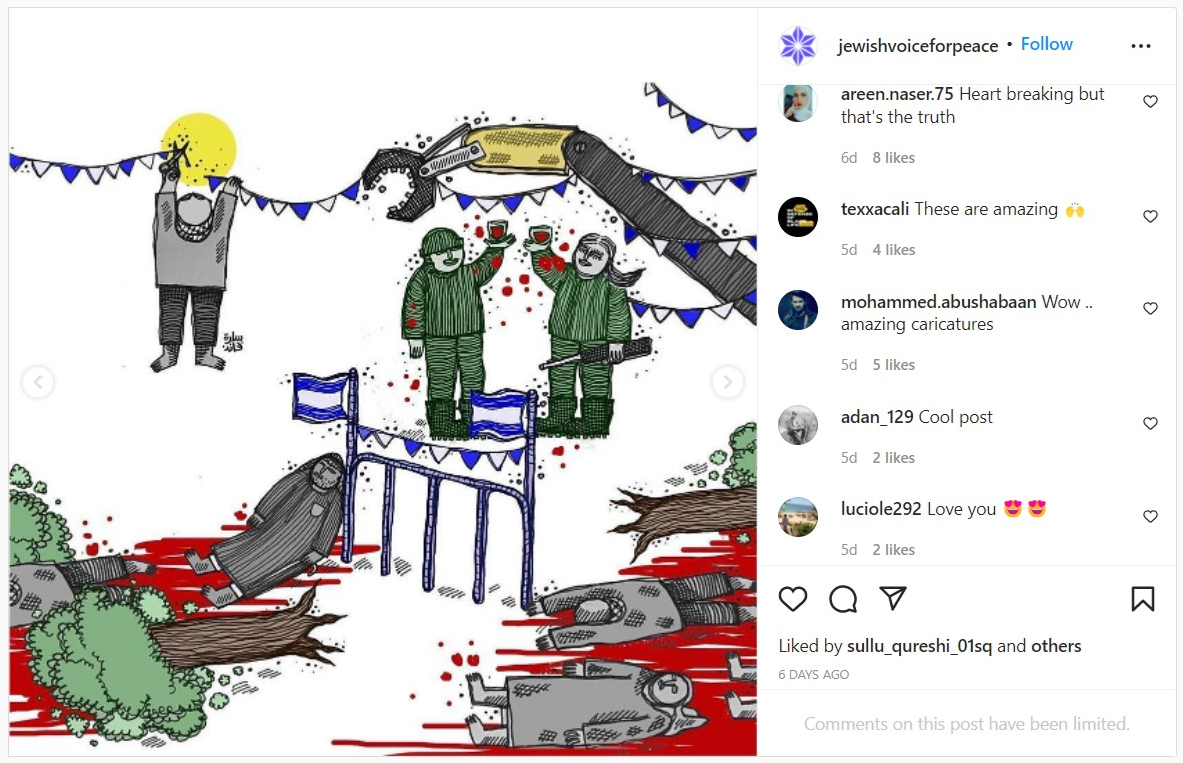
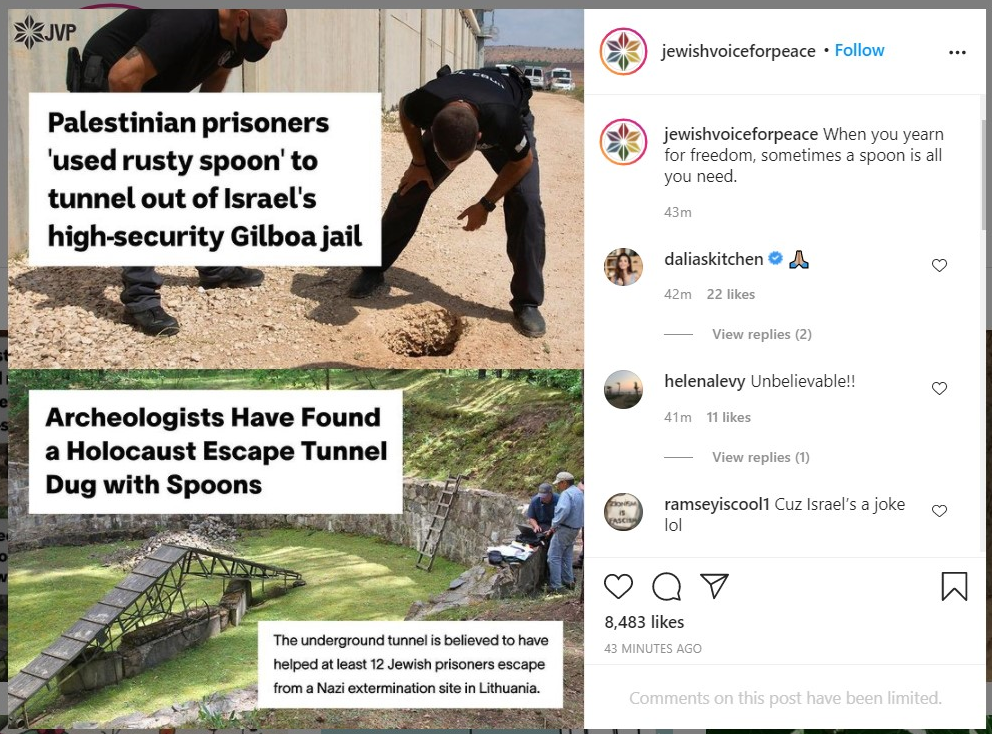
Henderson expresses incredulity that people, “even when they’re Jewish,” could be labeled “antisemitic” (Being Christian After the Desolation of Gaza, p. 287), but Gilad Atzmon, who was born Jewish, has self-identified as “a proud, self-hating Jew.” In fact, the Socialist Worker website removed an interview with Atzmon, describing as “damning” the evidence of Atzmon’s antisemitism.
Breaking the Silence
An organization that Fisk treats as a credible source is Breaking the Silence. However, the organization has been known for making questionable allegations. In fact, documentary evidence and witness testimony have contradicted claims made by the organization. Israel’s Channel 10 found that the testimony of a Breaking the Silence staff member, Nadav Weiman, was false and determined that 40% of 10 of the organization’s testimonies “could not be verified due to insufficient identifying details […] 20[%] were determined to be exaggerated, [and] another 20[%] were debunked as false,” while only “20[%] proved true.”
Churches for Middle East Peace
Fisk describes “[Churches] for Middle East Peace” as “an ecumenical collective directed by Mae Elise Cannon” that “has been heroic and instructive throughout this crisis” (Being Christian After the Desolation of Gaza, p. 77). Wagner states that the organization “provide[s] educational resources and practical opportunities for Christians in America seeking faithful ways to partner with others in the work of peace-building” (Ibid., p. 342).
However, CAMERA has documented how Churches for Middle East Peace has directed the great bulk of its criticism at the Jewish State and the United States while mostly staying silent about problematic behavior exhibited by Hamas and the Palestinian Authority.
Musalaha
Crump interacts with a Palestinian named Salim Munayer who founded the organization Musalaha. CAMERA has documented problems with such movies promoted by Musalaha as 5 Broken Cameras as well as Jenin, Jenin and has exposed the anti-Israel bias and misinformation of lectures from participants at the Christ at the Checkpoint conference—a conference promoted by Musalaha—which has overwhelmingly featured speeches delegitimizing the Jewish State.
IfNotNow
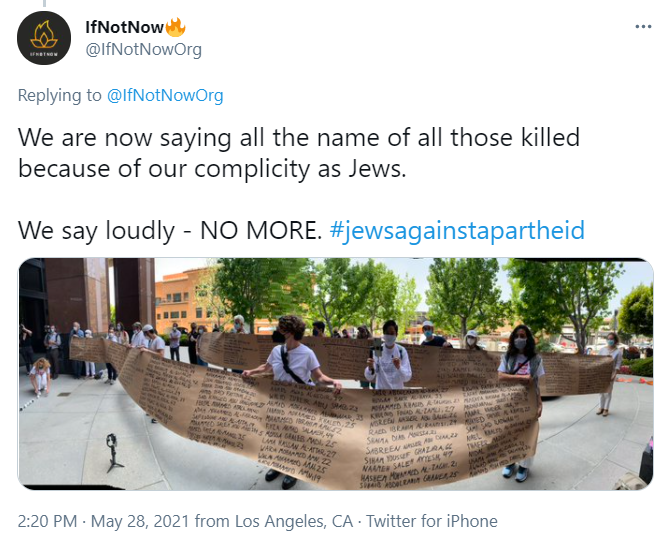 McGloughlin writes that she views IfNotNow as a model for her own organization, Mennonite Action, “combining Mennonite theology and traditions with public action for Palestine” (Ibid., p. 304). However, IfNotNow is an extremist organization that has engaged in Holocaust inversion; labeled Jews, not Israelis, as “complicit” for Israel’s actions; and has absurdly blamed the Jewish State for the actions of American serial rapist Harvey Weinstein.
It is particularly regrettable that McGloughlin would identify an organization that has engaged in such activities as a model for her own Mennonite Action given what Methodist Theological School Van Bogard Dunn Professor of Biblical Interpretation John Kampen has described as “[t]he record of Mennonite participation in the German army, complicity with Nazism and support for the Nazi cause” demonstrated in “major Mennonite population centers[,] such as Germany, Prussia (present-day Poland), and Ukraine,” notwithstanding the church’s professed pacifism (Peace and Faith, pp. 313-314).
Council on American-Islamic Relations
Fisk describes the Council on American-Islamic Relations (CAIR) as an organization responsible for “su[ing] Columbia and Barnard College for disclosing student records to the Education and Workforce Committee of the U.S. House of Representatives, allegedly to avoid losing federal funding” (Being Christian After the Desolation of Gaza, p. 371). He neglects to mention the organization’s documented extremism, as evidenced in its opposing legislation to “prohibit antisemitism in public schools and institutions of higher education” and its executive director’s support for the October 7, 2023 invasion of Israel led by Hamas. He expressed this support in the following words:
The people of Gaza only decided to break the siege, the walls of the concentration camp, on October 7, and yes, I was happy to see people breaking the siege and throwing down the shackles of their own land, and walk free into their land, which they were not allowed to walk in, and yes, the people of Gaza have the right to self-defense, have the right to defend themselves, and yes, Israel, as an occupying power, does not have that right to self-defense […] The Gazans were victorious.
These remarks by CAIR’s executive director led then-White House Deputy Press Secretary Andrew Bates to state, “We condemn these shocking, antisemitic statements in the strongest terms.”
Conclusion
The above analysis demonstrates that the book, Being Christian After the Desolation of Gaza, features numerous misrepresentations of Zionism, Christian Zionists, Hamas, and historical events; false genocidal accusations; inappropriate comparisons of Israelis to Nazis; villainized depictions of Israelis and their partners; misconstruals of the Apostolic Message; denial of the ancient roots of Jewish peoplehood; deflections of Hamas and Palestinian Islamic Jihad culpability for October 7, 2023; inaccurate claims; and promotion of extremist organizations as well as individuals with an anti-Israel bias. It is disappointing that Cascade Books published a book with so many problems given Cascade Books’ history of publishing many excellent volumes, including those featured in its New Testament After Supersessionism series as well as Mark S. Kinzer’s book, Jerusalem Crucified, Jerusalem Risen: The Resurrected Messiah, the Jewish People, and the Land of Promise, which presents a fair-minded assessment of Zionism. One hopes that the publication of Being Christian After the Desolation of Gaza represents a one-off mistake and not a concerning pattern going forward.