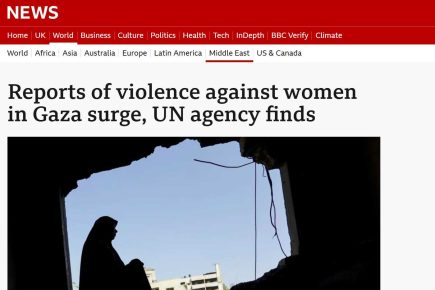
A serious examination of violence against Palestinian women should be capable of examining both the circumstances which make women vulnerable and the agency, choices and beliefs of those who exploit that vulnerability. The BBC's report overwhelmingly examines the former, Palestinian women deserve journalism willing to examine the latter too.
Motaz Azaiza dazzled the Western media with his coverage of the war in Gaza for four months, before he left. But when he revealed that Hamas controls the narratives that come out of Gaza, the press suddenly had nothing to say, CAMERA's Jennifer Kouzi writes at JNS.
Former advisor to PLO Chief Arafat says Oslo Accords were a deception. A parody account on the social media platform X claiming to be the fictional (and female) "Chief Rabbi of Gaza" duped a Gazan photojournalist. Over 6,000 historians, legal experts, academics and others sign an open letter rejecting accusation of genocide against Israel.
Gaza’s civilian deaths have become a weapon in the information war, creating a dangerous incentive to put civilians in harm’s way, CAMERA's Leah Benoz writes in The Jerusalem Post.
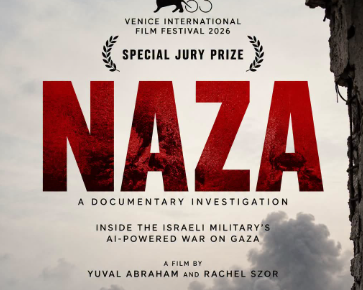
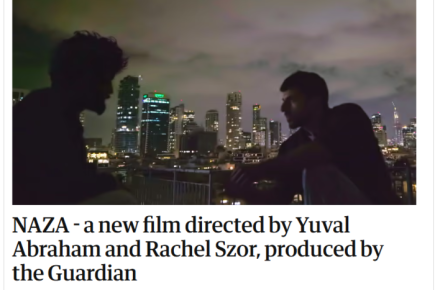
“NAZA” claims to “describe things as they really are.” Based on Yuval Abraham’s track record, the film expects a gullible audience to blindly trust but not verify, CAMERA's Shlomi Ben-Meir writes in TheWrap.
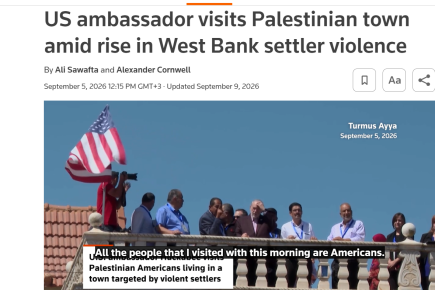
There is nothing American about weaponizing U.S. citizenship, CAMERA's Tamar Sternthal writes in The Washington Times. It is time for journalists to look past the strategically placed American flags to the inconvenient facts of terrorism — even if it means exposing a town that is no place like home.
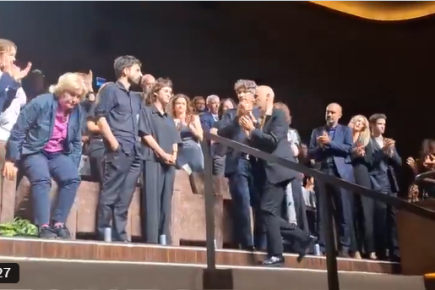
What exactly was the audience applauding when the screening of Naza ended at the Venice Film Festival? What was it? The war? The addition of yet more false material intended to constrain Israel’s ability to defend itself, asks CAMERA Español's Marcelo Wio in The Objective. Or the fear of ostracism, of cancellation, of the social, artistic, and moral gulag?
Imagine for a moment if a far-right U.S. filmmaker made an anti-black documentary with a variation of the “N”-word as the title, but without the “r” at the end, CAMERA's Adam Levick writes at JNS. The moral equivalent of such an obscene racist swipe, though aimed at another historically oppressed minority, was used in the title of a documentary produced by The Guardian newspaper.
The core question is whether an institution, including a university, that is undermining federal policy is entitled to federal money. This is a precedented issue, and the federal government under Democratic and Republican administrations has used its Title IX prerogatives to compel universities to follow federal policy, including issues concerning expression. Universities that do not accept federal money are entirely immune from federal policy.
While reporting on a recent building collapse in Gaza, NBC left the readers with the word of terror-tied Palestinian authorities in Gaza alone, without clarifying that Israel disputed the claim entirely.