The New York Times had many words to describe Yemen's Ansar Allah (Houthis), none of which conveyed the death and destruction the designated terror group has inflicted inside and outside of Yemen.
The BBC appears to be deciding the level of responsibility a child bears for their own actions based not on age, but on ethnicity. When we look at comparable reporting on allegations against Palestinian children, British children and Israeli children, a disturbing pattern emerges around who is responsible, who has agency, who is sympathetic, and who is humanised.
CAMERA prompts a social media uproar and a New York Times Editor's Note after the Gray Lady reported that "Israelis still largely view themselves as the victims of Oct. 7," wording which suggests that Israelis were not, in fact, the victims of Hamas' massacre, the worst slaughter of Jews since the Holocaust.
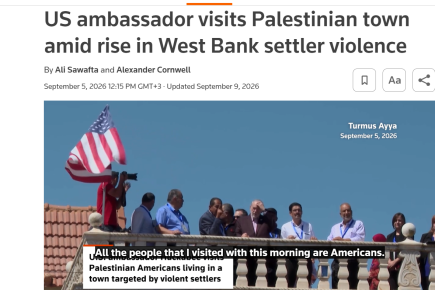
Reuters corrects after wrongly reporting that the slain husband of a Turmus Ayya widow who met with Amb. Mike Huckabee was a U.S. citizen killed by settlers. The news agency has declined to clarify, however, that Omar Jabaran Qattin was a verified Hamas operative.
News agencies should report what leaders say and do, not speculate about their private intentions, dreams, or desires, CAMERA's Tamar Sternthal writes in The Jerusalem Post.
The Wall Street Journal has embedded the theological drivers of Jewish extremism deeply into its coverage ecosystem while leaving Palestinian terror ideology entirely unexamined, CAMERA's Darcie Grunblatt writes in JNS.
PBS recently covered the ongoing fighting in Lebanon between the IDF and Hezbollah. But the outlet's coverage disproportionally focused on the effects of the fighting in several Hezbollah-linked villages, and not the cause.
NPR misled its audience when it edited out critical portions of Israeli Defense Minister Israel Katz's remarks, twisting his words into something nefarious.