
Among the same old tired canards in Amos Schocken’s Nov. 28 Op-Ed calling for the establishment a Palestinian state at the first possible opportunity and accusing the Israeli government of acting contrary to the state’s interests by opposing this move, the longtime Haaretz publisher introduces a novel falsehood (“Netanyahu and His Partners Are Working Against Israel’s Interests”).
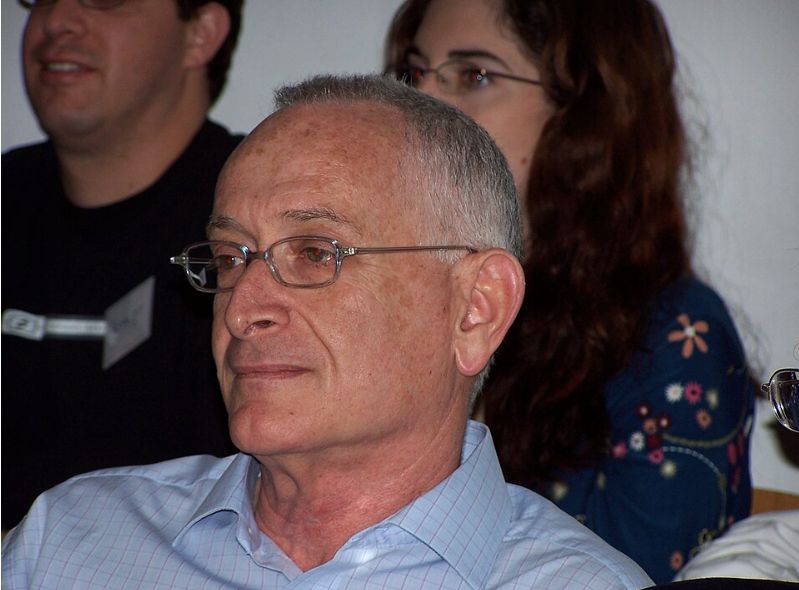
Amos Schocken (Photo by Ido Kenan, CC BY-SA 2.0, via Wikimedia Commons)
As he has for years, Schocken argues that the establishment of a Palestinian state is a moral imperative which will improve Israel’s political standing and bring an end to the conflict with the Palestinians. To support his longstanding view, he predictably deploys well-worn propaganda, charging that Israeli settlements contravene the Fourth Geneva Convention; falsely accusing Israel of imposing a “brutal apartheid regime,” and fabricating that Palestinian Authority Mahmoud Abbas seeks peace and opposes violence and terrorism.
So far, there’s nothing new. Then, in an innovative falsehood, Schocken invents that United Nations Security Council Resolution 2803, adopted last November, is “identical” to Security Council Resolution 2334, adopted in 2016. Schocken writes:
And from a practical standpoint, Israel is barred from annexing the occupied territories. They won’t ever be part of Israel, yet it’s clear that preventing the establishment of a Palestinians state is meant to preserve the country’s hold on territory that, according to this month’s UN Security Council resolution 2803 – which is identical to a resolution from December 2016 2334 – is intended for a Palestinian state. [Empasis Added]
How far-fetched and clueless is this claim? Well, there is no need for an in-depth understanding of international law to uncover the error. A cursory reading of Resolution 2803 from November 2025 and Resolution 2334 from December 2016 reveals that, aside from the fact that both mention Israel and the Palestinians, they are otherwise completely dissimilar. The two resolutions differ greatly from one another in their content, in the issues they address, and in the tone in which they are written.
Namely, Resolution 2334 from 2016 is a declarative resolution condemning Israel for establishing and expanding settlements. It doesn’t even mention the Gaza Strip, which has been vacant of Israeli settlements since the summer of 2005. It states that the basis for condemning the settlement enterprise is that it harms the “two-state solution on the basis of the 1967 lines.” Therefore, it can be argued that Res. 2334, unlike the resolution passed last month, indeed designates territories for a future Palestinian state.
Resolution 2803, in contrast, is an operational resolution concerning the Gaza Strip alone and dealing with the implementation of President Trump’s peace plan. It does not mention settlements or the West Bank at all. It does indeed speak of a “credible pathway to Palestinian self-determination and statehood,” but does not specify what the borders of the Palestinian state will be. While it instructs that Israel will not annex or occupy the Gaza Strip, per the Jewish state’s commitment within the framework of the agreement, the resolution does not condemn Israel at all. Rather, it mentions Israel as one of the parties to the agreement with which the implementation is to be coordinated.
Amos Schocken, therefore, is factually wrong on two central points: First, his claim that Resolution 2803 is “identical” to Resolution 2334 is baseless. Likewise, his assertion that Resolution 2803 designates territories to the Palestinian state is completely unfounded.
Two decades ago, Haaretz‘s publisher defended the false charge of “Jewish only roads” as truth “for all practical purposes.” By the same token, his recasting of the two very different Security Council resolutions is likewise truth “for all practical purposes,” meaning not at all true. Schocken’s insistence on falsehood as truth is unchanged, as is the embrace of anti-Israel charges. All that’s novel is the specific falsehood surrounding a new United Nations resolution.
CAMERA’s Israel office contacted Haaretz regarding the gross factual error. As of this writing, Haaretz editors have neglected to correct their publisher’s article.
For the Hebrew version of this article, see here.