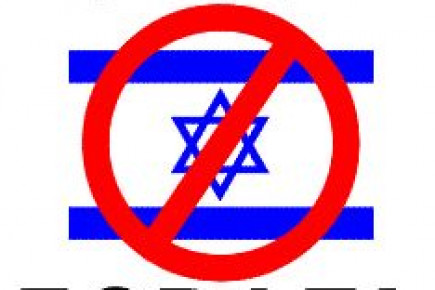
Since his passing, Archbishop Desmond Tutu, renowned for his fight against South African's apartheid and racism, has been widely eulogized for his accomplishments. Less mentioned was his call for a global boycott of the Jewish state. Such calls, even under the guise of human rights, hide an underlying anti-Semitism. In order to weigh both sides of the debate about anti-Jewish boycott and understand why so many seek to combat it, one must be familiar with the boycott’s history.
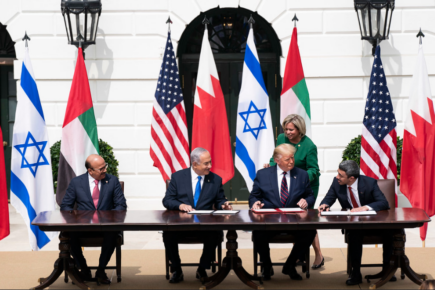
CAMERA prompts correction of The New York Times' egregious misreporting that all other Gulf States opposed the Emirates' normalization with Israel, or were reluctant to adopt the step.
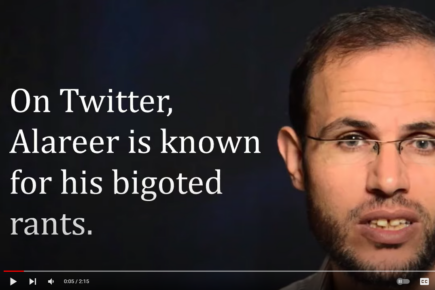
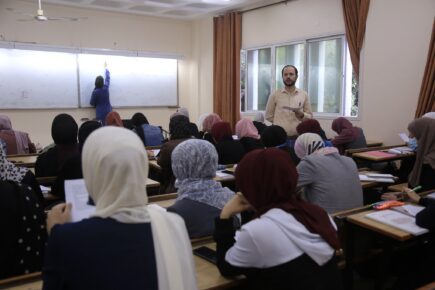
CAMERA's video shows footage of Alareer's classroom incitement. As a result of our research and outreach to New York Times editors, the newspaper published an editors' note effectively retracting their piece on the bigoted bridge-builder.
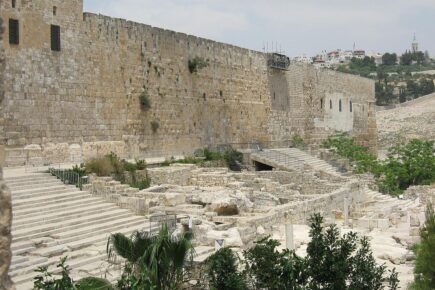
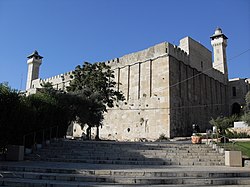
CAMERA prompts correction of a New York Times story referring to the Western Wall as "the last remaining part of an ancient Jewish temple that was destroyed in antiquity." The wall was a retaining wall of the Temple Mount, not part of the Temple itself, and is one of many surviving remains of the complex.
It is no wonder the New York Times' recent Op-Doc (op-ed documentary film) about Israel was a biased Breaking the Silence film that demonizes and delegitimizes Israel's military and Hebron’s Jewish residents. After all, the film represents the current mindset at a newspaper committed to villifying the Jewish state, its leaders and institutions.
The New York Times tells readers that Refaat Alareer, a professor who who incessantly dehumanizes "Zios" on Twitter, is a different man in the classroom, teaching students to appreciate Israeli poetry and, through, that, to humanize Israelis. This, though, is pure fiction. (Updated with information on newspaper's Editors' Note)
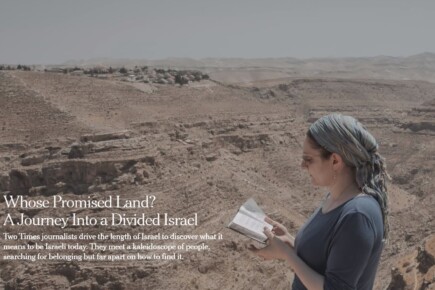
After CAMERA posts a critique and introduces the hashtag #SadSadIsrael, thousands of smiling Israelis ridicule a recent New York Times story about "what it means to be Israeli."
Demonstrating total abandonment of the journalistic imperative mandating strict adherence to factual accuracy, The New York Times is refusing to correct a blatant error: the misidentification of Rameh, an Arab town in northern Israel, as "Palestinian."
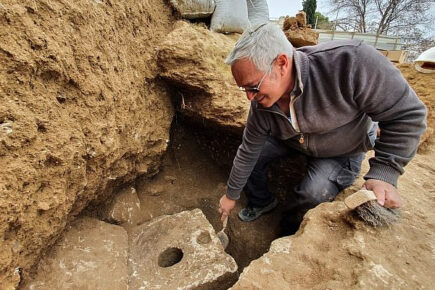
The AP’s report on the discovery of a First Temple era toilet omits Jewish references, while a NY Times Rosh Hashanah recipe evokes ’Canaanites,’ not Israelites.