
 “WIRED is obsessed with what comes next,” the Condé Nast publication writes about a defining feature of the popular technology magazine. Indeed, its Sept. 30 report, “Choke Points,” about checkpoints and other obstacles in the West Bank interfering with the fabric of Palestinian life, seems so obsessed with one vision of what comes next that it reports one possible future scenario as if it’s a present-day reality.
Thus, the story posits: “Since 2023, Israel’s fragmentation of Palestine, [sic], underway for generations, has accelerated. The West Bank, for the nearly 3.5 million Palestinians who live there, ceased to exist as a contiguous territory.”
While some major media outlets have recently (falsely) reported that the construction of Israel’s controversial E1 settlement plan east of Jerusalem will split the West Bank in half, preventing contiguity for Palestinians in the disputed territory, WIRED, in contrast, insists that the erasure of contiguity is already here.
“Over 18 months, WIRED, Lighthouse Reports, Arab Reporters for Investigative Journalism (ARIJ) and the Palestine Reporting Lab investigated the system that has carved the West Bank into cantons and measured what it cost people to move through it,” the article states.
Then, in a string of texts and graphics, the article undermines its own thesis that contiguity for West Bank Palestinians does not exist. The bottom line of the impact of the reported 925-plus barriers (citing December 2025 United Nations data) – “fixed and temporary checkpoints, metal gates, roadblocks and earth mounds” – is a longer commute.
WIRED reports:
The average West Bank commuter—someone who drives several times a week—loses about an hour and a half each week to additional travel time in an effort to avoid checkpoints. Over the course of the year, that amounts to 77 hours lost.
But sitting in traffic – for whatever reason—is not tantamount to a lost of contiguity, which means being next to or touching.
Despite the lost time and economic fallout, clearly bottlenecks and circuitous routing aren’t tantamount to the loss of contiguity – not in San Franciso, and not in the West Bank.
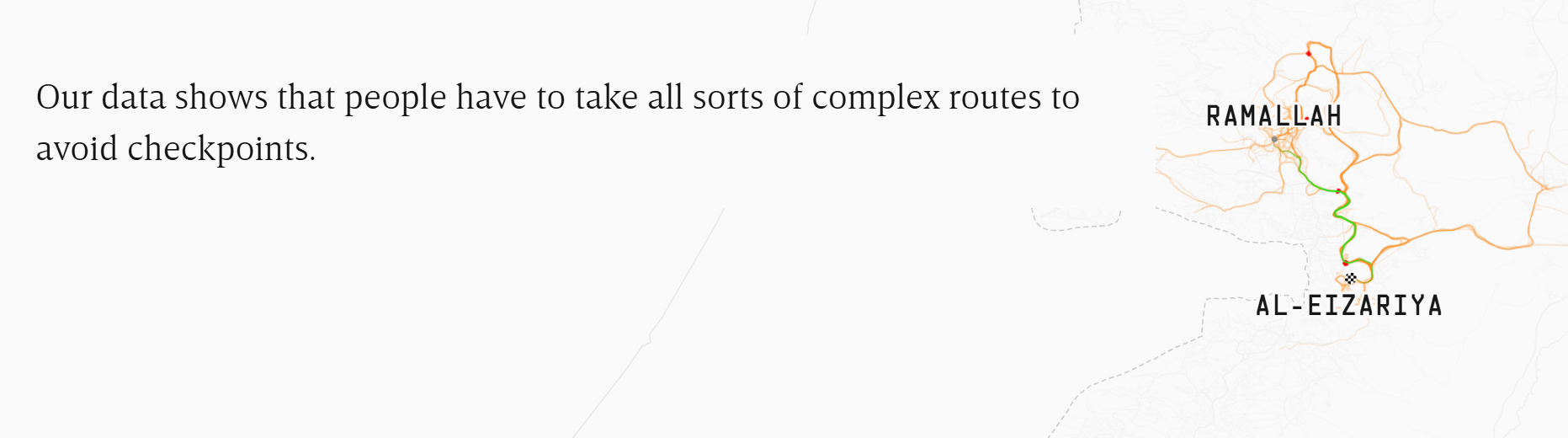 Indeed, WIRED’s abundant graphics (example at left) showing alternate routes Palestinian commuters take to avoid checkpoint points and barriers visually make the point that there is contiguity – albeit via a more circuitous route.
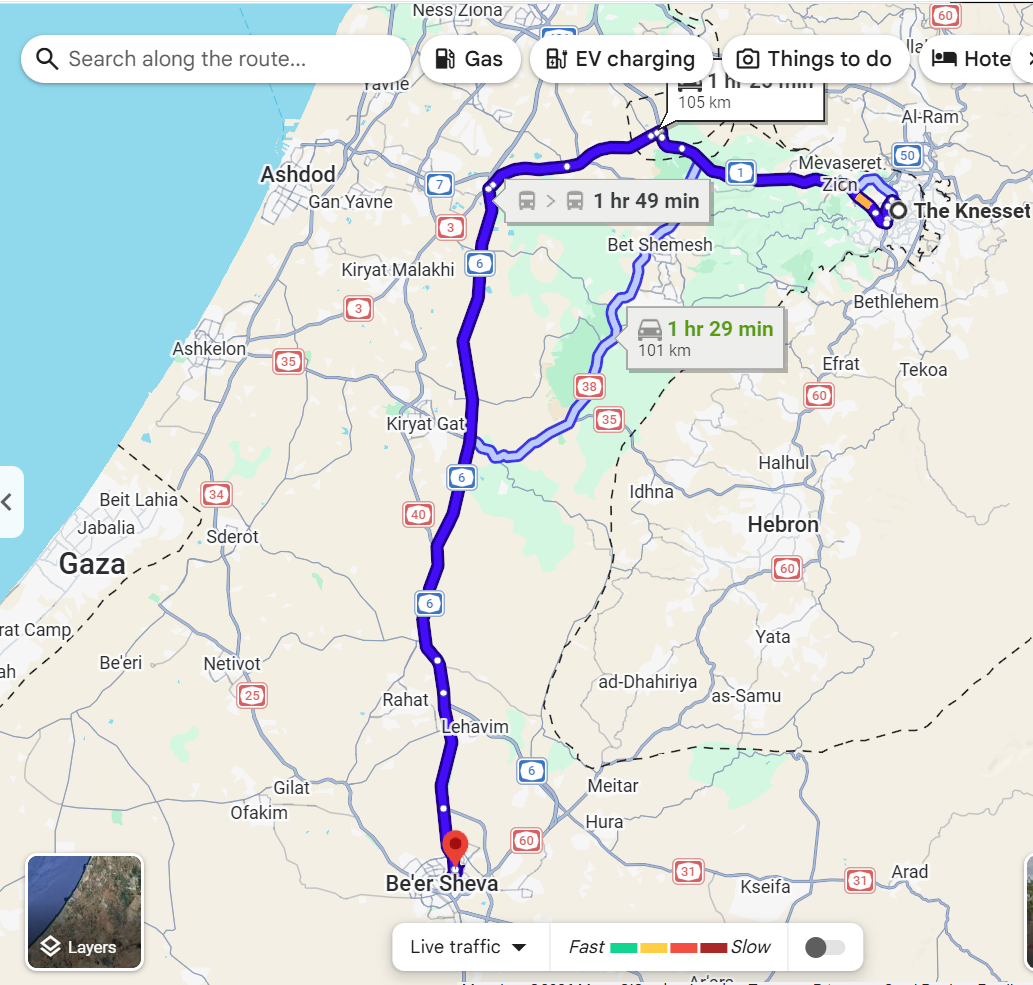 Notably, since the bilateral Oslo Accords more than a quarter of a century ago, when a Palestinian government for the first time gained control over West Bank land, Israeli citizens, too, often take circuitous routes to avoid Palestinian-governed territory.
WIRED previously decimated its credibility with an April 2026 cover story ludicrously claiming the vaporization of Palestinians in the Gaza Strip.
The Sept. 30 “Choke Points” report shares a great deal in common with its sci-fi vaporization predecessor: WIRED collaborated with Palestine Lab on both projects, both stories treat the Gaza Strip genocide libel and the Israeli apartheid slur as a given fact; and they both go large with their anti-Israel claims, displacing all semblance of careful professional reporting.
A new addition to WIRED’s “Choke Point” is Henriette Chacar, listed among the piece’s editors and producers. In 2023, when Reuters briefly hired the writer, CAMERA detailed exactly how
Ms. Chacar’s career is one huge embrace of hyper-advocacy. Her partisanship eschews objectivity and ethical news reporting, as she ceaselessly adopts the most extreme positions and smears Israel as a pariah state requiring elimination.
Her landing at WIRED as a contributor to “Choke Point” marks a perfectly fluid continuation of a well-hewn career path, marked by deeply flawed reporting and demonization of Israel by completely removing all traces of Palestinian culpability.
Thus, while “Check Point” refers seven times to October 2023 as a critical point after which the number of obstacles impeding Palestinian movement in the West Bank reportedly drastically increased, at no point does the article mention what exactly happened that month which prompted the significant change.
“Choke Point” completely erases the memory of Hamas’ Oct. 7 massacre, the worst slaughter of Jews since the Holocaust, euphemistically referring to “the aftermath of October 2023,” “after October 2023” (three times), “since October 2023” (two times), and “[B]etween October 2023 and August 2026.”
What doesn’t appear even once in the article is any reference to the Oct. 7 massacre or Palestinian terror in the West Bank, which prompted the construction of the security barrier and the introduction of checkpoints.
Just 10 days before the publication of “Choke Points,” on the eve of Yom Kippur, the holiest day on the Jewish calendar, a Palestinian terrorist murdered an Israeli father in front of his son as they ritually immersed in a spring.
Days later, on Sept. 23, Palestinian Mahmoud Suleiman from Beit Ur-Tahta carried out a car ramming attack, critically injuring Israeli reserve soldier Neria Leiter, the son of Yechiel Leiter, the Israeli Ambassador the United States.
Erasing Generations of Palestinian Culpability
WIRED’s historic account likewise erases any Arab culpability. Adapting Palestinian terminology calling the 1948 establishment of the only Jewish state a “Nakba,” or catastrophe, WIRED’s Lama Rabah, Sabrina Slipchenko, Charles Boutaud, Firas Tawil and Elena Debre give this grossly distorted background:
In 1948, in what is known as the “Nakba” or “catastrophe,” Zionist forces expelled more than 750,000 Palestinians from their homes. Hundreds of villages were depopulated or destroyed, and people were driven into exile.
Those who remained were placed under Israeli military for the next 18 years, forbidden to work, trade, study.
This egregiously selective account ignores the fact that five Arab armies joined local Arab forces to attack the fledgling Jewish state, prompting the refugee crisis. Nor does it acknowledge that the vast majority who were displaced left at the behest of their leaders, who urged what they envisioned to be a temporary flight to enable the expected conquest of the newborn Jewish state.
Nor does the deeply flawed timeline supposedly tracing the control of West Bank land acknowledge that the territory was under illegal Jordanian occupation from 1948 to 1967.
And, of course, prior to 1948 the land was under the British Mandate, which followed Ottoman control. Not until the bilateral Oslo Accords signed with Israel in the late 1990s did Palestinian Arabs ever enjoy governance over any land – in the West Bank –or elsewhere. But that fact didn’t stop WIRED from publishing the selective timeline under the false headline: “An Inheritance of Loss.”
About the 1995 Oslo Accords, WIRED ignores the salient fact which vaporizes their bogus narrative alleging “Israel’s fragmentation of Palestine, underway for generations.” Thus, the tech journal inverts the Palestinian Authority’s historic, unprecedented gain of West Bank land, stating the Oslo Process “further fragmented Palestinians by dividing the West Bank into administrative islands.”
The timeline’s 1995 entry also falsified that the Oslo Process “was meant to lead to the establishment of a sovereign Palestinian state.” As CAMERA previously noted:
As Martin Indyk, the former U.S. ambassador to Israel, made clear in a piece for the Atlantic marking the 25th anniversary of the agreements, the Oslo Accords “did not provide for a Palestinian state.” He also re-emphasized that the two-state solution is “a concept that is nowhere mentioned in the Oslo Accords.” (Emphases added.)
Prominent critics of Israel agree with Indyk. In the New Yorker, Rashid Khalidi wrote, “In Oslo and subsequent accords, the Israelis were careful to exclude provisions that might lead to a Palestinian political entity with actual sovereignty.” Palestinian statehood, he continued “are never mentioned in the text.” Avi Shlaim stated in the Guardian that the Accords “did not promise or even mention an independent Palestinian state at the end of the transition period,” and reiterated in the Journal of Palestine Studies that “The most basic criticism [of the Accords] was that the deal negotiated by Arafat did not carry the promise, let alone a guarantee, of an independent Palestinian state.”
Media outlets which have previously corrected the falsehood that the Oslo Accords were meant to deliver a Palestinian state include The New York Times, The Financial Times, and MSNBC.
The 1967 entry is similarly detached from facts, claiming:
In 1967, when Israel seized the remaining Palestinian territories, it reconstructed the same permit system there. Palestinians were sorted into categories, the color of an ID card determining who may go where.
It’s hard to know where to begin breaking down the audacious falsehoods here. Other media outlets including Voice of America, The Wall Street Journal, NBC, and Washington Post, have corrected after falsely referring to West Bank territory not under Palestinian Authority as “Palestinian territories.” But, once again, WIRED goes further than its colleagues – falsely claiming, by referring to the “remaining Palestinian territories,” that even internationally recognized Israeli territory are part of “Palestinian territories.”
The 1967 entry’s description of Palestinian movement, with color ID cards “determining who may go where,” is likewise a circuitous departure from reality. In fact, following the Six Day War until the Intifadas starting in the 1980s, West Bank Palestinians were able to travel freely into Israel and beyond. As CAMERA previously reported:
Before the First and Second Intifadas, which prompted Israel to substantially increase its presence in the West Bank and Gaza Strip, Palestinian workers were able to work in both Israel and the rest of the Middle East in the years after the Six Day War. As a result, the Palestinian economy was one of the fastest growing economies in the world. According to the World Bank, the real per capita Gross National Product (GNP) in the occupied territories more than doubled between 1970 and 1980, making it the fourth fastest growing economy in the world.
Indeed, even the anti-settlement B’Tselem organization has acknowledged:
Initially, after the occupation began [in 1967], Palestinians from the West Bank and the Gaza Strip could travel almost entirely freely. Tens of thousands worked in Israel. Palestinians from the West Bank, Gaza and Israel maintained family ties; students from Gaza studied in West Bank universities; and extensive trade took place among Palestinians, no matter where they lived.
In January 1991, during the Gulf War, Israel changed its policy, introducing a demand that any Palestinian wishing to enter Israel or East Jerusalem, including for the purpose of travel between the West Bank and Gaza, must obtain a personal permit from Israel. This policy split the Occupied Territories into three separate areas – the West Bank, East Jerusalem and Gaza – leaving travel between them entirely dependent on Israel’s approval.
The impact of this policy change was not immediately apparent. In the first few months, a great many permits were issued and for relatively long durations. As a rule, most Palestinians were still able to routinely enter Israel or travel between the West Bank and the Gaza Strip. However, Israel gradually reduced the number of permits issued and they became harder and harder to obtain, until, in March 1993, after Palestinians from the Occupied Territories killed nine Israeli civilians and six members of the Israeli security forces, Israel imposed full closure “until further notice”.
WIRED’s obsession with erasing Palestinian culpability is intransigent, steadfast in the next rounds of Palestinian malfeasance. Thus, it covers up the second Palestinian intifada, which brought mass murder of civilians to busses, cafés and Passover seders, as follows:
By the early 2000s, this system of closures and permits had become the status quo. In 2002, Israel started building the 713-kilometers-long separation wall, 85 percent of which runs through the West Bank.
And, about 2007, when Hamas, a designated terror organization with the mandate to murder Jews and eliminate the Jewish state as part of its founding charter, violently seized control of the Gaza Strip, throwing its own Palestinian political foes off roofs, WIRED tossed basic journalism under the bus: “And since 2007, Israel has imposed a blockade on Gaza, isolating it from the rest of Palestine.”
About the deadliest slaughter of Jews since the Holocaust, WIRED blacked out: “2023: In the years that followed, the restrictions intensified.”
The real takeaway from WIRED’s “Choke Points” is not, as it would have us believe, that “every generation of Palestinians since 1948 has inherited a smaller world than the one before it.” It’s that WIRED’s obsession with serving as a vehicle of the most unhinged, vile anti-propaganda means that its journalism has completely short-circuited.