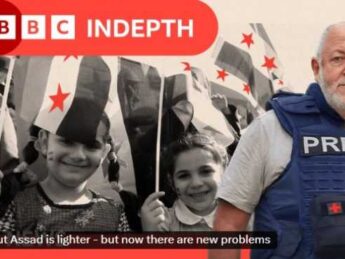
This is by no means the first time that Jeremy Bowen has tried to persuade BBC audiences that Israeli actions are the main factor behind the escalation of conflicts in the Middle East. However, as has been evident for many years, Bowen’s analyses often do anything but make a story more comprehensible to the corporation’s funding public due to his preference for advancing politically motivated and misleading talking points
The similarities between entries in the style guide used by the Hamas-supporting and terrorist-employing Qatari government-funded media outlet (which has been banned by several Arab countries) and those appearing in the BBC style guides certainly raise questions regarding the standards to which Britain’s national broadcaster apparently aspires.
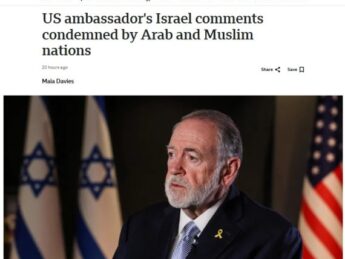
Obviously the prime aim of Davies’ reporting on this "much ado about nothing" story was to amplify the statement delegitimizing Israel that was put out by a collection of countries and organizations.
The BBC's pattern of reporting cannot by now be dismissed as isolated cases of errors and omissions. BBC audiences are being serially denied information which would contribute to their understanding of the way in which continued terrorist activity is currently influencing events in the post-ceasefire Gaza Strip.
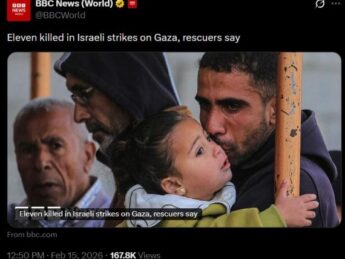
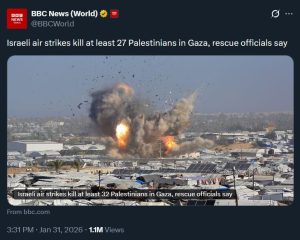
BBC reporting since the ceasefire came into effect in October 2025 has focused primarily on Israeli responses but has failed to adequately inform on the topic of the terrorist targets of such strikes. Near-daily ceasefire violations by terrorist organizations have for the most part been ignored. Unconfirmed claims sourced from Hamas-run agencies have been uncritically amplified, along with the “both sides” narrative concerning ceasefire violations.
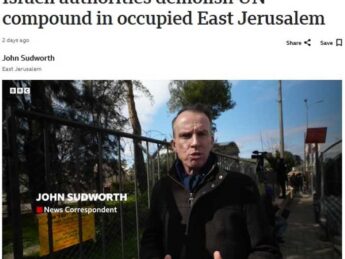
Even in light of the additional evidence of UNRWA cooperation with terrorist organizations that has accumulated over the past two years, BBC journalists are apparently still not embarrassed by the corporation’s policy of uncritical amplification of that organization’s talking points and its failure to investigate UNRWA’s terror links.
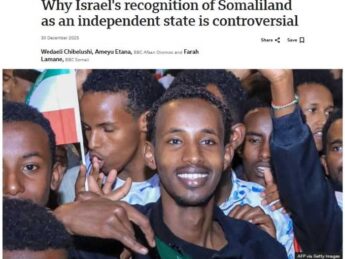
The BBC chose to frame recognition of a democratic country which it acknowledges has a “working political system” and “its own currency” – as well as defined borders – as “controversial.” In contrast, BBC audiences saw no such framing when, in September 2025, the corporation extensively covered the recognition of a Palestinian state (which lacks such features and has not held elections for two decades) by the UK and other countries.
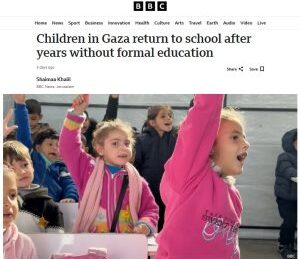
Even after two years of war, the BBC still has no interest in reporting accurately and impartially on the topic of the exploitation of educational buildings (and other public facilities, including hospitals) by terrorist organizations in the Gaza Strip in order to facilitate audience understanding of why such buildings may have been damaged or destroyed during that time.
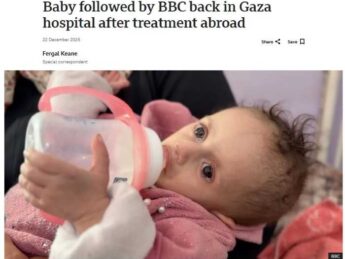
This is by no means the sole case in which the BBC has advanced its chosen "malnutrition," "starvation," and "famine" narratives using images of children and adults with underlying medical conditions
The BBC's Jeremy Bowen promoted the decidedly not “in-depth” (but definitely predictable) narrative that it is Israel that is “the problem” in the Golan Heights border area.