Jeremy Bowen’s comments, should they be accurate, breach BBC guidelines on multiple levels, and the BBC’s conduct on this issue suggest that his leadership is materially damaging the BBC’s commitment to impartiality. His position at the BBC is one of significant power, and the BBC response to his actions will tell us a huge amount about the BBC’s commitment to its own standards.
The Sudanese and Congolese people deserve our attention, they deserve our respect, they deserve support for the free democracies that they want to build, they deserve western demand for regulation on the trades that fund their subjugation, and they deserve to be treated with every bit as much seriousness as the Palestinian people do.
Perhaps the true tragedy of the Sudanese and Congolese people is that the BBC can’t blame Jews for their pain.
The BBC claims it needs independent verification to be able to report the killing of the Bibas family, but does it apply that standard to Palestinians?
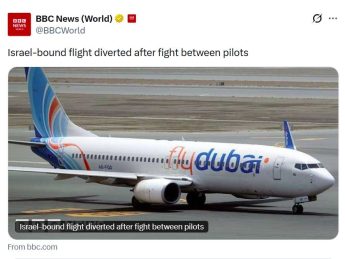
The BBC doesn’t use the word terrorist without attribution, we know this, whether we agree with it or not. But when a hijacking is reduced to first a fight, and then an altercation, the argument that this is simply journalistic caution and impartiality takes its own 17000ft nose dive.
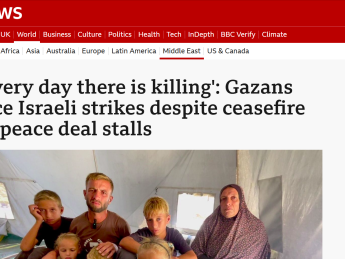
When British media outlets make editorial decisions which prioritise the media narrative of a terrorist organisation, fail to label the origin of their evidence, fail to report IDF denials and ignore opposing narratives entirely, the reporting process becomes one of laundering a Hamas narrative through sympathetic, or at worst affiliated, Gazan journalists, washing it off with the stain remover of western journalistic credibility, and presenting it, shiny and respectable, to a non expert audience missing half the facts and already primed to assume Israeli guilt.
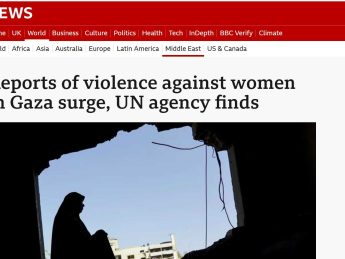
A serious examination of violence against Palestinian women should be capable of examining both the circumstances which make women vulnerable and the agency, choices and beliefs of those who exploit that vulnerability. The BBC's report overwhelmingly examines the former, Palestinian women deserve journalism willing to examine the latter too.
Gaza’s civilian deaths have become a weapon in the information war, creating a dangerous incentive to put civilians in harm’s way, CAMERA's Leah Benoz writes in The Jerusalem Post.
The BBC appears to be deciding the level of responsibility a child bears for their own actions based not on age, but on ethnicity. When we look at comparable reporting on allegations against Palestinian children, British children and Israeli children, a disturbing pattern emerges around who is responsible, who has agency, who is sympathetic, and who is humanised.
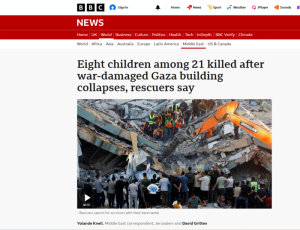
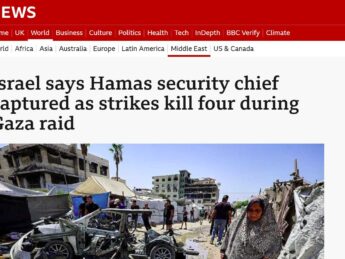
There is a key issue upon which Knell is completely silent; the question as to why such a senior military figure was even present in such a densely populated civilian area in the first place. This illustrates with perfect clarity a key issue the BBC must address, and a new rule which must be added to BBC guidelines, not to protect Israelis, but to protect Palestinians, and any other population which may have the misfortune to discover that their deaths have become politically useful to one party or another in any armed conflict.
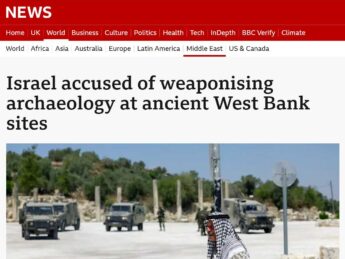
A pattern appears to be developing of the BBC deconstructing and re-writing Jewish history, replacing facts with a heavily editorialised reimagining that serves a political purpose.