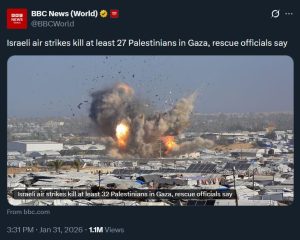
BBC reporting since the ceasefire came into effect in October 2025 has focused primarily on Israeli responses but has failed to adequately inform on the topic of the terrorist targets of such strikes. Near-daily ceasefire violations by terrorist organizations have for the most part been ignored. Unconfirmed claims sourced from Hamas-run agencies have been uncritically amplified, along with the “both sides” narrative concerning ceasefire violations.
To produce a documentary about a peace movement which only shows pain, suffering, and trauma on one side, and lays all agency, responsibility, and violence at the feet of the other, is a narrative decision which fails catastrophically in the BBC’s commitment to impartiality and accuracy.
The idea that Jews are collectively responsible for the actions of Israel, or that Jews are ultimately responsible for bigotry that they experience, is not a position the BBC should be lending its considerable credibility to, on any day, let alone on Holocaust Memorial Day.
Even in light of the additional evidence of UNRWA cooperation with terrorist organizations that has accumulated over the past two years, BBC journalists are apparently still not embarrassed by the corporation’s policy of uncritical amplification of that organization’s talking points and its failure to investigate UNRWA’s terror links.
The BBC chose to frame recognition of a democratic country which it acknowledges has a “working political system” and “its own currency” – as well as defined borders – as “controversial.” In contrast, BBC audiences saw no such framing when, in September 2025, the corporation extensively covered the recognition of a Palestinian state (which lacks such features and has not held elections for two decades) by the UK and other countries.
In less than five minutes, Jeremy Bowen misrepresented the Gaza Humanitarian Foundation and one of its founders, erased Hamas ceasefire violations, omitted key context on IDF activity in Gaza and the details of Trump’s Twenty Point Plan, and left listeners with almost no information on the Board of Peace but a clear impression of arbitrary Israeli cruelty.
Even after two years of war, the BBC still has no interest in reporting accurately and impartially on the topic of the exploitation of educational buildings (and other public facilities, including hospitals) by terrorist organizations in the Gaza Strip in order to facilitate audience understanding of why such buildings may have been damaged or destroyed during that time.
By leaving out the coordination between Iran and Venezuela the BBC turns a story about two deeply connected allies engaged in long-standing cooperation against US interests into a story about random American aggression, and it turns Iran and Hezbollah from internationally connected, savvy geopolitical actors with sophisticated financial networks into isolated and purely reactive characters in a Western-centric world.
This is by no means the sole case in which the BBC has advanced its chosen "malnutrition," "starvation," and "famine" narratives using images of children and adults with underlying medical conditions
The BBC's Jeremy Bowen promoted the decidedly not “in-depth” (but definitely predictable) narrative that it is Israel that is “the problem” in the Golan Heights border area.