David M. Litman is the U.S. Media Research Manager at the Committee for Accuracy in Middle East Reporting and Analysis (CAMERA), where he covers anti-Israel bias in the media. Previously, David worked at an independent watchdog organization focused on anti-Israel bias, international law, and human rights issues in the United Nations and international courts. David graduated magna cum laude from Case Western Reserve School of Law and holds a BA in International Studies.
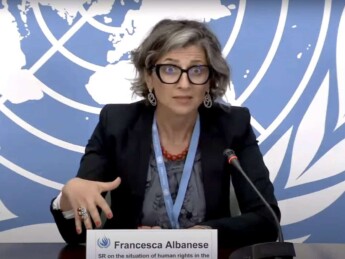
Fifty-two UN experts either didn’t bother to fact check their own statement or had no qualms about spreading lies about the Jewish state in order to accuse it of all manner of evils.
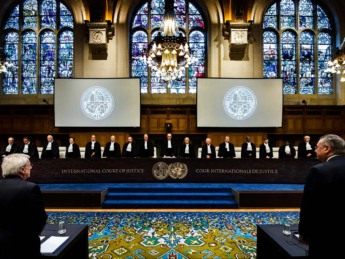
In its May 24 order, the International Court of Justice relied on a handful of dubious, generalized and misleading claims made by various United Nations figures.
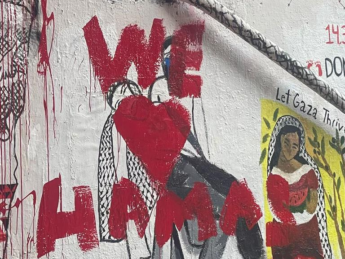
The text of CAMERA’s submission to the Meta Oversight Board regarding content moderation policies and the use of the phrase “from the river to the sea.”
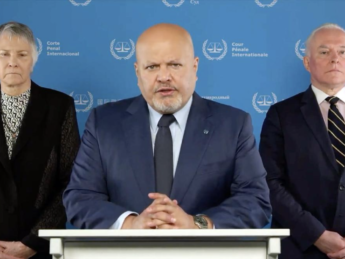
Military experts have attested that Israel is taking every possible step to avoid harm to civilians, while conducting a legitimate and necessary war of self-defense. To characterize this as “extermination” or “murder,” and to use it to justify international legal action against Israel's leaders, is to twist morality on its head.
As American universities are aflame with extremism, antisemitism, and lawlessness, universities have only themselves to blame for the decades-long promotion of faculty members who abuse their role to indoctrinate students in “resistance”. By rewarding bad behavior over respectful dialogue, they are sowing the seeds of yet more chaos and lawlessness.
When the International Court of Justice issued an order on January 26 in the “genocide” case between South Africa and Israel, it soon became common knowledge that the ICJ had found it “plausible” that Israel was committing “genocide.” This common knowledge, however, was in fact a myth.
A CNN graphic, and the preceding text, suggests that the daily average number of trucks bringing food into Gaza now is less than half of what it was before October 7. In fact, the truth is precisely the opposite. Substantially more trucks are bringing food into Gaza today than were a year ago.
In the world of journalism, there are understandable errors, and then there are the types of errors that make you wonder whether the journalists are living in the same reality.
If CNN can’t be relied upon to produce an accurate picture of the facts, or to give the proper analysis of those facts, then can CNN be relied upon as a serious journalistic entity at all?
First, the article spills large amounts of ink to link Israel to tragedies, while omitting or glossing over the existence and responsibility of other parties. Second, the article employs a curious double standard as to informing readers of when the network was “unable to verify” details being reported. Third, the background of one of the journalists himself raises questions of a conflict of interest.