A "News Hour" segment on damage to the rich cultural history of the Gaza Strip during two years of war covers up Hamas' presence at landmark sites, falsely reports the destruction of an intact church, and completely erases the territory's Jewish history, leaving behind a journalistic wasteland in its wake.
While Amnesty International has explicitly labeled Israel’s actions in Gaza a “genocide,” the organization’s recently published report on Oct. 7 omitted years of statements by Hamas leaders and language from its charter demonstrating genocidal intent against Jews.
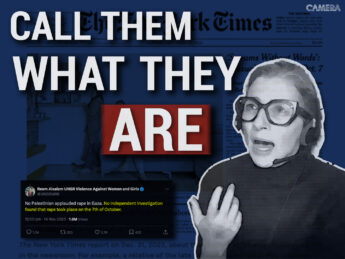
Hamas apologists continue to deny that mass sexual assaults took place on Oct. 7. In their minds, to do otherwise, would mean accepting that Hamas is a genocidal terrorist organization. The evidence is overwhelming that Hamas used rape as a tool of war against Israeli civilians during their invasion and against Israeli hostages in Gaza.
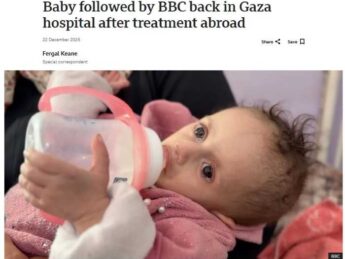
This is by no means the sole case in which the BBC has advanced its chosen "malnutrition," "starvation," and "famine" narratives using images of children and adults with underlying medical conditions
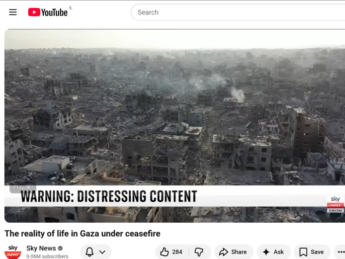
Shortly after Oct. 7, 2023, Sky News effectively made the decision to frame the war not as an unprovoked antisemitic massacre by a proscribed terrorist group, but primarily on the suffering of Palestinian civilians as the result of the IDF’s putatively “disproportionate” military response to the attacks.
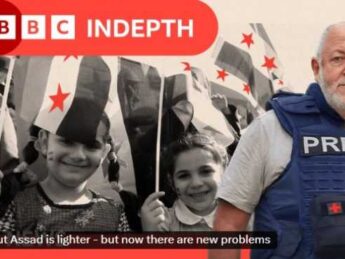
The BBC's Jeremy Bowen promoted the decidedly not “in-depth” (but definitely predictable) narrative that it is Israel that is “the problem” in the Golan Heights border area.
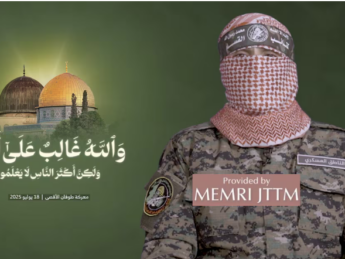
CAMERA prompts correction at The Los Angeles Times after the paper briefly resurrected Hamas spokesman Abu Obeida from the dead. A September speech following his August death would have been a truly unprecedented feat. But the truth is more mundane.
Six years after The Times’ notorious publication of a vile antisemitic cartoon depicting Israeli Prime Minister Netanyahu as a guide dog wearing a Jewish star collar leading a blind, kippah-clad President Trump, antisemitic tropes take firm root in countless media outlets globally.
Alex Rossi’s inability to distinguish between the leadership of an antisemitic death cult and their Jewish victims shows clearly that he is the last person at Sky who should be reporting on anti-Jewish terror in Australia, or anywhere else in the world.