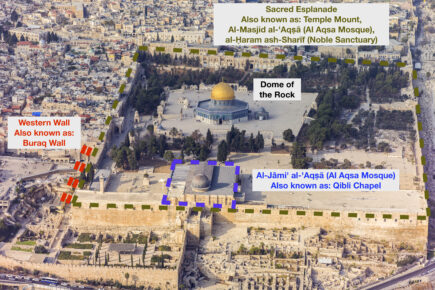
Once again, the dishonest battle cry to "defend" the Al Aqsa mosque from Jewish plans of takeover, is being cynically used as a clarion call for violent jihad. It is the latest salvo in a war against Judaism's legacy in Jerusalem. CAMERA provides background on the battle over the Temple Mount, which is based on Muslim claims of supremacy and fought on multiple political and violent battlefronts.
One of the main obstacles to previous peace-making efforts in the Palestinian-Israeli conflict has been the issue of dividing Jerusalem. There is no doubt that these competing demands and claims will be difficult to reconcile. It is made all the more difficult by a media that errs or misleads on the topic. This backgrounder addresses common media misrepresentations regarding Jerusalem.
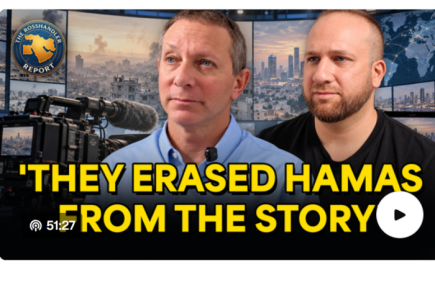
On Oct. 7, CAMERA's Adam Levick was interviewed by Israeli journalist Yaakov Lapin on his podcast The Rosshandler Report. They discussed how sections of the international media turned the worst massacre of Jews since the Holocaust into an unprovoked Israeli war against a faceless enemy.
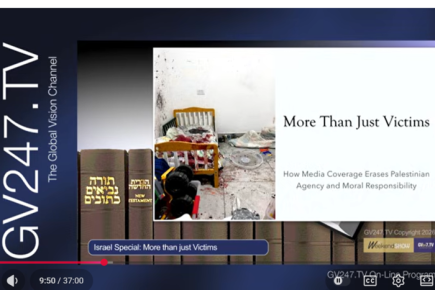
CAMERA's Adam Levick was interviewed last week by Deborah Menelaws of the Scotland-based Global Vision TV to discuss media bias against Israel and the related refusal of most outlets to assign Palestinians moral agency.
CAMERA prompted MS NOW to remove its claim that Israelis had “stormed” Al-Aqsa Mosque compound. Still, MS NOW declined to name the Temple Mount as the holiest site in the world for the Jewish people, despite nearly every other outlet acknowledging that fact.
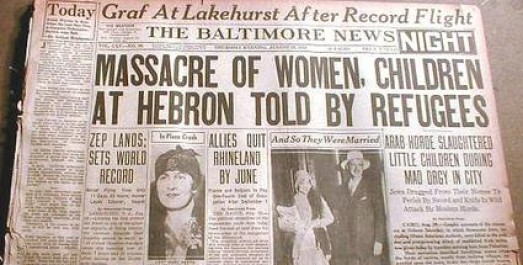
While nothing much shocks us anymore about the Guardian's institutional hostility to Israel and Jews, it's important to stress that, until now, we've never previously encountered an inversion of the 1929 Hebron Massacre that frames Jewish victims as the culprits at any other British outlet.
The Independent upheld our complaint and corrected several egregious errors in a story initially claiming Jews were "storming" the Temple Mount/al-Aqsa Mosque Compound, which they described as a uniquely Muslim holy site
The New York Times mentioned Tel Aviv as Israel's capital and seat of government. After CAMERA contacted the outlet, it refused to correct the mistake.
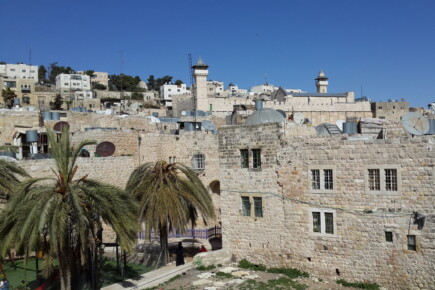
A Guardian article on Hebron adheres to an unwritten rule followed by Guardian reporters that once a city in the Land of Israel has been cleansed of its Jewish residents, Jews should never reside there again.
NBC's report from Jerusalem sounded like Palestinian Authority propaganda. From provocative, hyper-partisan language to asymmetric chronology and misinformation in service of a narrative, NBC's report created tensions rather than explaining them.
Middle East correspondent Yolande Knell provided what was framed as a deep dive into the volatile property disputes of East Jerusalem. But what was delivered to BBC audiences was a masterclass in deliberate distortion. Knell didn’t merely stumble into bias; she systematically bypassed the legal and historical realities of the area to fit a constructed narrative.


 One of the main obstacles to previous peace-making efforts in the Palestinian-Israeli conflict has been the issue of dividing Jerusalem. There is no doubt that these competing demands and claims will be difficult to reconcile. It is made all the more difficult by a media that errs or misleads on the topic. This backgrounder addresses common media misrepresentations regarding Jerusalem.