Demonstrating a marked absence of journalistic zeal, host and editor of the Boston Globe’s editorial page, James Dao, utterly failed to challenge Omer Bartov as he fabricated quotes, uttered falsities, and relied on conjecture bordering on the absurd.
Despite extensive citation of the NGO in their coverage of Israel and Gaza, the BBC and New York Times have yet to report on Amnesty International’s findings on Hamas’ extrajudicial killings, CAMERA's Maia Zelkha writes at JNS.
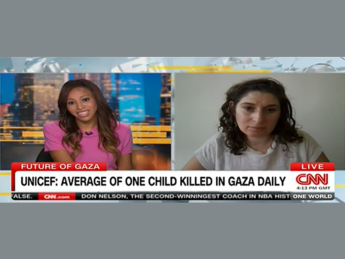
In a single CNN broadcast, Christiane Amanpour permitted guests to accuse the "Zionist government" of executing a "final solution," ignored extensive evidence of Hamas operating in the exact hospitals where her doctor guests volunteered, and concealed critical source biases.
While the Financial Times uncritically cites a UN claim that "Gaza now has the highest rate of child amputees per capita in the world," there appears to be no original source for that increasingly ubiquitous allegation.
Responsible coverage of the Israeli-Palestinian conflict demands that claims by political actors be subjected to rigorous scrutiny. Vox, by allowing inaccurate claims to stand unchallenged, failed its audience.
The Norwegian Refugee Council's Communications Adviser, Shaina Low, blamed Israel exclusively for all suffering in Gaza since the war began while lamenting the lack of sufficient aid, including dual-use items such as concrete, cement, rebar, and lubricant oil.
In an article analyzing the origin and spread of viral misinformation, The New York Times was unable to see how it has participated in the dangerous phenomenon.
A New York Times op-ed claims the recent wars in the Middle East demonstrate "the new physics of power." But these allegedly new physics are actually quite old.