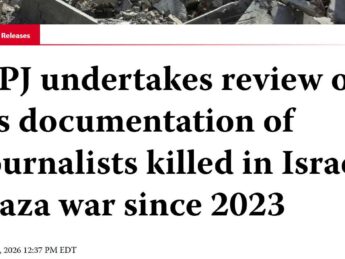
In reporting on a pianist's failed lawsuit after his performance was canceled following an on-stage proclamation that Israel was targeting journalists in Gaza, The New York Times cited to the Committee for the Protection of Journalists. The paper failed to acknowledge the organization was conducting a review after Hamas and Palestinian Islamic Jihad claimed many "journalists" as their fighters.
After nearly six months, the UK press regulator, IPSO, partially upheld our complaint to the Times over a false claim regarding the Israeli casualty count during the 2025 Iran War.
In the small local newspaper, The News-Gazette (Lexington, VA), a university professor is spewing big lies. Many of those lies unravel with the slightest bit of commonsense analysis.
Several statutes require the executive branch to report the provision of aid to Congress and explain how Israel uses it according to those constraints.
The New York Times published a second article on Israel's alleged plan for regime change in Iran. Just like the first article on the topic, this report too demonstrates serious issues.
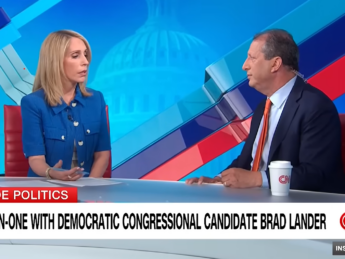
Dana Bash's interview with Brad Lander exposed a wave of media failures, from misrepresenting Raphael Lemkin’s genocide legacy to shockingly redefining Holocaust-era "kapos." This analysis debunks those claims alongside factual errors about Israeli democracy, voting rights, and West Bank security realities.
Post-Oct. 7, one would have at least hoped that there would be some soul-searching among supporters of the Palestinian cause and a reaction along the lines of “this is not how we imagined Palestinian resistance” or a “not in my name” campaign. However, neither distancing nor clarity was to be, CAMERA's Adam Levick writes in JNS.
Violent Israeli attacks on Palestinians in the West Bank have decreased by 25 percent since March. Yahya Sinwar's handwritten memo showed he planned the October 7 massacre despite believing Israel would retaliate with all its might, including possible use of nuclear weapons. A British-Israeli dual citizen who served in the IDF was awarded counsel fees in the UK after a court found the attempt to prosecute him to be egregious.