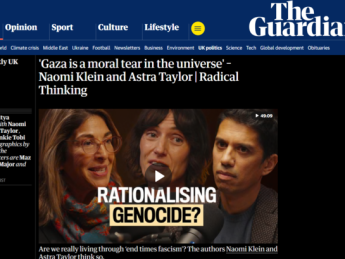
If The Guardian is willing to platform Klein and Taylor without challenge, both of whom advance the belief in which global elites are united in the defence of an “Israeli ethnostate,” erase Hamas from the narrative entirely when deploying genocide libels, and posit antizionist Jews as the default Jewish opinion while defaming dissenters as “Jewish fascists,” at what point does the outlet cease to do its own “radical thinking” and instead become a platform undergirded by deep-seated antisemitic and conspiratorial claims?
NPR went on a gaslighting blitz when it pretended that journalists out of Gaza aren't under Hamas control (including their own reporter there) and failed to acknowledge to its audience how many "journalists" in Gaza were outed as terrorists.
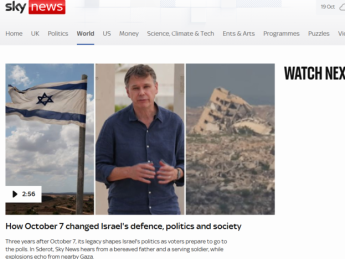
In a country that has seen rampant antisemitic attacks, historical and October 7th revisionism, British broadcasters have a duty not to use passive constructions that obfuscate responsibility. They also have a duty not to platform, without due diligence checks, those on the “Palestinian side” who openly support and eulogise the very terrorist groups who committed the October 7th atrocities. If Sky News obsessively coalesces around “the other side” narrative and offers Jewish voices no reprieve, must we conclude that it was never on the side of massacred Jews at all?
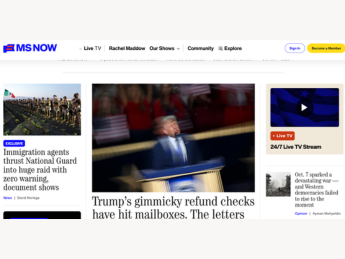
On the third anniversary of the October 7 massacre, MS NOW featured an op-ed by reporter Ayman Mohyeldin, who has a history of peddling antisemitic tropes, prominently at the top of its website.
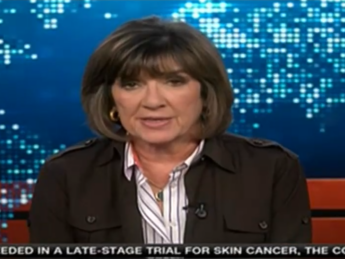
Tom Fletcher and the United Nations are entitled to their frustration with the IDF. Their missions do not exactly align. Both sides are also operating in an environment with no real historical precedents and are learning as they go. But Amanpour never engaged with the misaligned institutional imperatives.
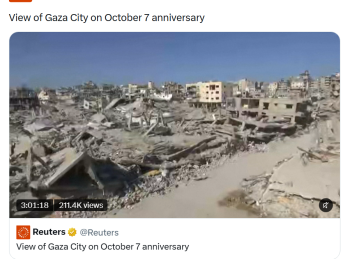
On the third anniversary of the Oct. 7 attacks, many major media outlets focused on Palestinians and Gaza, or the upcoming Israeli elections, instead of Israeli grief and commemoration.
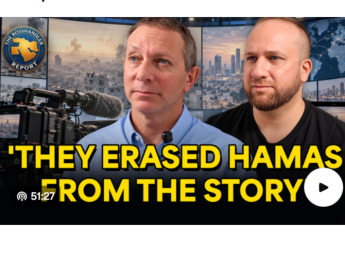
On Oct. 7, CAMERA's Adam Levick was interviewed by Israeli journalist Yaakov Lapin on his podcast The Rosshandler Report. They discussed how sections of the international media turned the worst massacre of Jews since the Holocaust into an unprovoked Israeli war against a faceless enemy.
Under what moral or journalistic compass does a leading news outlet mark the anniversary of a massacre by highlighting the victims’ ostensible failure to empathize with the plight of the other side, CAMERA's Tamar Sternthal asks in The Jerusalem Post.
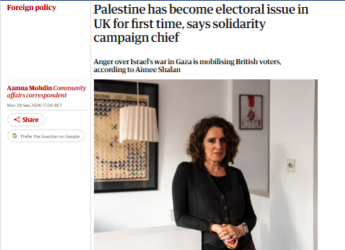
The Guardian uncritically published an interview with Aimee Shalan, the incoming director of the Palestine Solidarity Campaign, in which she repeated libels against Israel, and downplayed the extent to which the pro-Palestinian movement is compromised by antisemitism.
CNN's Jeremy Diamond and Tal Shalev’s Oct. 8, 2026, article on Israeli hostages killed in captivity illustrates exactly how little blame the reporters place on Hamas for the hostage crisis, and how willingly they blame Israel for the crimes of Palestinian terrorists.