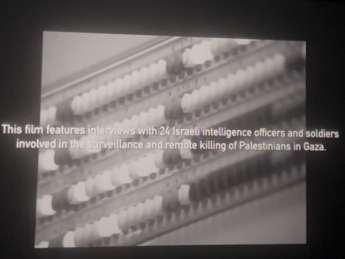
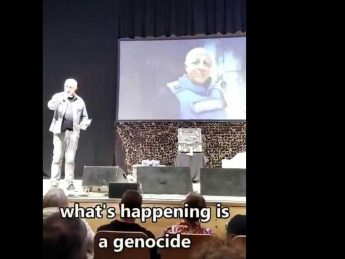
Channel 4 was willing not only to platform NAZA's producers without question, as they deployed genocide libels on the basis of unsubstantiated claims, but also let its own interviewers equivocate on casualty numbers to determine proportionality, despite this being legally untenable.
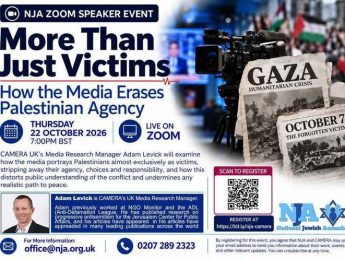
CAMERA’s Adam Levick was interviewed in a National Jewish Assembly webinar, examining how one of the root causes of anti-Israel bias involves the media’s refusal to hold Palestinians morally accountable for their actions.
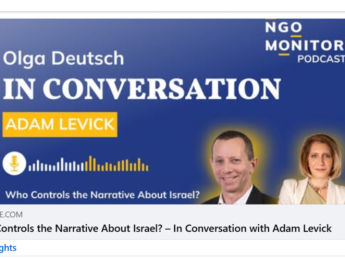
CAMERA's Adam Levick was interviewed by Olga Deutsch of NGO Monitor, where he discussed the erasure of Palestinian agency, and how media bias and the NGO network work hand in hand to shape and perpetuate an anti-Israel narrative.
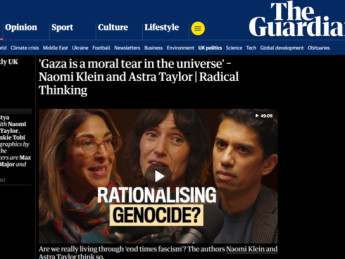
If The Guardian is willing to platform Klein and Taylor without challenge, both of whom advance the belief in which global elites are united in the defence of an “Israeli ethnostate,” erase Hamas from the narrative entirely when deploying genocide libels, and posit antizionist Jews as the default Jewish opinion while defaming dissenters as “Jewish fascists,” at what point does the outlet cease to do its own “radical thinking” and instead become a platform undergirded by deep-seated antisemitic and conspiratorial claims?
Jeremy Bowen’s comments, should they be accurate, breach BBC guidelines on multiple levels, and the BBC’s conduct on this issue suggest that his leadership is materially damaging the BBC’s commitment to impartiality. His position at the BBC is one of significant power, and the BBC response to his actions will tell us a huge amount about the BBC’s commitment to its own standards.
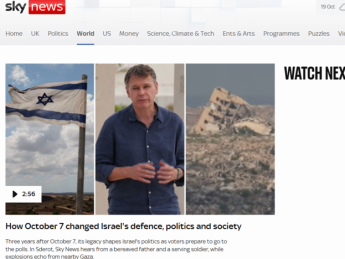
In a country that has seen rampant antisemitic attacks, historical and October 7th revisionism, British broadcasters have a duty not to use passive constructions that obfuscate responsibility. They also have a duty not to platform, without due diligence checks, those on the “Palestinian side” who openly support and eulogise the very terrorist groups who committed the October 7th atrocities. If Sky News obsessively coalesces around “the other side” narrative and offers Jewish voices no reprieve, must we conclude that it was never on the side of massacred Jews at all?
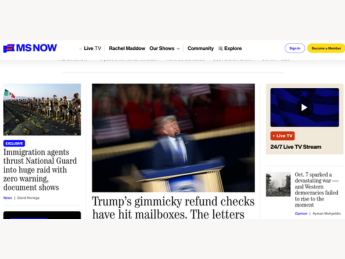
On the third anniversary of the October 7 massacre, MS NOW featured an op-ed by reporter Ayman Mohyeldin, who has a history of peddling antisemitic tropes, prominently at the top of its website.
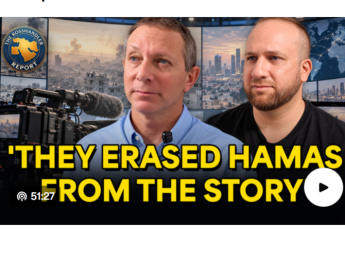
On Oct. 7, CAMERA's Adam Levick was interviewed by Israeli journalist Yaakov Lapin on his podcast The Rosshandler Report. They discussed how sections of the international media turned the worst massacre of Jews since the Holocaust into an unprovoked Israeli war against a faceless enemy.
In a Channel 4 Dispatches (UK) anti-Israel documentary whose 49-minute running time references Hamas only once, glosses over the Oct. 7 massacre in its first two minutes, sources its video footage to Hamas sympathisers and platforms individuals with a history of activism and close rapport with Hamas operatives - without disclosing either - what, then, are the film's producers really supporting?
NPR and Rolling Stone interviewed Ms. Rachel, the popular children's YouTube entertainer, in advance of her first album's debut. Her sideshow activism for Gaza dominated the interviews, but Ms. Rachel was asked no hard questions. Sadly, she taught neither outlet that "J" is for "journalism."