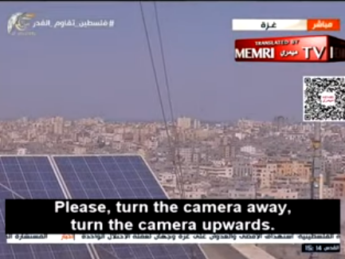
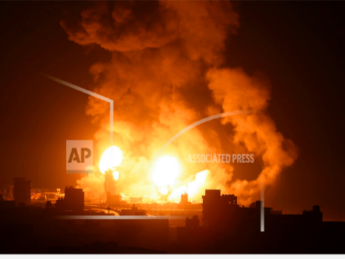
UPDATE: CAMERA prompts correction of an AP Week in Pictures feature which misidentified outgoing Islamic Jihad rockets launched from Gaza towards Israel as "Israeli airstrikes."
United Press International whitewashes designated terror organization Islamic Jihad as "pro-liberation forces," while observers in the Gulf slam the organization as an Iranian tool carrying out the regime's agenda at the expense of the Palestinian people.
UPDATED: Reuters commendably corrects after erroneously reporting that most residents of the Gaza Strip live in refugee camps. According to the UN, around 25 percent reside in refugee camps.
When a news picture fails to speak for itself, and the news caption fails to speak for it, news consumers lose out. AP captions ignore that Israeli airstrikes a) were in response to Palestinian rocket fire and b) targeted Hamas' rocket production facilities.
Reality – with which HRW has a tenuous relationship – can be rather inconvenient and complicated. But if HRW seeks to maintain any shred of credibility as a fact-driven, impartial institution, it cannot simply sweep away these complicating and inconvenient factors in pursuit of a partisan narrative.
History shows it doesn't take much for Gaza sources to override the essential journalistic dose of skepticism. After gargantuan flour consumption and Israeli-induced flooding, the latest tall tale hits the MRI machine-bereft territory: soaring mountains of spent batteries as high as the Arc de Triomphe.
Reuters' failure to correct its own mistaken footage calls into question the competency of its editorial unit dedicated to fact-checking visual material and social media claims.
With "Generation Gaza: The Young Have Pride Despite Privations," Janine di Giovanni proves that neither age nor time spent in the field dictates journalistic mastery. Antipathy can be a much more compelling influence.