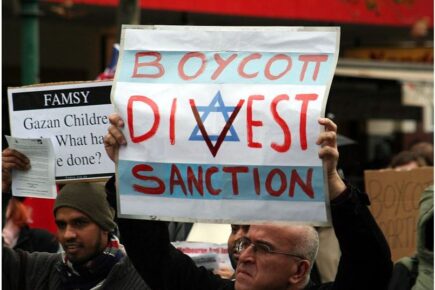
PBS depicts Yasmin Khan as committed to building connections, concealing the cookbook writer's past activity promoting an anti-Israel boycott meant to divide, not unite. Other falsehoods in the promotional interview include a question about a dish that Palestinians have eaten for "thousands of years."
After corresponding with CAMERA staff, the New York Times corrected a story that had falsely characterized the BDS campaign as seeking only an Israeli withdrawal from the West Bank.
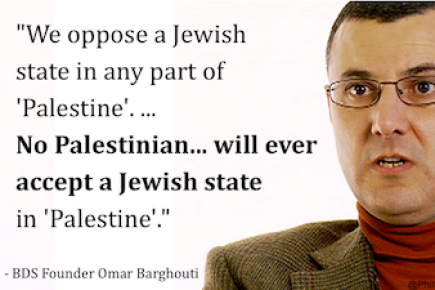
The New York Times is at it again – sanitizing Omar Barghouti and his Boycott, Divestment, and Sanctions (BDS) movement– this time in a column by its resident BDS defender, Michelle Goldberg.
That the New York Times chose to publish Nathan Thrall’s "How the Battle Over Israel and Anti-Semitism Is Fracturing American Politics" is not surprising: Thrall can be counted on to produce, on demand, the usual anti-Israel screed that has long been norm at the Times. But Thrall outdoes himself this time.
CAMERA takes to the pages of The Baltimore Sun to educate readers about the discriminatory nature of the anti-Israel boycott, divestment and sanctions (BDS) movement, which has links to U.S.-designated terror groups.
The Washington Post's coverage of the anti-Israel boycott, divestment and sanctions (BDS) movement is superficial, inaccurate and lazy. As CAMERA notes in a recent Op-Ed, The Post's failure to report accurately about BDS comes at the expense of its reputation.
An article published in the March 2019 edition of Commentary compares the New York Times' promises and performance in 2018, and finds striking patterns of bias.
One month after The New York Times was slammed for publishing an Alice Walker interview which promoted an antisemitic book, the "paper of record" cuts out the antisemitic "dual loyalty" slur from Representative Rashida Tlaib's tweet.