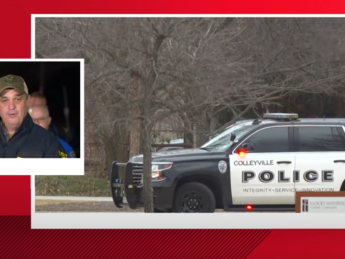
AP advances the absurdly false narrative that the terror assault on Congregation Beth Israel was not connected to the Jewish community. Repeatedly reporting an FBI statement disassociating antisemitism as a motive, while ignoring statements from POTUS and other top officials citing antisemitism, the news agency also silences the ADL while giving ample voice to the antisemitism-peddling CAIR.
CAMERA UK keeps us up to date on the scandal surrounding following BBC's miscoverage of an antisemitic attack on young Jews celebrating Hanukkah in London.
The self-described “anti-Zionist not antisemitic” crowd is now openly viewing their enemy not as a perceived evil state in the Middle East, but as a distinct group here at home in America.
As the generation of survivors and first-hand witnesses to the Holocaust pass on, the void is being filled by neo-Nazis and Holocaust deniers who peddle their anti-Semitic lies through mainstream online book vendors, like Barnes & Noble.
A recent Washington Times report highlights the growing antisemitism of the far left. The newspaper should be commended for covering a topic that many outlets fail to address. However, the report omitted key details about institutions and individuals who are promoting hatred of Jews and the Jewish state.
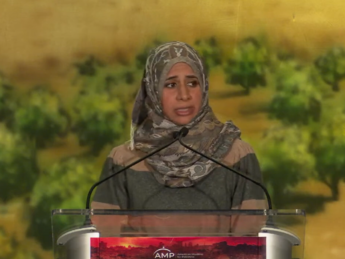
Less than one year after his suspension following the production of an AJ+ video promoting Holocaust denial, Amer al-Sayed Omar returned to the network. If the promised mandatory bias training ever happened, there's no evidence that it left a mark on Omar and colleague Muna Hawwa.
Elisha Wiesel, son of Holocaust survivor and Nobel Laureate, Elie Wiesel had a powerful message for students at Boston University on November 8, 2021. "My father believed in the power of students, especially at this university. You all have choices to make. I know my father's legacy and I am doing my best to live it. I know you will too," he said.
Target's removal of two dozen Holocaust-denial and anti-Semitic conspiracy books marketed on its website, in the wake of CAMERA's exposé is commendable, as its apology for its “error in having these books available on Target.com,” but it is only once chapter of a disturbing story whose conclusion is not yet obvious.
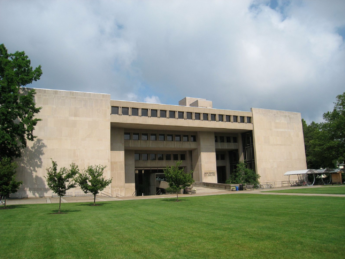
The Board of Trustees at Oberlin must be very proud — because the college has now given cover to a former Iranian diplomat who called for Israel’s destruction at the UN, and according to Amnesty International, worked to obscure a round of mass murders perpetrated in 1988. These days, the professor in question — Mohammad Jafar Mahallati — is preaching a message of “friendship” to his students at Oberlin, as if he never uttered the hateful things he said about Israel, or covered up mass murder.
Increasing assaults on Holocaust memory and the concomitant rise in anti-Semitism is not limited to Europe, but is being mainstreamed in the U.S., including by one of America’s largest retail corporations that is part of the S&P 500 index -- Target. Whether through choice, negligence or ignorance, Target has allowed its online bookselling platform to become a repository of Holocaust denial and anti-Semitism by an international coterie of Holocaust deniers.