BBC fails to provide critical context on Palestinian leadership and governance in coverage of the eighth Fatal General Conference, an event whose flag displays rifles, a grenade and an Israel-erasing map of "greater Palestine."
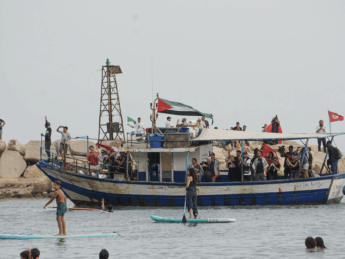
Global Sumud Flotilla's website deleted references to Hamas ties. A recent COGAT survey found that a large number of Gazans are interested in information about emigrating from Gaza. An Israeli task force has a plan for every single October 7 terrorist.
The New York Times wanted to examine how support for Hezbollah is impacted by the terror organization's war with Israel. Trying to demonstrate its arguments, the paper demonstrated faulty logic.
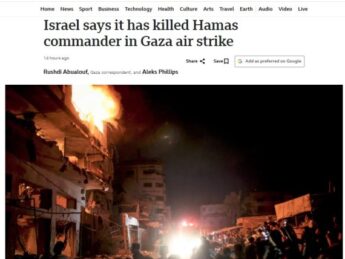
BBC's report on the killing of Hamas commander and Oct. 7 architect Izz ad-Din al-Haddad amplified unconfirmed claims that the strike also killed civilians, but failed to mention widely reported accounts that Haddad himself had used Israeli hostages as human shields.
One of the most fundamental tenets of liberal Western democracy is that moral standards are universal, and that there can be no exceptions to this principle due to race, religion, ethnicity or any other mere accident of birth.
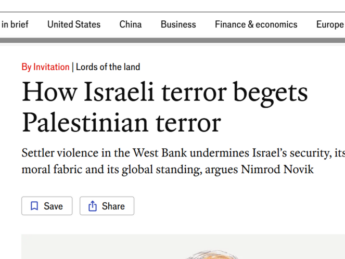
The Economist's failure to hold Palestinian jihadists responsible for their decisions is both racist and fundamentally illiberal.
A recent CNN report on a joint Israeli Palestinian memorial event omitted the crucial fact that one of the eulogized Palestinian casualties was an armed member of a designated terrorist organization killed in a clash with Israeli forces.
One of the supposedly “respectable institutions” that has taken such pro-Hamas propaganda laundering to the most extreme level is the Guardian – an outlet that has spread libel after libel about the Jewish state and – by extension – Jews qua Jews, thus contributing to the antisemitism epidemic in the U.K.
A superficial, softball interview of Irish hip hop band Kneecap ignored the group's hateful, inflammatory, anti-Israel rhetoric. NPR abandoned journalistic integrity in favor of cool vibes.
NPR surveyed the damage in southern Lebanon while escorted by a Hezbollah propagandist. Its report ignored Hezbollah's human shield strategy, attacks on Israel and how the terror group's tactics mirror those of Hamas.
Former Department of Homeland Security official Fayrouz Saad spoke with NPR about her family's connection to Bint Jbeil, Lebanon, following the destruction of her family's "ancestral home" there. Referring to the village as quaint, Saad omitted any reference to PLO control at the time her parents left Lebanon or to Hezbollah presence there in the last several decades.